
Best Quran Teacher for My Child Checklist helps parents evaluate a Quran teacher based on qualifications, teaching skills, communication, patience, lesson structure, and the child’s learning needs. Choosing an online Quran teacher is an important decision because the right learning environment can influence how comfortably a child reads, recites, practices, and develops a lasting connection with the Quran.
Finding a suitable teacher can feel difficult when parents see many online profiles and different teaching approaches. A teacher may have strong Quranic knowledge but limited experience with children. Another may communicate well but lack the Tajweed skills needed to correct pronunciation. Therefore, parents should look beyond a single qualification and consider the complete learning experience.
This guide explains what to check before choosing an online Quran teacher for a child. It also shows how parents can evaluate a trial lesson, compare individual tutors with academies, and recognize qualities that support consistent Quran learning. For families considering Tarteel Online Quran Academy, these criteria can also provide a practical framework for understanding what to look for in an online Quran learning environment.
Why Does the Right Quran Teacher Matter for a Child?
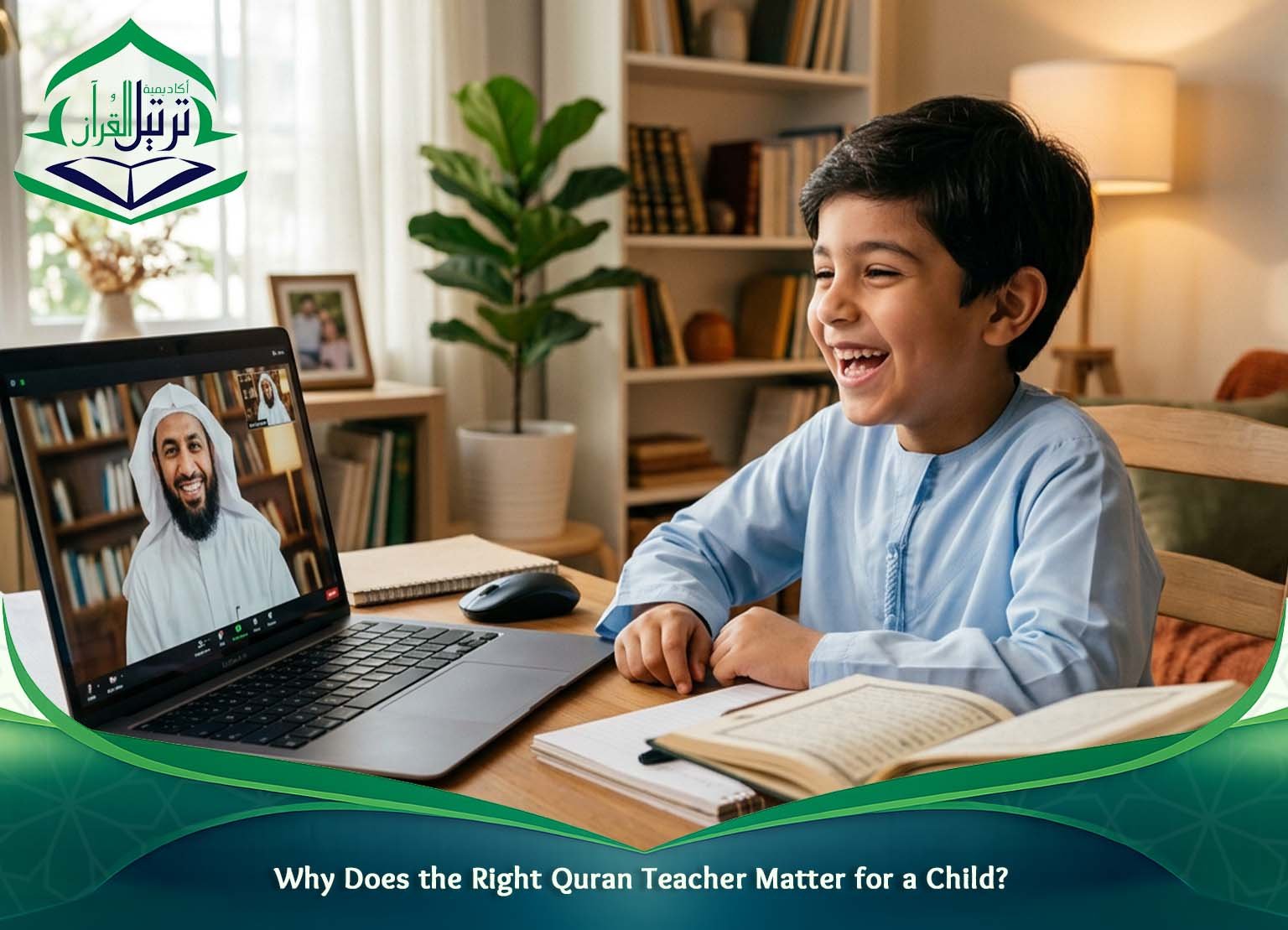
Children do not all learn Quran in the same way. Their age, previous experience, attention span, confidence, Arabic knowledge, and pronunciation skills can affect how they respond to lessons.
For that reason, the teacher’s role involves more than reading verses and correcting mistakes. A child may need repeated explanations, gentle correction, visual examples, or additional practice before a particular sound becomes clear.
A suitable teacher should create an environment where the child can ask questions and make mistakes without feeling embarrassed. At the same time, the teacher should maintain clear expectations so the child understands the importance of regular practice.
Parents should therefore think about the learning relationship rather than focusing only on certificates. A strong Quran teacher combines Quranic knowledge with the ability to explain, listen, correct, encourage, and adapt lessons to the student’s level.
Start Your Islamic Learning Journey Today
Join Tarteel Online Quran Academy today and begin a meaningful Islamic learning experience designed for children, adults, and beginners worldwide. Our qualified Quran teachers provide interactive lessons, flexible schedules, and personalised guidance to help students improve their Quran recitation, understand Islamic teachings, and strengthen their connection with Allah.
Through structured online classes, learners can study comfortably from home while receiving professional support at every step. Start your journey today and build a strong spiritual foundation with trusted Quran education.

Best Quran Teacher for My Child Checklist: Start With Qualifications
The first part of the Best Quran Teacher for My Child Checklist is checking the teacher’s Quranic knowledge and relevant qualifications.
Memorizing the Quran is a significant achievement, but memorization alone does not automatically demonstrate teaching ability. Teaching children requires another set of skills. A teacher must understand how to identify mistakes, explain pronunciation, organize practice, and adjust the lesson when a child struggles. Parents can ask about qualifications related to:
- Quran memorization.
- Tajweed.
- Makharij and correct pronunciation.
- Quran recitation.
- Ijazah, when applicable.
- Previous teaching experience.
- Experience working with children.
- Any formal Quranic or Islamic education.
Rather than accepting a qualification as the only deciding factor, parents can ask how the teacher applies that knowledge during a real lesson.
For example, if a child repeatedly mispronounces a letter, does the teacher simply ask the child to repeat it? Or does the teacher explain the articulation point and demonstrate the correct sound? That difference matters because effective teaching turns knowledge into understandable instruction.
Look for Strong Tajweed and Makharij Skills
Tajweed should have an important place in any evaluation of a Quran teacher. Children need accurate guidance from the beginning because repeated pronunciation mistakes can become difficult habits to correct later.
Makharij refers to the articulation points from which Arabic letters are pronounced. Some Arabic sounds can be challenging for learners who do not regularly speak Arabic. A teacher should therefore be able to demonstrate these sounds clearly and explain what the learner needs to change. During a trial lesson, parents can listen for several things:
- Does the teacher pronounce Arabic letters clearly?
- Does the teacher notice small pronunciation errors?
- Are corrections explained in a way the child understands?
- Does the teacher allow enough time for repetition?
- Does the teacher distinguish between different Tajweed rules?
- Does the correction remain encouraging rather than discouraging?
The Best Quran Teacher for My Child Checklist should include these questions because accurate recitation depends on consistent correction.
A teacher does not need to overwhelm a young learner with technical terminology. Instead, the explanation should match the child’s age. A younger student may benefit from a simple demonstration, while an older learner may understand a more detailed explanation of a Tajweed rule.
Best Quran Teacher for My Child Checklist: Check Experience Teaching Children
Knowing the Quran and knowing how to teach children are related, but they are not identical skills.
Children can lose concentration quickly, especially during a lesson that relies entirely on repetition. A teacher who works with young students should understand how to maintain attention without turning the lesson into constant entertainment.
Age also matters. The approach suitable for a five-year-old may not work for a ten-year-old. Likewise, a teenager may prefer more detailed explanations and greater independence. Parents can ask:
- What age groups has the teacher taught?
- How does the teacher handle distraction?
- How are difficult lessons broken into smaller steps?
- What happens when a child does not understand a concept?
- How does the teacher encourage regular practice?
An experienced children’s teacher usually recognizes when a student needs repetition and when the lesson should move forward. That balance can help prevent both frustration and boredom.
For parents using Tarteel Online Quran Academy, the same principle applies: the focus should remain on whether the learning approach fits the individual child’s age, level, and needs.
Best Quran Teacher for My Child Checklist: Evaluate Patience
Patience deserves special attention when choosing a Quran teacher for a child. Some Quranic sounds take considerable practice. A child may pronounce the same letter incorrectly several times before understanding the correction. If the teacher reacts negatively to every mistake, the child may become anxious about participating.
A patient teacher can correct the same mistake without making the student feel that the mistake itself is a failure. Look for behaviors such as:
- Calm repetition.
- Clear correction.
- Encouraging feedback.
- Respectful communication.
- Appropriate praise.
- Willingness to explain something again.
Positive feedback does not mean ignoring mistakes. Instead, it means correcting them while helping the learner remain motivated.
The Best Quran Teacher for My Child Checklist should therefore ask a simple question: “How does this teacher respond when my child struggles?”A trial lesson often reveals the answer more clearly than a profile description.
Best Quran Teacher for My Child Checklist: Assess Communication With Your Child
Communication can determine whether an online Quran lesson feels accessible or confusing. If a child cannot understand the teacher’s instructions, even a knowledgeable teacher may struggle to deliver an effective lesson. Parents should consider the language their child understands most comfortably and determine whether the teacher can communicate at an appropriate level.
The issue is not necessarily whether the teacher is a native speaker of a particular language. What matters is whether the teacher can explain Quranic reading and Tajweed clearly to that individual student. A teacher may need to explain:
- How to pronounce a difficult letter.
- Why a Tajweed rule applies.
- How to practice between lessons.
- Where a mistake occurred.
- What the child should read next.
- How to improve a recurring problem.
Children should also have opportunities to ask questions. If communication is one-sided, parents may find it difficult to determine whether the child truly understands the lesson.
Best Quran Teacher for My Child Checklist: Review the Lesson Structure
Another important part of the Best Quran Teacher for My Child Checklist is lesson organization. A productive lesson should have a clear purpose. The exact structure can vary according to the child’s level, but parents should understand what the teacher is trying to accomplish during each session. A lesson might include:
- Reviewing previous material.
- Correcting recurring pronunciation mistakes.
- Introducing new reading material.
- Practicing Tajweed.
- Checking the child’s independent recitation.
- Explaining practice expectations.
The teacher should also understand the difference between learning new material and reviewing older material. Children need repetition to retain what they have already learned.
Without a clear structure, lessons can become a sequence of unrelated reading exercises. A structured approach makes it easier for parents and students to understand progress over time.
Best Quran Teacher for My Child Checklist: Consider the Child’s Level
Parents should avoid choosing a teacher based only on reputation or qualifications. The teacher must also match the child’s current level.
A beginner may need to start with Arabic letters and basic reading skills. Another child may already read fluently but need help improving Tajweed. A more advanced learner may be working toward memorization or stronger recitation. Before lessons begin, parents should clarify:
- Can the child recognize Arabic letters?
- Can the child connect letters?
- Can the child read Quranic words?
- Does the child already know basic Tajweed?
- Does the child memorize the Quran?
- Which areas cause the greatest difficulty?
Once the starting point is clear, the teacher can provide instruction that is neither too difficult nor unnecessarily basic.
This is particularly useful when comparing online Quran learning options, including Tarteel Online Quran Academy, because parents can use the child’s current ability as a practical basis for evaluating whether an approach is appropriate.
Examine the Teacher’s Online Teaching Skills
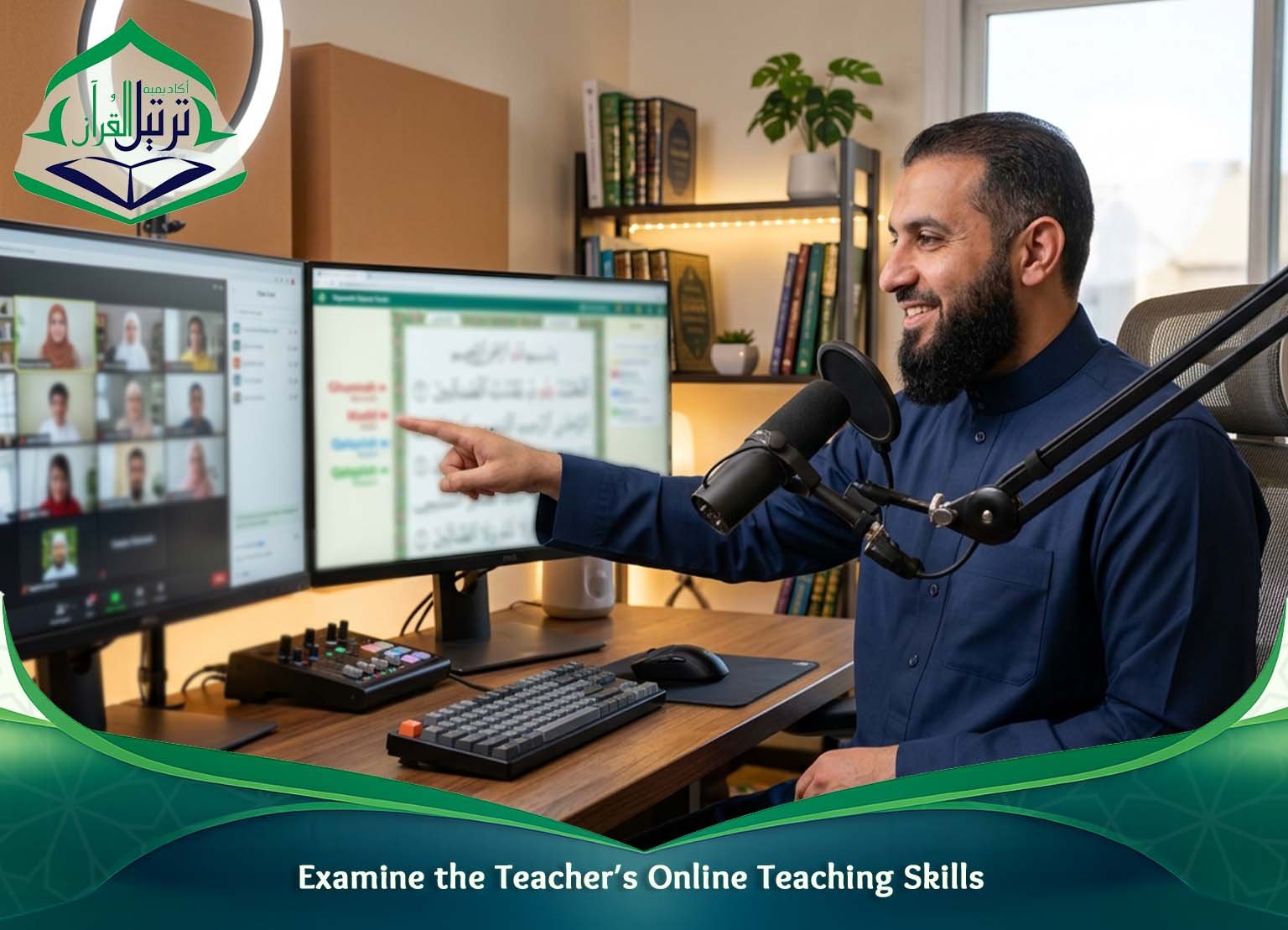
Teaching Quran online requires more than having a stable internet connection. The teacher should know how to make the virtual environment useful for the child. Screen sharing, digital Quran pages, annotation tools, visual demonstrations, and other classroom features can support learning when used appropriately. However, technology should serve the lesson rather than distract from it. Parents can observe whether:
- The Quran text is easy for the child to see.
- The teacher manages the online lesson smoothly.
- Audio quality allows accurate pronunciation practice.
- The teacher knows how to share or highlight material.
- Technical interruptions are handled calmly.
- The child remains involved rather than simply watching the screen.
Online learning works best when technology reduces barriers instead of creating new ones.
A teacher does not need to use every available digital tool. What matters is whether the tools selected make reading, listening, correction, and practice easier for the student.
Consider the Teacher’s Approach to Islamic Character
Quran education can involve more than technical reading skills. Parents may also want their child to understand that Quran learning connects with everyday Islamic values.
That does not mean every lesson should become a long lecture. Instead, the teacher can encourage respectful behavior, sincerity, consistency, good manners, and appreciation for Quranic teachings when appropriate.
The teacher’s own communication style matters here as well. Respectful interaction can reinforce the values parents want their children to develop.
However, parents should distinguish between Quran teaching and broader religious education. If they expect lessons to include Tafsir, Islamic studies, memorization, or other subjects, they should ask about those areas specifically rather than assuming they are automatically included.
Best Quran Teacher for My Child Checklist: Think About Comfort and Privacy
Family preferences can also influence the selection process. Some parents may prefer a female teacher for a daughter, while others may have different preferences based on age, family circumstances, or comfort. These preferences can be discussed before lessons begin.
The important point is to avoid assuming that one teacher profile works for every family. Parents should identify what makes their child comfortable enough to participate openly and consistently.
For younger children, comfort can be especially important. A nervous student may hesitate to ask questions or admit confusion. A suitable learning environment should give the child enough confidence to communicate.
Families considering Tarteel Online Quran Academy can use this part of the checklist to clarify their expectations before selecting a teacher or starting regular lessons.
Best Quran Teacher for My Child Checklist: Check Reliability and Scheduling
Consistency is another major factor in children’s Quran education. A child benefits from a predictable learning routine. Frequent cancellations, unexplained delays, or constant schedule changes can make it harder to establish that routine. Parents should ask about:
- Available lesson times.
- Expected lesson frequency.
- Cancellation procedures.
- Rescheduling arrangements.
- Communication when a teacher is unavailable.
- How schedule changes are handled.
A reliable schedule does not mean that emergencies will never happen. Instead, it means there is a clear process for handling unexpected situations.
Parents should also select lesson times that suit the child’s daily routine. A child who attends Quran lessons when exhausted after a long school day may struggle to concentrate regardless of how qualified the teacher is.
How to Evaluate a Trial Quran Lesson?
The trial lesson is one of the most useful parts of the selection process. Instead of focusing only on whether the teacher is friendly, parents should observe the complete interaction between the teacher and child. During the session, ask yourself:
- Did the teacher assess the child’s current level?
- Were instructions easy to understand?
- Did the teacher listen to the child’s responses?
- Were mistakes corrected clearly?
- Did the teacher remain patient?
- Did the child have opportunities to participate?
- Was the lesson organized?
- Did the child seem comfortable asking questions?
The Best Quran Teacher for My Child Checklist becomes much more useful when parents apply it during an actual lesson rather than relying only on written profiles.
Afterward, ask the child what they thought. A parent may notice technical qualities that the child does not notice, while the child can describe whether the lesson felt comfortable or confusing.
Questions to Ask Before Enrollment
A short conversation before enrollment can prevent misunderstandings later. Parents can use the Best Quran Teacher for My Child Checklist while asking the following questions:
- What Qualifications Do You Have?
Ask the teacher to explain their Quranic education, Tajweed training, memorization background, or relevant certifications. This helps parents understand the teacher’s preparation before lessons begin. - How Do You Teach Distracted Children?
The answer can reveal whether the teacher has a practical strategy for maintaining a child’s attention. Parents can look for methods that include short activities, clear instructions, repetition, and age-appropriate interaction. - How Do You Correct Pronunciation Mistakes?
Look for an explanation that includes demonstration, guided practice, repetition, and patient correction. A child should have enough opportunity to understand the mistake and practice the correct pronunciation. - How Do You Determine a Child’s Starting Level?
A thoughtful assessment is more useful than automatically placing every learner in the same program. The teacher should consider the child’s Quran reading ability, Arabic letter recognition, Tajweed knowledge, memorization level, and previous learning experience. - What Should My Child Practice Between Lessons?
Parents need to know whether regular practice is expected and how it should be completed. Clear guidance can make home practice easier to manage without creating unnecessary pressure for the child. - How Do You Communicate Progress?
A clear answer helps parents understand how they will know whether their child is improving. Parents can also ask how learning goals are reviewed and how concerns are communicated when a child needs additional support.
Private Quran Tutor or Online Quran Academy?
The Best Quran Teacher for My Child Checklist can be used whether parents are considering an individual tutor or an online academy.
A private tutor may offer direct communication with one teacher. Some families appreciate that simplicity. However, parents may need to manage qualification checks, scheduling, payments, and changes independently.
An online academy can provide a more organized framework, although the exact services differ between academies. Parents should therefore evaluate the specific academy rather than assuming every organization works in the same way.
A simple comparison can help:
| Factor | Individual Tutor | Online Quran Academy |
|---|---|---|
| Teacher selection | Usually handled by parents | May follow an academy process |
| Scheduling | Often arranged directly | Depends on academy policies |
| Continuity | May depend on one teacher | May involve broader support |
| Curriculum | Can vary by tutor | May follow an established structure |
| Parent communication | Usually direct | May involve teacher and administration |
| Flexibility | Depends on the tutor | Depends on available academy options |
Neither option should be selected automatically. The child’s needs, family preferences, teaching quality, communication, and reliability should guide the decision.
Red Flags Parents Should Notice

Some warning signs deserve attention before committing to regular lessons. Parents should reconsider the arrangement if a teacher:
- Becomes irritated whenever the child makes mistakes.
- Cannot explain basic pronunciation corrections.
- Avoids questions about qualifications.
- Frequently changes lesson times without clear communication.
- Provides no understandable learning structure.
- Ignores the child’s current level.
- Makes the child uncomfortable during lessons.
- Spends excessive lesson time dealing with technical problems.
- Uses inappropriate or humiliating correction methods.
One imperfect lesson does not necessarily provide enough evidence to make a final judgment. However, repeated problems should not be ignored.
The goal is not to find a teacher who never makes a mistake. Instead, parents should look for a consistent learning environment where problems are handled professionally.
How Can Parents Support Quran Learning at Home?
Parents do not need to become Quran teachers to support their child’s learning. Their role can focus on creating a routine and encouraging practice. Simple actions can include:
- Setting a consistent lesson time.
- Providing a quiet learning space.
- Making sure the child has the necessary device and internet connection.
- Asking what was learned after the lesson.
- Encouraging practice without excessive pressure.
- Celebrating steady improvement.
- Communicating concerns with the teacher early.
A supportive home environment can make regular Quran learning easier to maintain. Parents can also use practical ideas from How to Keep Kids Motivated to Learn Quran Online to make lessons more engaging and help children remain interested in regular Quran practice.
Parents should also avoid turning every mistake into a major issue. Children often need time to develop confidence, especially when learning unfamiliar Arabic sounds.
Best Quran Teacher for My Child Checklist: A Quick Parent Review
Before choosing a teacher, parents can use this simplified Best Quran Teacher for My Child Checklist:
Quran knowledge
- Does the teacher demonstrate accurate Quran recitation?
- Do they understand Tajweed and pronunciation?
- Can they explain corrections clearly?
Teaching ability
- Have they taught children before?
- Can they adapt lessons to different ages?
- Do they use age-appropriate explanations?
Communication
- Can my child understand the teacher?
- Can my child ask questions comfortably?
- Does the teacher listen carefully?
Lesson quality
- Is the lesson structured?
- Does the teacher review previous material?
- Is there enough practice?
Online learning
- Is the audio and video quality suitable?
- Can the teacher use basic online classroom tools?
- Does technology support rather than interrupt learning?
Reliability
- Are lesson times clear?
- Is there a process for cancellations?
- Can parents communicate concerns?
Child comfort
- Does my child feel respected?
- Can the child make mistakes without fear?
- Does the teaching style encourage participation?
Using this checklist can turn a vague search into a practical comparison. Parents should also understand Common Mistakes When Learning Tajweed because recognizing common pronunciation and Tajweed difficulties can help them understand what effective correction should look like during lessons.
Choosing a Teacher Through a Child-Centered Approach
The Best Quran Teacher for My Child Checklist should ultimately be about the child rather than the teacher’s profile alone.
A teacher can have impressive qualifications and still be unsuitable for a particular learner. Another teacher may have a communication style that works exceptionally well with one child but not another.
Parents should therefore evaluate the complete match. Consider the child’s age, reading level, personality, schedule, language needs, and learning goals.
For families exploring Tarteel Online Quran Academy, the same child-centered approach can help parents identify the qualities they want from an online Quran learning experience without relying on assumptions or promotional claims.
What Makes a Quran Learning Relationship Sustainable?
Long-term Quran learning depends on consistency. Children need time to develop reading fluency, pronunciation accuracy, Tajweed awareness, and confidence. Progress may not always be visible after one or two lessons.
A useful teacher helps the child understand that improvement comes through regular practice. Small corrections can become meaningful progress when they are addressed consistently.
Parents should therefore avoid judging a teacher solely by how much material the child completes in a single lesson. Quality of learning matters alongside quantity.
A child who reads fewer lines but improves pronunciation may be making more meaningful progress than a child who completes many pages without correcting recurring mistakes. Families can also review How Long It Does Take to Memorize the Quran when setting realistic expectations about memorization and recognizing that learners progress at different rates.
Best Quran Teacher for My Child Checklist Before Making the Final Decision
Before committing to regular lessons, review the full Best Quran Teacher for My Child Checklist one final time. Ask whether the teacher:
- Has appropriate Quranic knowledge.
- Demonstrates accurate Tajweed.
- Understands children’s learning needs.
- Communicates clearly.
- Corrects mistakes patiently.
- Provides organized lessons.
- Uses online teaching tools effectively.
- Respects the family’s preferences.
- Maintains a dependable schedule.
- Creates a comfortable environment for the child.
If several of these areas remain unclear, ask additional questions before making a commitment.
Parents can also compare more than one teacher when possible. A short trial or introductory conversation can provide information that a written profile cannot.
Most importantly, allow the child to participate in the evaluation. The child will be the person attending the lessons, asking questions, practicing recitation, and interacting with the teacher regularly. Parents who are also studying or memorizing Quran can find useful guidance in Quran Memorization Tips for Busy Adults, while beginners can use Tajweed Rules for Beginners Explained to understand foundational Tajweed concepts.
The Role of Tarteel Online Quran Academy
When parents consider Tarteel Online Quran Academy, they can apply the same objective criteria used to evaluate any online Quran learning option.
Rather than focusing only on the academy’s name, parents should consider whether the available teaching approach matches their child’s age, Quranic level, schedule, communication needs, and learning goals.
A useful evaluation can include questions about teacher qualifications, Tajweed instruction, lesson organization, communication, scheduling, and the process for monitoring learning.
This approach keeps the decision centered on the child’s educational needs. It also helps parents understand what they should expect before beginning regular online Quran lessons.
Frequently Asked Questions
Frequently Asked Questions about choosing the right Quran teacher can help parents clarify important concerns before starting their child’s online Quran learning journey.
Can a child change Quran teachers if the teaching style is not suitable?
Yes. If a child continues to struggle with communication, comfort, or the teaching approach, parents can discuss the issue with the teacher or academy. If the problem continues, changing teachers may be considered.
How long should parents wait before judging a child’s Quran progress?
There is no single timeline for every child. Progress depends on age, starting level, lesson frequency, practice, and individual learning needs. Parents should look for gradual improvement rather than expecting identical results from every learner.
Should parents sit beside their child during every online Quran lesson?
Not necessarily. The appropriate level of parental involvement depends on the child’s age and independence. Younger children may need help getting ready for lessons, while older students may be able to manage sessions more independently.
What should parents do if a child suddenly loses interest in Quran lessons?
First, try to identify the reason. The issue could involve lesson timing, difficulty level, fatigue, communication, or lack of variety. Discussing the change with the teacher can help determine whether the learning approach needs adjustment.
In conclusion, the Best Quran Teacher for My Child Checklist gives parents a practical way to move beyond attractive profiles and focus on the qualities that influence a child’s learning experience.
The right teacher should combine Quranic knowledge with effective teaching skills, clear communication, patience, accurate Tajweed correction, organized lessons, and an understanding of children’s needs. Parents should also consider schedule reliability, online teaching ability, family preferences, and the child’s comfort.
A trial lesson can provide valuable evidence because it allows parents to observe how the teacher explains, listens, corrects, and responds to mistakes. The child’s reaction matters too.
For families considering Tarteel Online Quran Academy, these same criteria can help create a clear set of expectations before choosing an online Quran learning arrangement.
Ultimately, Quran education should help children develop accurate reading skills while building confidence, consistency, and a positive relationship with the Quran. Careful teacher selection can make that learning journey more comfortable and sustainable.