
Tajweed mistakes to avoid are not always easy to recognize, especially when someone is learning to recite the Quran in a language they do not speak. Imagine a young boy named Yusuf sitting in front of his Quran teacher, confidently reciting a few verses of Surah Al-Fatiha. He has practiced several times at home and believes he is reading perfectly.
His teacher listens carefully. After a few verses, he gently raises his hand.
“Yusuf, can we go back to that word and read it again?”
Yusuf looks confused. “Did I make a mistake, teacher?”
“Yes, but don’t worry. That is why we practice together. You know the Arabic letters, but there are some important pronunciation rules we need to work on.”
Yusuf tries again. However, the teacher notices another problem. Some letters sound too similar, certain vowels are being shortened, and he is rushing through words that require more attention.
“Teacher, I can read the Quran. Why do I still make mistakes?”
The teacher smiles and answers:
“Reading the Quran and reciting it correctly are two skills that develop together. You have already taken the first step. Now, let’s learn how to improve your recitation.”
That lesson became the beginning of Yusuf’s journey towards better Quran recitation.
His experience highlights a common challenge among children and adults who learn Quran online, particularly those who grow up speaking English, French, Spanish, or other non-Arabic languages.
For example, many learners can recognize Arabic letters and read Quranic words but unknowingly make mistakes in pronunciation, vowel length, nasal sounds, and other Tajweed rules.
Fortunately, these mistakes can be identified and corrected with proper instruction and consistent practice.
In this guide, we will follow Yusuf’s learning journey to explore the most common Tajweed mistakes to avoid, understand why they happen, and discover practical ways to improve Quran recitation.
Why Do Quran Learners Make Tajweed Mistakes?

Before correcting Yusuf’s mistakes, his teacher wanted him to understand something important.
Making pronunciation mistakes does not necessarily mean someone is careless or incapable of learning Tajweed.
In fact, many common mistakes happen because learners have not received enough practical pronunciation guidance.
For non-Arabic speakers, Arabic pronunciation can be particularly challenging because some sounds do not exist in their native languages.
For example, English speakers may find it difficult to pronounce letters such as ع (Ayn), ح (Haa), and خ (Khaa).
Similarly, beginners may struggle to distinguish between س (Seen) and ص (Saad), or between ت (Ta) and ط (Taa).
Other mistakes happen because learners:
- Read too quickly without paying attention to individual letters.
- Confuse short vowels with long vowels.
- Do not understand the articulation points of Arabic letters.
- Apply the wrong Tajweed rule to a Quranic word.
- Stop or continue reading at inappropriate places.
- Memorize verses without practicing their correct pronunciation.
- Learn from recordings without receiving personal feedback.
Yusuf’s teacher explained that the solution was not to memorize dozens of rules in one day.
Instead, they would identify each mistake, understand its cause, practice the correct pronunciation, and apply the lesson to Quranic verses.
“Today,” the teacher said, “we will learn how to recognize mistakes before they become habits.”
1. Confusing Arabic Letters With Similar Sounds
The teacher began by asking Yusuf to read a few Arabic letters individually.
Yusuf pronounced most of them correctly, but when he reached ص (Saad), he pronounced it too much like س (Seen).
The teacher stopped him.
“Listen carefully. These two letters may look similar, but their sounds are different.”
He demonstrated both letters slowly.
Yusuf repeated them, but his pronunciation was still not accurate.
The teacher explained that Arabic letters have specific articulation points and characteristics. Some letters may sound similar to beginners, but they should not be treated as interchangeable.
Common Letter Confusions to Avoid
| Letters | Common Mistake |
|---|---|
| س and ص | Pronouncing both with the same light sound |
| ت and ط | Not distinguishing between their articulation and characteristics |
| ذ and ز | Replacing the correct sound of ذ with ز |
| ح and ه | Pronouncing the deeper ح like the lighter ه |
| ع and أ | Replacing the throat sound of ع with a Hamzah sound |
| ق and ك | Pronouncing ق too close to ك |
How to Correct This Mistake
The teacher gave Yusuf a simple exercise.
First, listen to the correct pronunciation of each letter. Then repeat it slowly, paying attention to where the sound is produced.
Practice individual letters before using them in complete words.
For non-Arabic-speaking learners, this step is particularly important because their native language may influence how they pronounce Arabic letters.
Teacher’s advice: Never assume that two Arabic letters sound the same simply because they are difficult to distinguish. Give each letter the attention it deserves.
2. Mispronouncing the Makharij al-Huruf (Articulation Points)
After working on individual letters, the teacher introduced Yusuf to another important concept: Makharij al-Huruf.
“Yusuf, do you know where Arabic letters come from when we pronounce them?”
Yusuf looked at his mouth and replied, “From the tongue?”
“Some come from the tongue, but not all of them. Different Arabic letters are produced from different areas of the mouth and throat.”
Makharij al-Huruf refers to the articulation points of Arabic letters.
In the traditional Tajweed framework, these articulation points are grouped into five general areas:
- Al-Jawf: The empty space extending through the mouth and throat, which is the articulation point for the three Madd letters: Alif, Waw, and Ya, when they meet their respective conditions.
- Al-Halq: The throat, where several Arabic letters are articulated.
- Al-Lisan: The tongue, responsible for the articulation of many Arabic letters.
- Ash-Shafatan: The two lips, involved in pronouncing letters such as ب، م، and و.
- Al-Khayshum: The nasal passage, which is the articulation point of Ghunnah.
Why Is This Important?
Imagine trying to pronounce the Arabic letter ع using the same mouth position as the English letter A.
The result may sound similar to an inexperienced learner, but it does not produce the correct Arabic articulation.
The same problem can occur with ح، خ، ق، and other Arabic letters.
How to Avoid Makharij Mistakes
Yusuf’s teacher asked him to practice one group of letters at a time.
Instead of reading complete verses immediately, they focused on the correct articulation of individual sounds.
The teacher demonstrated the position, Yusuf listened, and then repeated the letter.
This exercise helped him understand that correct Quran recitation begins with correct letter pronunciation.
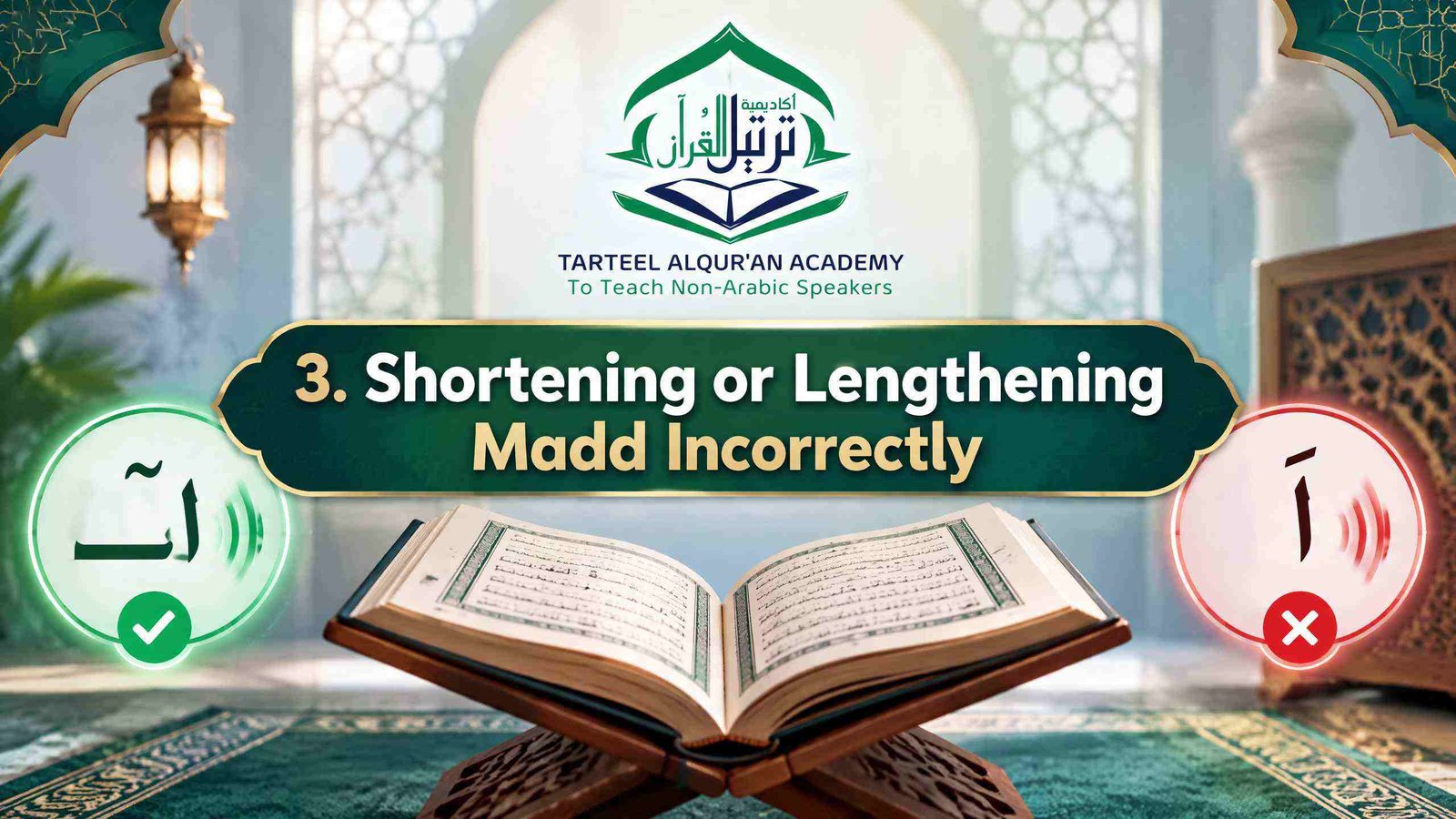
3. Shortening or Lengthening Madd Incorrectly
During the next part of the lesson, Yusuf started reading a verse more confidently.
However, the teacher noticed that he was not giving certain long vowel sounds their required duration.
“Let’s read that word again,” he said.
“Why?” Yusuf asked.
“You are shortening a sound that needs to be lengthened. In Tajweed, this is called Madd.”
Madd refers to the lengthening of certain vowel sounds in Quranic recitation.
The three Madd letters are:
- ا (Alif), preceded by Fathah.
- و (Waw), preceded by Dammah.
- ي (Ya), preceded by Kasrah.
It is important to distinguish between Madd letters and the two Leen letters. Waw and Ya with Sukoon, when preceded by Fathah, are called Leen letters rather than Madd letters.
Common Madd Mistakes
Mistake 1: Shortening a required Madd
Some learners pronounce a long vowel as if it were an ordinary short vowel.
Mistake 2: Lengthening a short vowel unnecessarily
A short Fathah, Kasrah, or Dammah should not automatically be stretched.
Mistake 3: Applying the same duration to every type of Madd
Different types of Madd have different rules and durations.
For example, Madd Tabee’i is generally prolonged for two counts, while other types of Madd may require different durations depending on the rule and recitation.
How to Avoid Madd Mistakes
The teacher explained each type of Madd using actual Quranic examples.
He asked Yusuf to listen carefully, identify the long vowel, and practice the correct duration.
Yusuf discovered that simply reading slowly was not enough. He also needed to understand which sounds should be lengthened and which should remain short.
A useful tip: Practice Madd using a qualified teacher’s recitation rather than relying only on counting sounds independently. The correct duration must follow the applicable Tajweed rule.
4. Ignoring Ghunnah or Pronouncing It Incorrectly
A few minutes later, Yusuf reached a word containing a rule that required Ghunnah.
He pronounced it quickly without producing the required nasal sound.
The teacher stopped him again.
“Yusuf, did you notice what happened to the sound here?”
“No, teacher.”
“Listen carefully. Some Quranic letters and combinations require Ghunnah. You should not ignore it or pronounce it carelessly.”
Ghunnah is a nasal sound associated with the letters ن (Noon) and م (Meem).
It is particularly important in rules such as
- Noon Mushaddadah.
- Meem Mushaddadah.
- Idgham with Ghunnah.
- Ikhfa.
- Iqlab.
In common beginner instruction, Ghunnah is generally held for two counts in the rules that require this duration, although its application depends on the specific Tajweed rule. Learners can practice these applications through structured Tajweed online classes.
Common Ghunnah Mistakes
- Omitting the nasal sound where it is required.
- Making the sound too short.
- Making it unnecessarily long.
- Confusing Ghunnah with the ordinary pronunciation of Noon and Meem.
- Failing to apply the rule correctly when reading connected words.
How to Practice Ghunnah
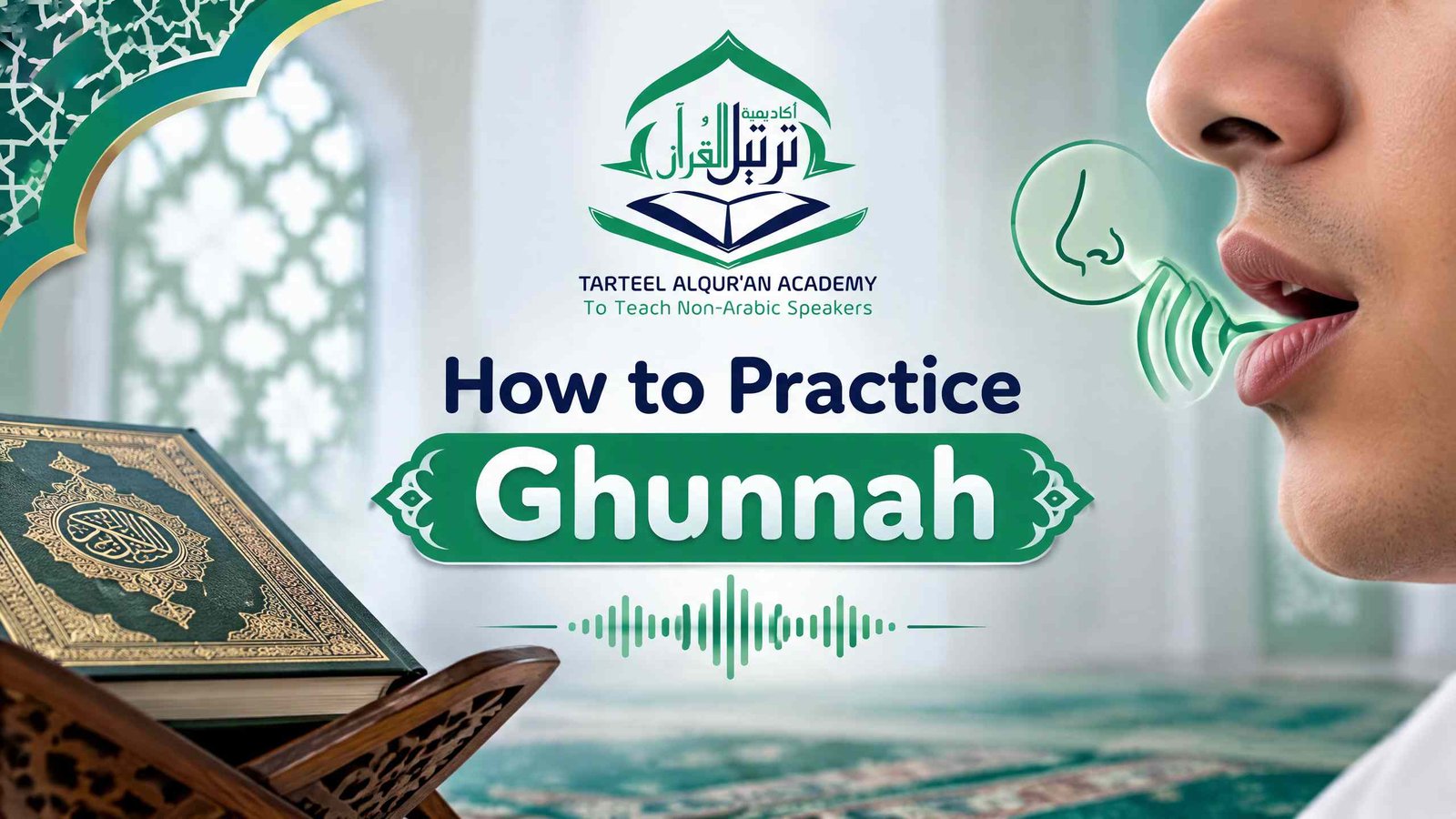
The teacher asked Yusuf to listen to examples of Noon and Meem with Shaddah.
He demonstrated the sound and asked Yusuf to repeat it.
They then practiced examples of Ikhfa and Idgham with Ghunnah.
After several repetitions, Yusuf began recognizing where the nasal sound was required.
The important lesson was that Ghunnah is not simply an extra sound added whenever a reader wants. It must be applied according to its specific Tajweed rule. Learners can develop a clearer understanding of these rules by following a structured Learn Quran online with Tajweed program.
5. Confusing the Rules of Noon Sakinah and Tanween
Yusuf was beginning to understand why Tajweed required careful attention.
But his teacher had another challenge for him.
He opened the Quran and pointed to examples containing Noon Sakinah and Tanween.
“Can you tell me what happens when Noon Sakinah or Tanween is followed by different Arabic letters?”
Yusuf shook his head.
The teacher explained that these rules are divided into four main categories: Izhar, Idgham, Iqlab, and Ikhfa. There is also a special case called Izhar Mutlaq, which occurs when Noon Sakinah is followed by ي or و within the same word. In these cases, the Noon is pronounced clearly rather than merged. This occurs in four Quranic words: الدنيا، بنيان، صنوان، قنوان.
A. Izhar
Izhar means making the Noon Sakinah or Tanween sound clear.
It applies when they are followed by one of the six throat letters:
ء، ه، ع، ح، غ، خ
A common mistake is to merge the sound when it should be pronounced clearly.
B. Idgham
Idgham means merging the Noon Sakinah or Tanween sound into the following letter.
It applies to the letters:
ي، ر، م، ل، و، ن
These are commonly remembered through the word يرملون.
Idgham is divided into two types:
- Idgham with Ghunnah: ي، ن، م، و.
- Idgham without Ghunnah: ل، ر.
A common mistake is applying Ghunnah to every Idgham case, even when it is not required.
C. Iqlab
Iqlab occurs when Noon Sakinah or Tanween is followed by ب (Ba).
The sound is changed into a hidden Meem sound with Ghunnah.
Some beginners pronounce the Noon clearly instead of applying Iqlab.
D. Ikhfa
Ikhfa means concealing the Noon Sakinah or Tanween sound while maintaining Ghunnah.
It applies with the remaining fifteen letters.
A common mistake is making the Noon completely clear or merging it incorrectly.
How Did Yusuf Remember These Four Rules?
His teacher gave him a practical exercise.
Instead of memorizing the definitions alone, Yusuf identified the following letter in different Quranic examples.
He then decided whether the rule was Izhar, Idgham, Iqlab, or Ikhfa.
This made the lesson much easier to understand.
Teacher’s advice: Learn the four rules with their letters, listen to their correct application, and practice identifying them in Quranic verses.
6. Applying Meem Sakinah Rules Incorrectly

The teacher then introduced another group of rules that beginners sometimes overlook.
Meem Sakinah has three main rules:
Izhar Shafawi
When Meem Sakinah is followed by any letter other than ب or م, the Meem is pronounced clearly.
A common mistake is adding unnecessary nasalization or hiding the Meem.
Idgham Shafawi
When Meem Sakinah is followed by another Meem, the two sounds merge with Ghunnah.
Some learners pronounce the two Meems separately instead of applying the correct merging rule.
Ikhfa Shafawi
When Meem Sakinah is followed by ب, the Meem is concealed with Ghunnah.
A common mistake is pronouncing the Meem too clearly or failing to observe the correct nasal sound.
The teacher demonstrated all three rules using Quranic examples.
Yusuf listened carefully and practiced each one until he could recognize the differences.
7. Mispronouncing Qalqalah
Just when Yusuf thought he had learned enough for one lesson, his teacher introduced Qalqalah.
“Have you ever noticed that some Arabic letters produce a distinct bouncing sound when they have Sukoon?”
Yusuf nodded.
“That is Qalqalah.”
Qalqalah applies to five Arabic letters:
ق، ط، ب، ج، د
These letters are commonly remembered through the expression قطب جد.
Qalqalah occurs when one of these letters has Sukoon. The sound should be released clearly with its characteristic bouncing quality, without adding a Fathah, Kasrah, or Dammah after the letter.
Recognizing this exception is important because it helps learners apply the rules correctly instead of relying on memorized letter combinations alone. It is one of the Tajweed mistakes to avoid when studying Noon Sakinah and Tanween.
Common Qalqalah Mistakes to Avoid
Adding an unnecessary vowel: Some beginners add a clear Fathah, Kasrah, or Dammah after the Qalqalah letter.
Making the sound too strong: The letter should not be exaggerated beyond its proper pronunciation.
Ignoring Qalqalah: Some learners pronounce the letter without its required bouncing quality.
Confusing ordinary Qalqalah with Qalqalah when stopping: The strength of the sound can vary depending on the context and whether the reader is stopping.
How to Correct It
The teacher asked Yusuf to identify the five letters and listen to examples where they appeared with Sukoon.
They practiced the sounds individually before moving to complete Quranic words.
Yusuf began to recognize Qalqalah more easily.
8. Rushing Through Quranic Recitation
After several pronunciation exercises, the teacher asked Yusuf to read a short passage without stopping.
Yusuf started reading quickly.
He wanted to finish the passage as soon as possible.
The teacher gently interrupted him.
“Why are you in such a hurry?”
“I want to finish the page, teacher.”
“Reading the Quran is not a race. You should give every word the attention it deserves.”
This was another serious mistake.
Many learners focus on how much Quran they can read rather than how carefully they pronounce it. Following a structured quran with Tajweed course can help them develop accurate recitation habits and apply Tajweed rules correctly.
Rushing can lead to:
- Missing required Madd.
- Weak pronunciation of Arabic letters.
- Incorrect application of Ghunnah.
- Confusing connected words.
- Ignoring appropriate stopping points.
- Losing the rhythm and clarity of recitation.
What Is the Better Approach?
The teacher introduced Yusuf to the different styles of Quranic recitation speed:
- Tahqiq: A slow and deliberate style, useful for careful learning and practice.
- Tartil: A measured and deliberate recitation in which each letter is given its proper characteristics and pronunciation, while observing Tajweed rules and reflecting on the meanings.
- Tadwir: A moderate pace between slower and faster recitation.
- Hadr: A faster style that still maintains the rules of Tajweed.
For beginners, slower and measured practice is often helpful because it allows them to concentrate on pronunciation.
The objective is not simply to read more verses. It is to recite them correctly by understanding the Tajweed rules for beginners explained and applying them during Quran recitation.
9. Stopping and Starting at the Wrong Places
Yusuf was making progress, but there was still something missing.
His teacher noticed that he sometimes stopped in the middle of a phrase without considering the meaning or the rules of Waqf.
“Yusuf, do you know that stopping in the wrong place can sometimes affect the meaning of what you are reading?”
Yusuf looked surprised.
The teacher explained that Waqf refers to stopping during Quranic recitation, while Ibtida refers to beginning or resuming recitation.
Understanding stopping and starting signs is an important part of learning to recite the Quran properly.
Common Waqf Mistakes
- Stopping without considering the meaning.
- Ignoring important stopping signs.
- Starting again from a place that makes the meaning unclear.
- Stopping unnecessarily in the middle of a connected phrase.
- Not knowing when to continue or pause.
How to Avoid These Mistakes
Beginners should learn the common Waqf signs and understand their purpose. They can also review common mistakes when learning Tajweed to recognize Tajweed mistakes to avoid and improve their Quran recitation.
They should also practice with a teacher who can explain where stopping is appropriate and where continuing is preferable.
A teacher can help students understand that good recitation is not only about individual letter pronunciation. It also involves reading in a way that respects the structure and meaning of Quranic verses.
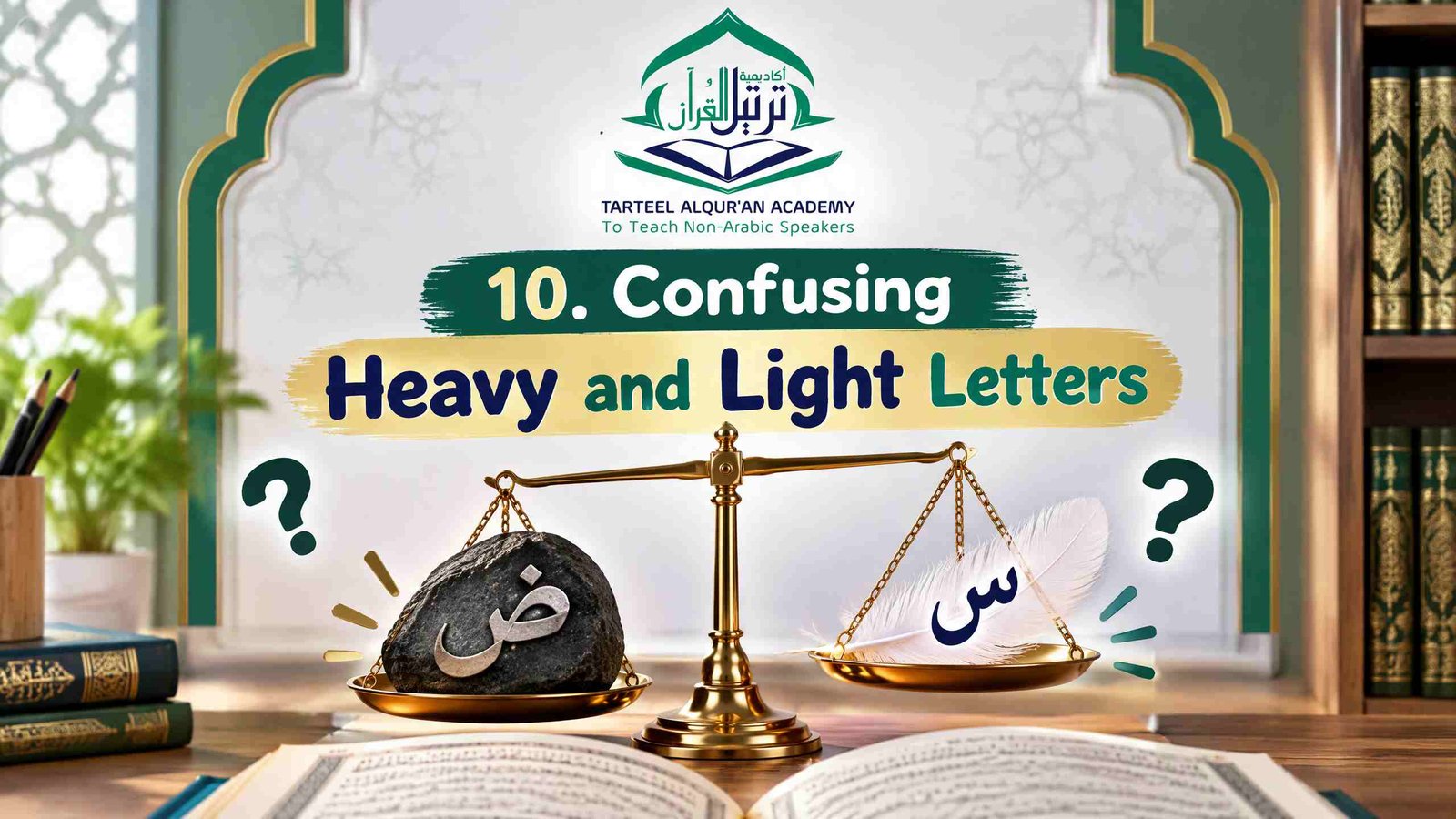
10. Confusing Heavy and Light Letters
During another practice session, Yusuf noticed that his teacher kept correcting the way he pronounced certain letters.
“Why does this letter sound heavier than the others?” he asked.
The teacher explained the concept of Tafkheem and Tarqeeq.
Tafkheem refers to a heavier or fuller quality of pronunciation, while Tarqeeq refers to a lighter quality.
The seven letters of Ist’ila are خ، ص، ض، غ، ط، ق، ظ, and they are generally pronounced with Tafkheem. Other letters are generally pronounced with Tarqeeq. Certain letters, particularly ر (Raa) and ل (Lam) in the word Allah, have context-dependent rules.
Common Mistakes
- Pronouncing every Arabic letter with the same weight.
- Making light letters unnecessarily heavy.
- Pronouncing heavy letters too lightly.
- Ignoring the specific rules of Raa.
- Applying the wrong pronunciation to the Lam in the word Allah.
How to Improve
The teacher demonstrated heavy and light sounds using Quranic examples.
Yusuf practiced distinguishing between the two qualities and learned that pronunciation depends on the letter and its surrounding conditions.
This lesson was particularly useful because some non-Arabic-speaking learners naturally transfer pronunciation habits from their native language into Quranic reading.
11. Ignoring the Rules of Noon and Meem Mushaddadah
The teacher noticed another small mistake during Yusuf’s recitation.
Whenever Yusuf encountered Noon or Meem with Shaddah, he sometimes read them too quickly.
The teacher explained:
“Whenever you see a Noon Mushaddadah or Meem Mushaddadah, remember that Ghunnah is required.”
Examples include:
- إِنَّ
- ثُمَّ
These letters require a nasal sound with a duration commonly taught as two counts.
What Should Learners Avoid?
- Skipping the nasal sound.
- Pronouncing the letter too quickly.
- Making the Ghunnah unnecessarily long.
- Confusing it with ordinary Noon or Meem pronunciation.
The teacher asked Yusuf to identify these letters in short Quranic passages and practice them slowly.
It was a small exercise, but it helped him recognize an important rule more consistently.
12. Learning Tajweed Rules Without Practicing Them
After several lessons, Yusuf became excited.
He had learned the names of many Tajweed rules and could explain their definitions.
But when the teacher asked him to apply those rules while reading a passage, he still made mistakes.
“Teacher, I know all these rules. Why can’t I use them correctly when I read?”
The teacher smiled.
“Because knowing a rule and applying it are two different stages of learning.”
This is one of the most common problems among Quran learners.
Some students memorize definitions of Tajweed rules but do not spend enough time practicing their application.
For example, a student may know what Ikhfa means but fail to recognize it while reading.
Another student may understand Madd theoretically but shorten the sound during actual recitation.
How to Avoid This Problem
A balanced Tajweed learning routine should include:
- Understanding the rule.
- Listening to a correct example.
- Practicing the sound individually.
- Identifying the rule in Quranic verses.
- Reading the verse aloud.
- Receiving feedback from a qualified teacher.
- Revising the rule regularly.
The teacher explained that practical application was the most important part of Yusuf’s next learning stage.
Why Do Non-Arabic-Speaking Students Need Special Attention When Learning Tajweed?
Yusuf’s experience is especially common among children and adults who grow up in countries where Arabic is not their first language.
A student in the UK, USA, Canada, or Australia may understand Quran lessons in English but still struggle with Arabic pronunciation.
This happens because the sounds and pronunciation patterns of Arabic can be very different from those of English and other languages.
For example:
- The letter ع requires an articulation that English speakers may not be familiar with.
- The letter ح is different from the English H sound.
- The distinction between س and ص requires attention to the characteristics of each letter.
- Madd requires understanding specific vowel-length rules.
- Ghunnah requires correct nasal pronunciation in particular situations.
For these students, simply reading a Tajweed textbook may not be enough.
They need to hear the correct pronunciation, practice it, and receive feedback.
A qualified Quran teacher can identify errors that a student may not notice independently.
This is why personalized Quran and Tajweed lessons can be particularly helpful for non-Arabic-speaking learners.
How Can You Avoid Tajweed Mistakes in Your Daily Quran Practice?

After identifying Yusuf’s mistakes, his teacher created a simple practice routine.
It was not complicated, and it did not require hours of study every day.
Instead, the focus was on consistency and correcting one problem at a time.
Here is a similar routine that beginners can follow.
Step 1: Review Arabic Letter Pronunciation
Spend a few minutes practicing difficult Arabic letters.
Focus on their articulation points and characteristics.
Step 2: Revise One Tajweed Rule
Choose one rule, such as Madd, Ghunnah, or Qalqalah.
Review its meaning and listen to examples.
Step 3: Read a Short Quranic Passage
Choose a few verses and read them slowly.
Try to apply the rule you have studied.
Step 4: Record Your Recitation
Recording your voice can help you notice pronunciation differences and track your progress.
However, self-listening should not replace feedback from a qualified teacher.
Step 5: Get Your Recitation Corrected
Ask a Quran teacher to listen to your reading and identify specific mistakes.
Focus on correcting the most important issues before moving to more advanced rules.
Step 6: Repeat and Revise
Revisit previous lessons regularly.
Tajweed is a practical skill, and consistent revision helps students retain what they have learned.
Why Learning Tajweed With a Qualified Teacher Makes a Difference
At the end of one lesson, Yusuf asked his teacher another question.
“Can I learn all these rules by watching Quran videos online?”
The teacher replied:
“Videos can help you understand the rules, but who will listen to your pronunciation and tell you whether you are applying them correctly?”
This was an important point.
Online videos, books, and audio recordings are useful learning resources. However, they cannot always identify the specific mistakes a student makes while reciting.
A qualified teacher can:
- Listen to individual letter pronunciation.
- Correct articulation mistakes.
- Explain difficult Tajweed concepts.
- Identify incorrect Madd and Ghunnah.
- Demonstrate the correct application of Tajweed rules.
- Monitor progress over time.
- Adjust lessons according to the student’s ability.
For children, having an experienced teacher who understands how to teach young learners is particularly valuable.
Lessons should be encouraging, interactive, and appropriate for the child’s age.
Can You Learn Tajweed Online Without Speaking Arabic?
Absolutely.
You do not need to speak Arabic fluently to begin learning Tajweed.
Many online Quran learning programs are designed specifically for non-Arabic-speaking children and adults.
They explain Tajweed rules in English and provide live recitation practice with qualified instructors.
A good online Tajweed course should include:
1. Individual attention: Teachers should listen to each student’s recitation and correct mistakes.
2. Structured lessons: Students should progress from Arabic pronunciation to basic and advanced Tajweed concepts.
3. Practical application: Every rule should be connected to real Quranic examples.
4. Flexible schedules: Lessons should fit around school, work, and family responsibilities.
5. Progress tracking: Students and parents should understand which skills have improved and what still needs attention.
If you or your child are struggling with Quran pronunciation, enrolling in structured online Tajweed lessons can be a practical way to receive consistent guidance.
Start Improving Your Quran Recitation Today
Yusuf’s journey did not end after one lesson.
He continued practicing, reviewing difficult letters, correcting Madd, and applying Tajweed rules to the Surahs he already knew.
Some mistakes took longer to correct than others, but he gradually became more aware of his pronunciation.
His teacher never expected perfection overnight.
Instead, every lesson focused on meaningful improvement.
That is exactly how learning Tajweed should work.
At Tarteel Online Quran Academy, we help children and adults from non-Arabic-speaking backgrounds develop stronger Quran recitation skills through structured online Quran and Tajweed lessons.
Our learning approach focuses on:
- Correct Arabic letter pronunciation.
- Understanding Makharij al-Huruf.
- Learning essential Tajweed rules.
- Identifying and correcting common recitation mistakes.
- Practicing Quranic verses with qualified teachers.
- Building confidence through personalized guidance.
Are you ready to correct your Tajweed mistakes and improve your Quran recitation?
Book a trial lesson today and discover how a structured learning plan can help you or your child recite the Quran with greater accuracy and confidence.
Frequently Asked Questions About Tajweed Mistakes
Find clear answers to common questions about Tajweed mistakes, their causes, and how to avoid them for more accurate Quran recitation.
1. What are the most common Tajweed mistakes beginners make?
Some of the most common mistakes include confusing Arabic letters with similar sounds, mispronouncing Makharij, shortening or lengthening Madd incorrectly, omitting Ghunnah, applying Noon Sakinah and Tanween rules incorrectly, and rushing through Quranic recitation.
2. How can I identify mistakes in my Quran recitation?
You can start by listening carefully to your own recitation, comparing it with reliable recitations, and reviewing basic Tajweed rules. However, the most effective way to identify pronunciation errors is to recite in front of a qualified Quran teacher who can provide direct feedback.
3. Can I learn Tajweed without speaking Arabic?
Yes. You can learn Tajweed without being fluent in Arabic. A structured course with English explanations, practical pronunciation exercises, and live teacher feedback can help non-Arabic speakers develop accurate Quran recitation skills.
4. How long does it take to correct Tajweed mistakes?
The time depends on the number of mistakes, the student’s current reading level, and how regularly they practice. Some pronunciation errors may improve within a few lessons, while others require longer periods of consistent correction and revision.
5. Is it better to learn Tajweed online or with a private Quran teacher?
Both options can be effective. Online private Quran lessons offer direct interaction with a teacher, personalized pronunciation correction, and flexible scheduling. The most important factor is choosing a qualified instructor who can listen to your recitation and guide your progress.
Conclusion: Correct Your Mistakes, Improve Your Recitation, and Grow With the Quran
By the end of Yusuf’s learning journey, he understood something that he had never considered before.
Learning the Quran was not simply about recognizing Arabic words or finishing a page. It was also about giving every letter its correct pronunciation and understanding the rules that guide beautiful Quranic recitation.
His teacher had helped him recognize mistakes he could not identify on his own.
From confusing Arabic letters to incorrect Madd, Ghunnah, Qalqalah, and stopping rules, every correction became another step towards better recitation.
The same journey is possible for you or your child.
If you are learning the Quran in a non-Arabic-speaking environment, do not feel discouraged by pronunciation difficulties. These challenges are a natural part of learning, and they can be addressed through patience, proper instruction, and regular practice.
Start by identifying your most common mistakes. Learn the rules behind them, practice with Quranic examples, and seek guidance from a qualified teacher.
Remember: Better Quran recitation does not happen in a single lesson. It develops one corrected letter, one understood rule, and one practice session at a time.