
A conversational Arabic course online can help learners move beyond memorizing vocabulary and begin using Arabic in practical situations. Instead of studying words in isolation, students learn how expressions work in real conversations, how to respond naturally, and how to understand common Arabic speech. This approach is especially useful for beginners who know a few Arabic words but still hesitate when they need to speak.
Arabic requires patience because pronunciation, sentence structure, vocabulary, and regional varieties can all present challenges. However, a clear learning path makes the process more manageable. With regular listening, speaking practice, vocabulary review, and useful conversations, learners can gradually build confidence.
Online education adds another advantage: flexibility. Students can study from home, review lessons when needed, and organize practice around work, family, university, or other responsibilities. For learners seeking an Islamic educational environment, Tarteel Arabic Academy online can provide structured online learning that connects Arabic development with Quranic and Islamic studies.
The real objective is simple: understand Arabic more easily, respond with greater confidence, and use the language in situations that matter in everyday life.
What Is a Conversational Arabic Course Online?
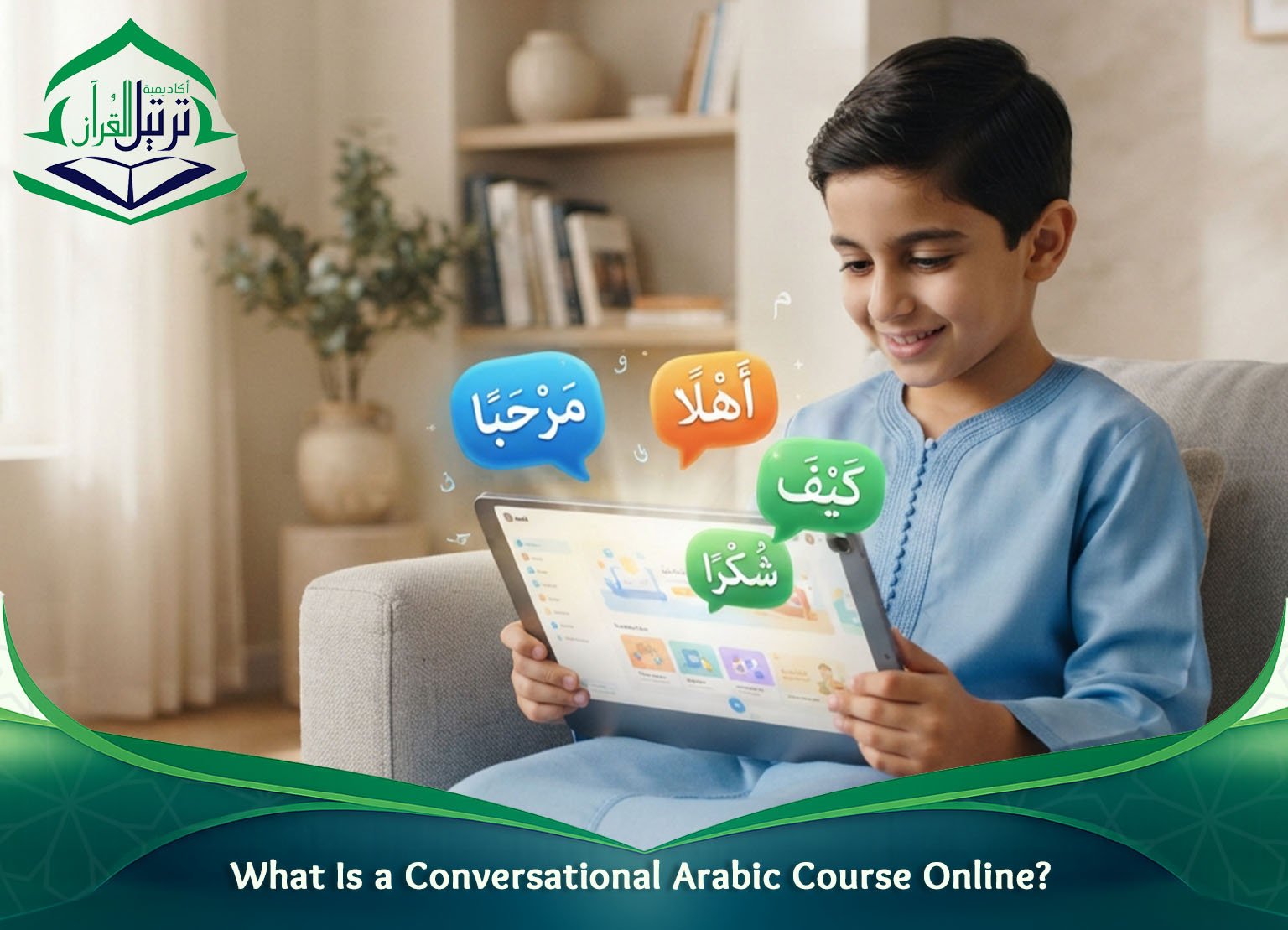
A conversational Arabic course online is a digital learning program that focuses primarily on helping students communicate in Arabic. Grammar and writing can still be part of the curriculum, but practical communication remains central.
Instead of beginning with long grammar explanations, learners can start with useful expressions. Greetings, introductions, family conversations, shopping, travel, food, directions, work, and daily activities are common examples.
This method gives vocabulary a clear context. For example, learning the Arabic word for “water” is useful, but knowing how to ask for water in a natural sentence is much more practical. The same principle applies to greetings, requests, questions, and responses.
A strong program should gradually move the learner through several stages:
- Understand common Arabic expressions.
- Listen to accurate pronunciation.
- Repeat words and sentences aloud.
- Practice short dialogues.
- Answer simple questions.
- Create original sentences.
- Use familiar structures in new situations.
- Communicate with less hesitation.
As a result, students develop active language skills instead of simply recognizing information on a page.
Start Your Islamic Learning Journey Today
Join Tarteel Online Quran Academy today and begin a meaningful Islamic learning experience designed for children, adults, and beginners worldwide. Our qualified Quran teachers provide interactive lessons, flexible schedules, and personalized guidance to help students improve their Quran recitation, understand Islamic teachings, and strengthen their connection with Allah.
Through structured online classes, learners can study comfortably from home while receiving professional support at every step. Start your journey today and build a strong spiritual foundation with trusted Quran education.

Why Choose an Online Conversational Arabic Course?
Arabic learners have different goals, but many share one problem: they want to speak but do not know how to learn Arabic USA to begin. An online course can address this difficulty by combining structure with regular practice.
Flexible Arabic Learning for Busy Students
Flexibility is one of the strongest advantages of online education. A university student may need to study around classes, while a professional may only have time after work. Parents may also prefer lessons that fit around family responsibilities.
Online learning makes this possible. Rather than spending time traveling to a language center, learners can study from a familiar environment.
More importantly, flexibility can encourage consistency. A manageable 20- or 30-minute study session several times a week may be easier to maintain than an ambitious schedule that quickly becomes exhausting.
Practice Arabic From Home
Speaking a new language can feel uncomfortable, especially during the first few weeks. Students often worry about pronunciation, grammar mistakes, or forgetting vocabulary.
A familiar environment can reduce some of this pressure. Learners can repeat difficult expressions, pause audio, review notes, and practice sentences several times before using them in a conversation.
Gradually, that private practice can lead to greater confidence in real communication.
Learn Language for Real Situations
Practical communication should answer an important question: “When would I actually use this?”
A useful lesson might teach a learner how to introduce themselves, ask someone where they live, order a meal, request assistance, describe a daily routine, or discuss a hobby.
Such activities make the language immediately relevant. They also help students remember vocabulary because every expression is connected to a situation.
Conversational Arabic Course Online for Beginners
Beginners require a different approach from advanced learners. They should not be expected to understand long conversations from the beginning.
Instead, the first stage should establish a strong foundation. Students can learn basic sounds, essential vocabulary, common expressions, and simple sentence patterns.Parents who are choosing a Quran teacher for their child can use the Best Quran Teacher for My Child Checklist to consider important factors before making a decision.
Build Arabic Vocabulary by Topic
Learning vocabulary through themes can make memorization easier. A beginner might study family-related words in one lesson and food-related vocabulary in another.
For example, a lesson about daily life could include words connected with waking up, eating breakfast, going to work or school, returning home, and sleeping.
The advantage is clear: related words reinforce one another. Consequently, learners can remember them as part of a meaningful context instead of as unrelated items.
Learn Arabic Expressions as Complete Phrases
Memorizing complete expressions can also support fluency. Beginners often try to translate every sentence word by word, which can make speaking slow and unnatural.
Learning common phrases as units reduces this problem. Once a phrase becomes familiar, learners can modify part of it to create new sentences.
This technique is particularly useful for greetings, requests, questions, introductions, and everyday responses.
Develop Arabic Pronunciation From the Start
Arabic pronunciation deserves attention from the first lessons. Several Arabic grammar courses for beginners may be unfamiliar to learners, so postponing pronunciation practice can allow inaccurate habits to develop.
Listening carefully is therefore essential. Students should hear a sound, repeat it, compare their attempt with the model, and practice again. With regular repetition, difficult sounds usually become more familiar.
How an Online Arabic Course Improves Speaking Confidence?
Confidence comes from successful practice. A learner may understand Arabic while reading but still hesitate when someone asks a question aloud.
That difference occurs because reading and speaking involve different skills. Speaking requires quick recall, pronunciation, sentence construction, and listening comprehension at the same time.
Begin With Short Arabic Conversations
Short exchanges are usually easier for beginners than long dialogues. A learner can start by practicing an introduction, answering a simple question, and asking the same question in return. Once these patterns become familiar, the conversation can gradually become longer.
For example, a basic introduction can eventually include information about family, work, studies, interests, and daily activities.
Reuse Familiar Arabic Sentence Patterns
Repetition becomes more useful when the context changes. Instead of repeating one exercise endlessly, students can use the same structure with different vocabulary.
A sentence pattern used to describe a morning routine could later describe an evening routine, a weekend, or a workday.
This type of variation builds flexibility. Learners begin to understand how Arabic works rather than memorizing one fixed answer.
Use Mistakes as Learning Opportunities
Fear of mistakes can prevent students from speaking. Yet mistakes are unavoidable during language acquisition.
A correction is useful when the learner understands why the mistake occurred and then practices the correct form. Over time, repeated feedback improves accuracy.
Therefore, students should aim for communication first and perfection later. Accuracy develops through continued practice.
Conversational Arabic Course Online and Modern Standard Arabic
Learners often wonder whether they should study Modern Standard Arabic or a regional dialect. The answer depends largely on their goals.
Modern Standard Arabic is important in formal writing, education, news, books, official communication, and many other contexts. It also gives learners a broad foundation for understanding written Arabic.
Everyday speech, however, often relies on regional dialects. Egyptian Arabic, Levantine Arabic, Gulf Arabic, and other varieties can differ in vocabulary and pronunciation.
Someone preparing to live in a particular country may eventually benefit from studying its local dialect. Meanwhile, a learner interested in formal Arabic, reading, or Islamic studies may prefer to develop a stronger Modern Standard Arabic foundation first.
Trying to learn Arabic alphabets of several varieties simultaneously can overwhelm beginners. A focused starting point is usually more effective.
How to Choose the Right Conversational Arabic Course Online?
The quality of an online course depends on more than attractive videos or a large collection of lessons. Students should examine how the program actually teaches communication.
Look for a Clear Arabic Learning Structure
A well-organized program should have a logical progression. Beginners need foundational lessons before moving into complex conversations.
Clear learning objectives also help students understand what they should be able to do after completing each level.
For example, an early level might focus on introductions and basic questions. A later stage could introduce descriptions, opinions, experiences, and longer discussions.
Prioritize Speaking Activities
If speaking is the main goal, speaking practice should occupy an important part of the course.
Grammar explanations can be useful, but they should support communication rather than replace it. Dialogues, role-play, question-and-answer activities, and guided speaking tasks can give learners valuable practice.
Check the Listening Component
Listening is essential for conversation. Students need to recognize familiar vocabulary when it is spoken naturally rather than only when it appears in writing.
A good progression begins with clear and manageable audio. Later, learners can work with faster and more natural speech.
Consider Additional Study Resources
Useful supporting materials can make independent review easier. Depending on the program, students may receive vocabulary lists, worksheets, audio resources, study plans, pronunciation exercises, or review activities.
These materials help learners continue practicing between lessons.
How Tarteel Online Quran Academy Can Support Arabic Learning?
Tarteel Arabic Academy online may be particularly relevant to learners who want Arabic learning connected to Quranic and Islamic education. For these students, Arabic can serve two purposes: communication and deeper engagement with religious texts.
A structured online environment can help learners develop vocabulary, pronunciation, comprehension, and confidence progressively.
The connection with Quranic learning can also give students a clear motivation for studying Arabic. Understanding the language of the Quran can encourage learners to pay closer attention to vocabulary, sentence structures, and meanings.
At the same time, students should distinguish between conversational Arabic and specialized Quranic Arabic. They overlap in important areas, but they are not identical learning goals. For this reason, learners should select lessons according to what they want to achieve.
What Skills Should a Conversational Arabic Program Teach?
Speaking alone is not enough to create strong communication. Successful learners develop several related skills.
Speaking Arabic
Speaking practice should occur regularly. Beginners can discuss familiar subjects such as their name, family, work, studies, hobbies, and daily routine.
As their vocabulary expands, they can describe experiences, express preferences, explain ideas, and participate in longer conversations.
Listening to Arabic
Listening develops recognition and pronunciation at the same time. Students become familiar with rhythm, sounds, common expressions, and sentence patterns.
Short dialogues are particularly effective because learners can listen repeatedly until the meaning becomes clear.
Reading Arabic
Reading supports vocabulary development and helps students recognize sentence structures.
Beginners can start with individual words and short sentences. Later, they can progress to dialogues, stories, articles, and other appropriate texts.
Writing Arabic
Writing is not always the central goal of a speaking-focused course, but it reinforces vocabulary and grammar.
Simple exercises can include writing an introduction, describing a family member, answering questions, or recording daily activities.
Arabic Pronunciation
Clear pronunciation makes communication easier. Regular listening and repetition can help students recognize and reproduce unfamiliar Arabic sounds.
Early correction is useful because it prevents inaccurate pronunciation from becoming deeply established.
Conversational Arabic Course Online for Travel
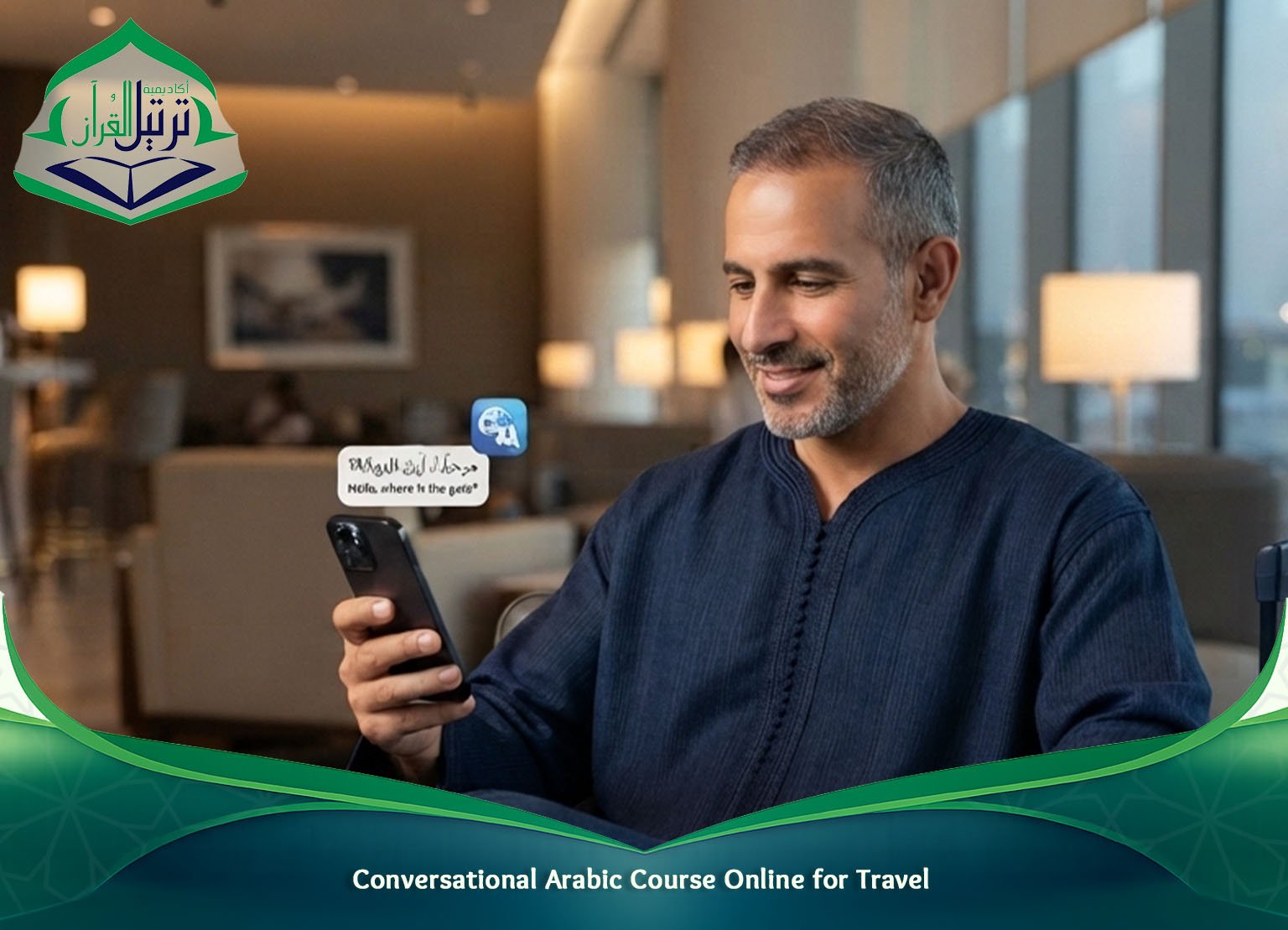
Arabic can be extremely useful for travelers visiting Arabic-speaking countries. Even basic communication can make everyday situations easier.
A traveler may need to ask for directions, order food, buy something, use transportation, check into accommodation, or request help.
Preparing for these situations before traveling can reduce stress. Instead of translating every sentence from scratch, the learner can rely on expressions already practiced.
Furthermore, speaking Arabic can create more natural interactions with local people. Even simple phrases can demonstrate respect and interest in the local culture.
Arabic Conversation Skills for Work
Arabic can also provide professional advantages. Employees who can communicate with Arabic-speaking customers, partners, or colleagues may find additional opportunities in international business.
Professional communication eventually requires specialized vocabulary. Meetings, schedules, projects, customer service, negotiations, and presentations all involve language beyond everyday conversation.
A conversational foundation still provides an important starting point. Once learners become comfortable with everyday Arabic, they can add vocabulary related to their profession.
A teacher, business professional, researcher, tourism worker, and customer-service employee may all require different specialized language.
How Long Does It Take to Learn Conversational Arabic?
There is no universal timeline. Progress depends on study frequency, previous language experience, exposure to Arabic, motivation, and opportunities to practice speaking.
Someone who practices regularly may progress faster than a learner who studies only occasionally. Likewise, learners who frequently hear Arabic outside their lessons may develop listening skills more quickly. Instead of focusing exclusively on a deadline, it is better to measure concrete abilities.
A learner might set goals such as:
- Introduce themselves confidently.
- Understand common questions.
- Use practical vocabulary.
- Hold short conversations.
- Describe daily activities.
- Understand simple spoken Arabic.
- Express preferences and opinions.
- Maintain longer conversations.
These milestones provide a more meaningful measure of progress than simply counting completed lessons.
How to Practice Arabic Between Online Lessons?
Independent practice can significantly strengthen what students learn quran arabic UK during lessons.A short daily routine might include listening to Arabic, reviewing vocabulary, repeating sentences, and writing a few examples.
Learners can also integrate Arabic into ordinary activities. While preparing food, they can name ingredients in Arabic. During a walk, they might describe what they see using simple sentences.
Another useful technique is to speak to yourself. Describe what you are doing, what you plan to do, or what you did earlier.
Although this may feel unusual initially, it gives the brain additional opportunities to retrieve Arabic without relying on a teacher.
Common Mistakes When Learning Conversational Arabic
Certain habits can slow progress even when students study regularly.
Memorizing Vocabulary Without Context
Large vocabulary lists may look impressive, but isolated words are easy to forget. Learning words through sentences and situations makes them more useful.
Waiting to Speak Until Grammar Is Perfect
Perfect grammar is not a requirement for beginning a conversation. Speaking practice itself helps develop grammar accuracy.
Ignoring Listening Practice
Students who focus only on written Arabic may struggle when someone speaks naturally. Listening should therefore be part of the weekly routine.
Studying Without Consistency
Long gaps between lessons can weaken memory. Regular short sessions generally provide better continuity.
Translating Every Word
Translation can help beginners, but relying on it constantly may slow comprehension. Over time, students should try to understand familiar expressions directly in Arabic.
Build a Practical Conversational Arabic Course Online Study Routine
A successful conversational Arabic course online becomes much more effective when students follow a realistic routine between lessons. The goal is not to spend hours studying every day. Instead, learners should divide their time between listening, speaking, vocabulary review, and practical sentence building. This balanced approach keeps the learning process manageable while giving every major language skill regular attention.
Follow a Simple Conversational Arabic Course Online Routine
A 30-minute daily session can be organized into several focused activities:
- 5 minutes: Review vocabulary from previous lessons.
- 10 minutes: Listen to a short Arabic conversation and identify familiar expressions.
- 10 minutes: Repeat sentences aloud and answer simple questions.
- 5 minutes: Write several sentences using the new vocabulary.
This routine can be adjusted according to the learner’s schedule. Someone with more available time may extend the speaking and listening sections, while a busy student can complete a shorter session. What matters most is maintaining regular contact with Arabic.
Furthermore, learners should avoid filling every session with new material. Reviewing previously studied expressions helps move vocabulary from short-term recognition into long-term memory.
Use Spaced Review in Your Arabic Course
Spaced review is especially useful for language learners. Instead of studying a new word repeatedly on one day and then forgetting it, students can revisit the same word after several intervals.
For example, new vocabulary can be reviewed:
- Later on the same day.
- The following day.
- Three or four days later.
- One week afterward.
- Again during a speaking activity.
As a result, learners encounter important vocabulary several times in different contexts. This repeated exposure makes it easier to recall words during real conversations.
Use Technology to Improve Conversational Arabic Course Online Practice
Technology can make a conversational Arabic course online more interactive and accessible. Learners can combine structured lessons with audio recordings, videos, digital flashcards, pronunciation exercises, and mobile study tools.
However, technology works best when it encourages active language use. Simply downloading several Arabic applications will not automatically improve speaking ability. Students need to interact with the language and use what they learn.
Use Audio to Strengthen Arabic Listening
Listening should be part of regular practice. Students can replay short conversations several times and gradually move from understanding individual words to recognizing complete expressions.
Headphones can also help learners notice pronunciation details more clearly. After listening, students should repeat selected sentences aloud rather than remaining passive listeners.
Turn Your Phone Into an Arabic Practice Tool
A mobile phone can become a useful learning resource when used intentionally. Learners can review vocabulary during a short break, listen to Arabic audio while commuting, or record themselves pronouncing new expressions.
Recording your own voice is particularly useful. By comparing your pronunciation with a reliable model, you may notice sounds, endings, or words that require additional practice.
Combine Technology With Active Speaking
Digital resources should support communication rather than replace it. After watching an Arabic lesson, try to summarize what you understood. After learning a dialogue, change some of the vocabulary and create your own version.
This simple step transforms passive exposure into active practice.
Make Your Conversational Arabic Course Online Experience More Enjoyable

Enjoyment can make a major difference in long-term language learning. Students are more likely to maintain their study routine when Arabic connects with subjects that interest them personally.
A traveler, for instance, may enjoy practicing hotel conversations, directions, transportation, and shopping. Someone interested in food might focus on restaurant conversations, ingredients, meals, and preferences.
Choose Arabic Topics You Actually Enjoy
Personal interests can provide natural motivation. Learners interested in history can read simple historical content. Those who enjoy stories can practice through short Arabic narratives. Students interested in Islamic studies may connect language practice with appropriate religious material.
The important point is to make Arabic meaningful rather than treating every lesson as an isolated task.
Keep Your Conversational Arabic Practice Varied
Variety can prevent the learning routine from becoming repetitive. One day might focus on listening, while another emphasizes speaking or vocabulary review.
For example, a weekly routine could include:
- Listening to a short dialogue.
- Practicing a conversation aloud.
- Reviewing vocabulary.
- Reading a simple Arabic text.
- Writing a short paragraph.
- Revisiting difficult pronunciation.
Nevertheless, repetition should not disappear completely. Frequently used words and expressions need repeated exposure before they become automatic.
Why Consistency Matters in a Conversational Arabic Course Online?
Consistency is one of the most important factors in language development. A single long study session cannot replace regular exposure to Arabic.
Even a short daily session can reinforce vocabulary, pronunciation, and sentence patterns. Therefore, learners should create a routine that fits their actual lifestyle rather than choosing an unrealistic schedule.
Choose Consistent Arabic Study Over Occasional Intensive Sessions
Studying for 20 minutes every day can be more sustainable than studying for three hours once and then taking several weeks off.
Regular practice keeps recently learned information active. It also reduces the amount of time needed to remember material that would otherwise become unfamiliar.
For busy learners, the key is to make Arabic part of the normal day. A short session before breakfast, during a break, or before bed can gradually become a reliable habit.
Track Small Achievements in Your Arabic Course
Progress can be easier to recognize when learners record specific achievements. Instead of asking whether you are fluent, consider what you can do now that you could not do previously.
You might notice that you can:
- Introduce yourself without hesitation.
- Understand a familiar question.
- Use new vocabulary correctly.
- Pronounce a difficult Arabic sound more clearly.
- Describe your daily routine.
- Respond without translating every word.
These small improvements demonstrate that consistent practice is producing results.
How a Conversational Arabic Course Online Takes You From Beginner to Speaker?
A conversational Arabic course online can guide learners through a gradual journey from recognizing individual Arabic words to participating in meaningful conversations. At first, beginners may understand only simple vocabulary and familiar expressions. With regular practice, however, these words begin to form complete phrases and useful sentences.
The goal is not to memorize large amounts of vocabulary without knowing how to use it. Instead, learners should gradually connect new words with real situations, common questions, and everyday responses. This approach makes Arabic easier to recall when speaking.
Conversational Arabic Course Online: Move From Words to Complete Sentences
Once learners understand basic Arabic vocabulary, they should begin combining words into meaningful sentences. This step is essential because knowing individual words does not necessarily mean being able to communicate.
For example, instead of memorizing separate words related to work, morning, and daily activities, students can practice complete sentences describing what they normally do each morning.
This method connects vocabulary with sentence structure. As a result, learners become more comfortable producing Arabic independently rather than waiting to remember a perfect sentence from a textbook.
Conversational Arabic Course Online: Progress From Short Replies to Natural Conversations
Speaking development usually starts with short answers. A beginner may respond to a question using one or two words. After gaining more confidence, the learner can provide complete sentences and eventually ask questions in return.
A conversational Arabic course online should therefore give students opportunities to practice different conversation patterns. For example, a learner might first answer questions about their name and location. Later, the same student could discuss family, work, hobbies, travel, or personal preferences.
Progress may not occur at the same speed across every skill. Listening might improve before speaking, while vocabulary may develop faster than pronunciation. This difference is completely normal, and regular practice helps bring these skills together.
Conversational Arabic Course Online: Reduce Mental Translation Gradually
Many beginners translate Arabic into their native language before responding. This habit is understandable during the early stages because students are still building their vocabulary and sentence patterns.
However, translating every sentence can make conversations slow and mentally tiring. Frequent exposure to common Arabic expressions can gradually reduce this dependence on translation.
With enough repetition, familiar phrases become easier to recognize directly. Eventually, learners can respond to common questions without consciously translating every individual word.
Stay Motivated With a Conversational Arabic Course Online
Maintaining motivation is an important part of language learning. Some periods may feel exciting because progress is easy to notice, while other weeks may seem slower.
A conversational Arabic course online becomes more rewarding when learners measure specific abilities instead of focusing only on the broad goal of fluency.
Conversational Arabic Course Online: Set Specific Speaking Goals
Clear goals make progress easier to measure. Instead of saying, “I want to speak Arabic fluently,” choose smaller objectives that can be achieved and evaluated.
For example, your goals might include:
- Introduce yourself confidently in Arabic.
- Hold a five-minute basic conversation.
- Understand a short everyday dialogue.
- Describe your daily routine without notes.
- Ask and answer common questions.
- Speak about your hobbies using complete sentences.
Each achievement provides evidence that your skills are developing.
Conversational Arabic Course Online: Connect Learning With a Personal Purpose
A personal reason for learning Arabic can provide additional motivation. Some students want to communicate while traveling, whereas others need Arabic for work, family conversations, cultural interests, or Islamic studies.
When Arabic has a clear purpose in your life, studying becomes more meaningful. Consequently, maintaining a regular routine becomes easier even when motivation naturally decreases.
Conversational Arabic Course Online: Celebrate Small Improvements
Fluency should not be the only measure of success. Understanding a sentence that once seemed difficult is progress. Remembering a new expression without checking its translation is also progress.
Likewise, pronouncing a difficult Arabic sound more clearly or responding more quickly to a familiar question shows that practice is working.
Recognizing these small improvements can make the learning process more encouraging and sustainable.
Who Can Benefit From a Conversational Arabic Course Online?
A conversational Arabic course online can benefit learners with different backgrounds, levels, and reasons for studying Arabic. The most important consideration is choosing learning material that matches the student’s current ability and personal objective.
Conversational Arabic Course Online for Complete Beginners
Complete beginners can use structured lessons to establish their Arabic foundation. Early lessons may introduce pronunciation, essential vocabulary, greetings, simple questions, and basic sentence patterns.
A gradual learning process prevents beginners from becoming overwhelmed. Instead of introducing complicated grammar immediately, students can first develop enough vocabulary to communicate simple ideas.
Conversational Arabic Course Online for Intermediate Learners
Intermediate learners often face a different challenge. They may understand many Arabic words but hesitate when trying to speak.
Conversation practice can help these students become more flexible. Rather than repeating memorized sentences, they can learn to explain opinions, describe experiences, ask follow-up questions, and respond to unexpected questions.
Conversational Arabic Course Online for Travelers
Travelers can focus on situations they are likely to encounter in Arabic-speaking countries. Useful topics include transportation, hotels, restaurants, shopping, directions, greetings, and asking for assistance.
Learning these expressions before traveling can make everyday interactions less stressful. Furthermore, using even simple Arabic can help travelers communicate more naturally with local people.
Conversational Arabic Course Online for Professionals
Professionals may need Arabic for customer service, meetings, business relationships, travel, or communication with Arabic-speaking colleagues.
A general conversational foundation can provide the basic communication skills needed for everyday interaction. Later, learners can add vocabulary related specifically to their profession.
Conversational Arabic Course Online for Islamic Studies
Arabic can also be valuable for students interested in Islamic studies. Understanding Arabic vocabulary and sentence structures can provide greater access to religious and classical texts.
For learners who want an Islamic educational environment, Tarteel Online Quran Academy can be considered as part of a broader Arabic and Quranic learning journey.
Why a Structured Conversational Arabic Course Online Learning Path Matters?
Self-study provides freedom, but having too many resources can sometimes create confusion. A learner might use one website for grammar, another for vocabulary, several videos for pronunciation, and different applications for speaking.
Without a clear sequence, important skills may develop unevenly. A structured conversational Arabic course online can solve this problem by organizing lessons into a logical progression.
Conversational Arabic Course Online: Follow a Clear Learning Progression
An effective learning path should gradually introduce new skills while reviewing previous material.
A typical progression may include:
- Arabic sounds and pronunciation.
- Essential everyday vocabulary.
- Greetings and introductions.
- Simple questions and answers.
- Daily conversations.
- Longer descriptions.
- Opinions and personal experiences.
- More natural Arabic communication.
This sequence allows learners to build a strong foundation before moving toward more demanding conversations.
Conversational Arabic Course Online: Review Before Learning More Difficult Arabic
New material should build on knowledge that students already understand. Before introducing complicated sentence structures, learners should become comfortable with basic patterns.
Regular review also strengthens confidence. When previously difficult material becomes familiar, students can approach the next level without feeling that they are starting from zero.
Practical Ways to Get Better Results From a Conversational Arabic Course Online
The habits students develop outside their lessons can strongly influence their results. Even a well-designed conversational Arabic course online cannot replace consistent personal practice.
Conversational Arabic Course Online: Review After Every Lesson
Spend a few minutes reviewing the most important vocabulary and expressions after each lesson. Give additional attention to words that were difficult to remember or pronounce.
Instead of simply reading a translation, use each new expression in an original sentence. This creates a stronger connection between the word and its practical meaning.
Conversational Arabic Course Online: Speak Arabic Out Loud
Silent reading can improve recognition, but it does not automatically develop speaking ability. Therefore, learners should say new words and sentences aloud.
You can describe objects around you, talk about your daily plans, answer imaginary questions, or summarize a lesson using simple Arabic.
Even when studying alone, speaking aloud gives your brain regular practice producing the language.
Conversational Arabic Course Online: Build a Personal Vocabulary List
Rather than recording every unfamiliar Arabic word, focus on vocabulary that you are likely to use frequently.
For each important word, write an example sentence. This method is more useful than memorizing a translation alone because it shows how the word functions in context.
Conversational Arabic Course Online: Learn From Corrections
Correction is a normal part of language development. If an instructor identifies a pronunciation or grammar problem, record the correction and practice it again later.
Repeated exposure to the correct form can gradually replace an inaccurate habit with a more natural one.
Is a Conversational Arabic Course Online Better Than Traditional Classes?
There is no universal answer because online and traditional learning can both be effective. The right choice depends on the student’s schedule, preferences, goals, and access to qualified instruction.
Conversational Arabic Course Online: Benefits of Online Learning
Online Arabic education can provide several practical advantages:
- Flexible lesson schedules.
- No daily commuting.
- Access from different locations.
- Digital learning materials.
- Easier review between lessons.
- Greater convenience for busy learners.
These advantages can make language study easier to fit into a modern lifestyle.
Conversational Arabic Course Online vs. Traditional Classes
Traditional classrooms provide direct physical interaction and a fixed learning environment. For some students, that structure can be motivating.
However, the location of the lesson does not automatically determine educational quality. Teaching methods, instructor experience, speaking opportunities, course organization, and student participation are often more important. Therefore, compare the actual learning experience before choosing a format.
How to Measure Progress in a Conversational Arabic Course Online?
Progress should be measured according to what you can understand and communicate rather than simply counting completed lessons.
Conversational Arabic Course Online: Test Your Basic Communication Skills
At an early level, ask yourself whether you can introduce yourself, answer basic questions, describe your family, and discuss simple daily activities.
If these tasks become easier and require less hesitation, your communication ability is improving.
Conversational Arabic Course Online: Measure Intermediate Speaking Skills
Intermediate learners can evaluate whether they are able to explain preferences, describe previous experiences, ask follow-up questions, and maintain a conversation for several minutes.
Another useful test is the ability to recover when you forget a word. If you can explain the same idea using different vocabulary, you are developing an important real-world communication skill.
Conversational Arabic Course Online: Record Your Speaking Practice
Recording yourself every few weeks can provide clear evidence of progress. Compare an older recording with a recent one and listen for differences in pronunciation, vocabulary, sentence length, pauses, and confidence.
A learning journal can support this process as well. Record new expressions, recurring mistakes, weekly objectives, and achievements. Together, these methods provide a practical picture of how your Arabic speaking ability is developing.
Conversational Arabic Course Online: Patience in Arabic Learning
Arabic can become challenging at different stages. Pronunciation may require extra attention, vocabulary can seem extensive, and grammar may initially appear unfamiliar.
Nevertheless, difficulty does not mean that progress is impossible. Concepts that seem complicated at first often become clearer after repeated exposure and practical use.
Rather than comparing your progress with another learner, focus on your own development. Every student has a different background, schedule, learning speed, and reason for studying Arabic.
A small improvement each week is still meaningful. With consistent practice, useful speaking activities, and a realistic learning routine, those small improvements can eventually develop into greater confidence and more natural Arabic communication.
Frequently Asked Questions About Conversational Arabic Learning
Answer common questions about speaking practice, study methods, and improving Arabic conversation skills.
Can I start Arabic conversation lessons as a complete beginner?
Yes. Beginners can start with basic vocabulary, greetings, pronunciation, and simple sentence patterns. A suitable program should introduce these elements gradually rather than expecting previous knowledge.
Is Modern Standard Arabic useful for everyday communication?
Modern Standard Arabic is highly valuable for formal contexts, reading, education, media, and written communication. However, everyday conversations often use regional dialects, so learners should choose their focus according to their goals.
Can children learn Arabic through online classes?
Yes. Children can learn effectively online when lessons match their age and attention span. Interactive activities, repetition, stories, and simple speaking exercises can make lessons more engaging.
How can I improve my Arabic accent?
Regular listening and speaking practice are essential. Learners should imitate accurate pronunciation, record themselves when possible, and receive corrections from a qualified instructor.
Does learning Arabic help with Quranic studies?
Arabic knowledge can help learners understand Quranic vocabulary and structures more deeply. However, students who want detailed Quranic interpretation may need specialized Quranic Arabic and Tafsir studies in addition to general conversation practice.
In conclusion, a conversational Arabic course online should do more than teach vocabulary. It should help learners understand spoken Arabic, respond naturally, pronounce words clearly, and gradually become comfortable communicating.
The strongest programs combine speaking, listening, vocabulary, pronunciation, reading, and practical situations. They also provide a logical progression so that students can build new skills without constantly returning to the beginning.
Personal goals should guide the choice. Someone preparing for travel may prioritize everyday conversations, while a professional may need workplace vocabulary. Likewise, a learner interested in Quranic studies may want Arabic instruction that complements Islamic education.
For that audience, Tarteel Online Quran Academy can provide an online learning environment connected with Quranic education and Arabic development.
Ultimately, successful language learning depends on consistency more than speed. Regular practice, active speaking, careful listening, useful vocabulary, and willingness to accept mistakes can gradually transform a beginner into a more confident Arabic speaker.
Start with practical expressions, practice them in meaningful situations, and continue building on what you already know. With patience and a clear learning path, Arabic can become not merely a subject to study but a language you can genuinely use.