
Quranic Arabic vs Modern Standard Arabic is an important comparison for anyone trying to understand which form of Arabic to study. Although both belong to the same broad linguistic tradition, they serve different purposes and developed in different historical contexts.
Quranic Arabic is closely connected to the language of the Quran, Islamic texts, classical scholarship, and traditional religious study. Modern Standard Arabic (MSA), by contrast, is the standardized form used today in formal writing, education, journalism, official communication, and many professional settings.
At first glance, the two may appear almost identical because they share Arabic roots, grammatical structures, and a large amount of vocabulary. Nevertheless, learners quickly discover differences in word choice, expressions, style, vocabulary, and practical use. These distinctions become especially important when deciding what type of Arabic course to take.
For that reason, understanding the difference before beginning a learning program can save time and help students choose a path that matches their goals. Someone who wants to understand Quranic verses needs a different learning focus from someone preparing for university studies, reading Arabic news, or communicating in a formal professional environment.
What Is Quranic Arabic? Understanding Its Meaning and Use
Quranic Arabic refers to the form of Arabic associated with the Quran and the linguistic tradition surrounding its revelation and interpretation. It is generally studied as part of Classical Arabic, although the language of the Quran has its own distinctive vocabulary, structures, rhetorical features, and stylistic characteristics.
For Muslims, learning Quranic Arabic is not simply an academic exercise. It can provide a deeper understanding of the words and meanings encountered during Quran recitation, prayer, tafsir, and Islamic study. Instead of relying entirely on translations, learners can gradually recognize important Arabic words and grammatical patterns directly from the original text.
One of the notable characteristics of Quranic Arabic is its rich vocabulary. Some words and expressions that appear frequently in classical religious texts are uncommon in everyday conversations today. Therefore, a student may understand a modern Arabic sentence reasonably well while still finding certain Quranic expressions unfamiliar.
The language also contains a highly developed grammatical and rhetorical system. Word endings, sentence structure, verb forms, particles, and changes in meaning can all contribute to a more precise interpretation of a verse.
Why Do Students Learn Quranic Arabic?
Learners approach Quranic Arabic for different reasons. However, several goals appear repeatedly:
- Understanding Quranic verses without depending entirely on translation.
- Improving comprehension during Quran recitation.
- Studying tafsir and traditional Islamic scholarship.
- Recognizing recurring Quranic vocabulary.
- Understanding Arabic grammar through authentic Quranic examples.
- Developing a stronger connection with the meanings of the Quran.
- Preparing for more advanced Islamic studies.
Consequently, Quranic Arabic is particularly valuable for students whose primary motivation is religious understanding rather than everyday conversation.
Start Your Islamic Learning Journey Today
Join Tarteel Online Quran Academy today and begin a meaningful Islamic learning experience designed for children, adults, and beginners worldwide. Our qualified Quran teachers provide interactive lessons, flexible schedules, and personalized guidance to help students improve their Quran recitation, understand Islamic teachings, and strengthen their connection with Allah.
Through structured online classes, learners can study comfortably from home while receiving professional support at every step. Start your journey today and build a strong spiritual foundation with trusted Quran education.

What Is Modern Standard Arabic and How Is It Used?
Modern Standard Arabic is the standardized form of Arabic used throughout the contemporary Arab world in formal contexts. It appears in newspapers, books, official documents, academic publications, television news, educational materials, speeches, and many professional environments.
Unlike regional dialects, MSA is designed to provide a shared written and formal linguistic system across Arabic-speaking countries. As a result, a reader in Egypt can generally understand formal Arabic material produced in Morocco, Jordan, Saudi Arabia, or the United Arab Emirates, even though everyday speech differs considerably between these regions.
Modern Standard Arabic shares many foundations with Classical Arabic. Its grammar and vocabulary developed from the same broader Arabic tradition. Nevertheless, modern usage has introduced new terminology and expressions that reflect contemporary life.
For example, modern Arabic needs words and expressions related to technology, science, economics, transportation, politics, medicine, and digital communication. Therefore, students learning MSA encounter vocabulary that would not normally appear in classical religious texts.
Where Is Modern Standard Arabic Used?
MSA is particularly common in formal and written communication. Its uses include:
- Newspapers and online news.
- Academic textbooks and research.
- Government documents.
- Formal speeches.
- Television and radio broadcasts.
- Business communication.
- Literature and modern publications.
- Educational institutions.
- Official announcements.
Because of this wide range of applications, MSA can be a practical foundation for learners who want to read contemporary Arabic or work in an Arabic-speaking environment.
Quranic Arabic vs Modern Standard Arabic: Main Differences
The most important point in the Quranic Arabic vs Modern Standard Arabic comparison is that the two varieties are closely related but are not identical in purpose or usage.
Both can contain familiar grammatical structures and shared vocabulary. Even so, the context in which the language is used changes what a learner needs to know.
| Feature | Quranic Arabic | Modern Standard Arabic |
|---|---|---|
| Main association | Quran and classical Islamic texts | Contemporary formal communication |
| Primary purpose | Religious and classical understanding | Education, media, business, and formal communication |
| Vocabulary | Classical and Quran-specific terms | Modern and contemporary vocabulary |
| Written use | Quran, tafsir, classical literature | News, books, education, official texts |
| Diacritics | Highly important in Quranic study | Usually omitted in ordinary writing |
| Modern terminology | Limited | Extensive |
| Learning goal | Understanding religious texts | Reading and formal communication |
This distinction does not mean that a learner must choose one and completely ignore the other. In fact, students who become advanced in Arabic often benefit from studying both because each opens access to different types of material.
Arabic vs Modern Standard Arabic
Vocabulary is one of the areas where students notice the difference most clearly. Quranic Arabic contains words whose meanings may be familiar from Islamic study but less common in contemporary communication.
Some terms have also developed additional meanings over time. Therefore, understanding a word in a modern context does not always guarantee that the learner will understand its exact meaning in a Quranic verse.
MSA, meanwhile, includes vocabulary created or adopted to describe modern concepts. A learner studying newspapers, science, technology, or business will encounter terminology that is generally absent from Quranic vocabulary.
For instance, modern Arabic has developed terminology associated with computers, smartphones, digital platforms, international organizations, modern transportation, and contemporary political institutions.
Therefore, a student studying Quranic Arabic should build a vocabulary centered on recurring Quranic words, roots, grammatical patterns, and expressions. Someone studying MSA may need a much broader vocabulary covering current affairs and everyday formal subjects.Parents who are choosing a Quran teacher for their child can use the Best Quran Teacher for My Child Checklist to consider important factors before making a decision.
Does Quranic Arabic Have a Smaller Vocabulary?
It is tempting to describe Quranic Arabic as having a small vocabulary simply because learners often focus on recurring words. However, this can be misleading.
The Quran contains a substantial and highly expressive vocabulary. What makes learning more manageable is that certain roots, words, and grammatical structures occur repeatedly. Once students understand these recurring patterns, they can recognize related words across different verses.
This approach can make vocabulary development more systematic. Instead of memorizing isolated words, learners can study Arabic roots and see how different forms relate to one another.
Grammar in Quranic Arabic vs Modern Standard Arabic
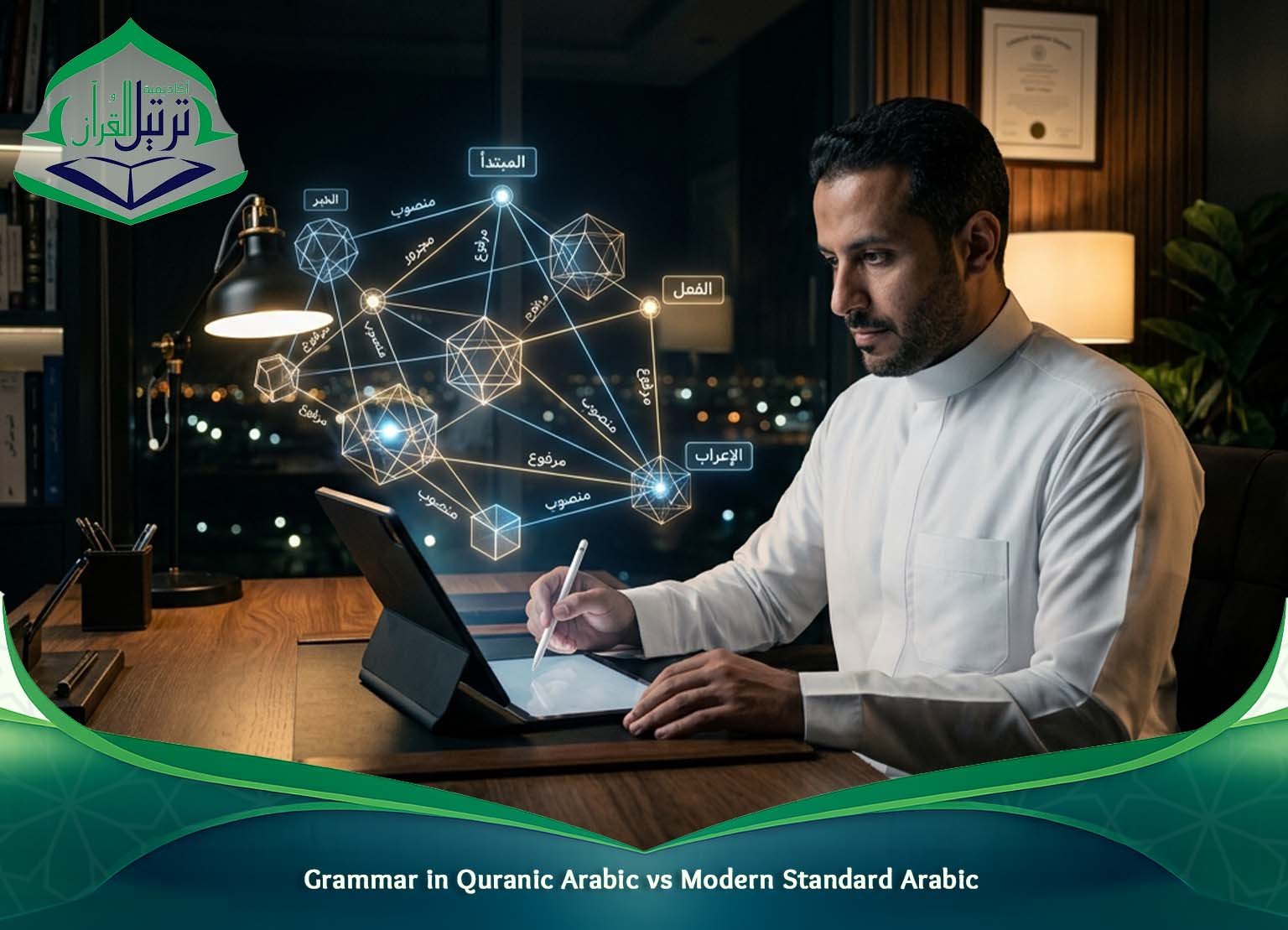
Grammar is another important part of the Quranic Arabic vs Modern Standard Arabic comparison. Both forms preserve many Arabic grammatical principles. However, the texts learners encounter and the way those structures function in context can differ.
Quranic Arabic frequently requires careful attention to grammatical endings, particles, verb forms, pronouns, and sentence relationships because even a small grammatical distinction can affect interpretation.
Modern Standard Arabic also uses formal grammar, particularly in carefully written texts. However, ordinary modern publications often omit short vowels and case endings because readers are expected to infer pronunciation and meaning from context.
For Quran learners, this makes grammar particularly important. Understanding why a word has a particular ending or form can help students identify its grammatical role within a verse. For learners who prefer a consistent routine, flexible-schedule online Quran classes can make it easier to balance grammar study with regular Quran reading and practice.
Why Grammar Matters in Quranic Arabic?
A translation may communicate the general meaning of a verse, but grammar can reveal relationships that are less obvious in translation.
For example, Arabic sentence structure can indicate:
- Who acts.
- Who receives the action.
- Whether a word is definite or indefinite.
- How words relate to one another.
- Whether a verb refers to the past, present, or another grammatical construction.
- How emphasis is created.
- How pronouns connect different parts of a sentence.
Consequently, students who want a deeper understanding of the Quran should not treat grammar as a separate academic subject. Instead, grammar can become a practical tool for understanding meaning. Students with limited weekday availability may also benefit from weekend Quran classes online to maintain consistent learning without disrupting their regular schedule.
Quranic Arabic and Modern Standard Arabic: The Role of Diacritics
Diacritics, or Arabic vowel marks, are particularly important when discussing Quranic Arabic. The Quran is traditionally presented with detailed pronunciation markings that help readers pronounce the text correctly. These marks are essential for learners because Arabic vowels can influence pronunciation, grammatical interpretation, and sometimes meaning.
Modern Standard Arabic, on the other hand, is normally written without full diacritics. Native readers generally understand the intended pronunciation from context and their familiarity with the language.
This creates an important difference for beginners. A learner may find a fully vocalized Quranic text easier to pronounce at first because the vowel information is visible. However, understanding why those endings occur requires knowledge of Arabic grammar.
For that reason, effective Quranic Arabic study should combine vocabulary, grammar, pronunciation, and reading practice rather than treating them as completely separate skills. Learners looking for budget-friendly options can also compare affordable Quran classes online that provide structured instruction.
Is Quranic Arabic Used in Everyday Conversation?
Quranic Arabic is not normally the language people use for casual daily conversations. Arabic-speaking communities generally communicate through regional dialects in ordinary situations. Egyptians, Saudis, Moroccans, Iraqis, and Levantine speakers, for example, may use noticeably different expressions and pronunciation patterns in everyday life.
Modern Standard Arabic has a different role. Although it is not normally the natural home language of most Arabic speakers, it can be used in formal situations and understood across national boundaries.
Therefore, a learner should distinguish between understanding Arabic texts and speaking naturally with Arabic speakers. These are related skills, but they require different learning approaches. For learners who prefer studying after work, school, or family responsibilities, evening Quran classes online can provide a practical way to maintain regular Quran learning.
Quranic Arabic vs Modern Standard Arabic: Which Should You Learn First?
The right answer depends primarily on your objective. If your main goal is understanding the Quran, learning Quranic Arabic should be a priority. You can focus on Quranic vocabulary, basic grammar, common roots, pronunciation, and the structures that appear frequently in the Quran.
On the other hand, if your goal involves reading modern newspapers, studying at an Arabic-speaking university, following formal broadcasts, or working with official Arabic documents, MSA is likely to be more suitable.
For everyday conversation, neither option should be treated as the only solution. A regional spoken dialect is usually more appropriate because native speakers naturally use dialects in informal interactions. For learners who want to build their studies into a manageable long-term plan, a Quran classes monthly subscription may provide a convenient structure for continuing lessons consistently.
When Should You Choose Quranic Arabic?
- Understand Quranic vocabulary.
- Improve your comprehension of Quran verses.
- Study Islamic texts.
- Learn the language of traditional religious scholarship.
- Explore Arabic roots and classical expressions.
- Develop stronger Quran reading comprehension.
When Should You Choose Modern Standard Arabic?
- Read contemporary Arabic publications.
- Follow formal news.
- Study Arabic academically.
- Work with official documents.
- Build a foundation for formal Arabic communication.
- Understand modern written Arabic across different countries.
Can You Learn Quranic Arabic and Modern Standard Arabic Together?
Yes. In fact, learning the two together can be useful when the student has enough time and a clear study plan. The key is to understand that they have different learning objectives. A student should not expect one course to automatically provide complete mastery of both.
A balanced program might begin with foundational Arabic grammar and reading skills. From there, the learner can study Quranic vocabulary and passages while gradually adding modern vocabulary and contemporary texts.
For example, a student might spend part of the week studying Quranic verses and another session reading short MSA articles. This approach creates opportunities to compare vocabulary, grammar, and sentence structures in context.
However, beginners should avoid taking on too much material simultaneously. A focused learning path is usually more effective than memorizing large amounts of unrelated vocabulary.
How Can a Tarteel Online Quran Academy Help You Learn Quranic Arabic?
Students who specifically want to understand the Quran can benefit from structured instruction rather than relying entirely on independent study.
A suitable Tarteel Online Quran Academy can organize lessons around the learner’s current reading ability, vocabulary level, grammar knowledge, and long-term goals. Instead of moving randomly between complicated texts, students can progress from basic concepts toward more advanced Quranic comprehension.
A structured program can also provide opportunities to practice reading aloud, identify vocabulary, understand grammatical patterns, and ask questions when a verse or expression is unclear.
For beginners, this guidance is particularly valuable because Arabic words can change form according to grammatical context. A qualified teacher can explain those changes and show how the same root appears in different words.
Moreover, consistent lessons can make the learning process easier to maintain. Rather than studying intensively for a few days and then stopping, learners can follow a realistic schedule and gradually build their knowledge.
Common Mistakes When Comparing Quranic Arabic and Modern Standard Arabic
Several misconceptions can make Arabic learning unnecessarily confusing. First, some learners assume that Quranic Arabic and MSA are completely separate languages. They are not. They share a substantial linguistic foundation and many grammatical features.
Second, others believe that learning MSA automatically means they will understand every Quranic expression. Although MSA knowledge can provide a useful foundation, Quranic vocabulary, style, and classical usage still require dedicated study.
Another common mistake is assuming that Quranic Arabic will allow someone to speak naturally with Arabic speakers. Reading and understanding classical religious texts is different from participating in everyday conversations.
Finally, some students focus exclusively on memorizing vocabulary without learning roots and grammar. This may produce short-term progress, but it can make deeper comprehension more difficult later.
Quranic Arabic vs MSA: Which One Is Easier to Learn?
There is no universal answer because difficulty depends on the learner’s background and objective. Quranic Arabic may feel easier for a student who is already familiar with Quran recitation and regularly encounters Arabic religious vocabulary. Familiarity with the text can provide useful context.
MSA, however, may feel more practical for someone interested in contemporary reading. Modern textbooks, news articles, educational resources, and formal media provide many opportunities for exposure.
The learning method also matters. A structured curriculum can make either form easier by presenting concepts gradually. Conversely, trying to learn advanced grammar and vocabulary without guidance can make both varieties seem unnecessarily difficult. Ultimately, the easiest form is often the one that matches the learner’s immediate purpose.
Can Modern Standard Arabic Help You Understand the Quran?
Yes, MSA can provide a valuable foundation, but it should not be considered a complete substitute for Quranic Arabic study.
Students with a strong MSA background may already understand many Arabic roots, grammatical structures, pronouns, verb patterns, and common vocabulary. This knowledge can make Quranic study easier.
Nevertheless, the Quran contains classical vocabulary, rhetorical structures, and expressions that require additional attention. Therefore, learners should expect to encounter unfamiliar material even after developing good MSA skills.
A useful strategy is to use MSA as a foundation and then specialize in Quranic Arabic when the primary goal is Quran comprehension.
Can Quranic Arabic Help You Learn Modern Standard Arabic?
It can. Quranic Arabic introduces learners to important Arabic foundations, including roots, verb forms, sentence structures, grammatical concepts, and a large body of vocabulary.
However, students moving from Quranic Arabic into MSA will need to expand their vocabulary considerably. Modern topics require terminology that does not commonly appear in Quranic texts.
The transition becomes easier when learners begin reading contemporary material gradually. Short articles, children’s educational texts, simple news reports, and formal conversations can introduce modern vocabulary without overwhelming the student.
In this way, the two varieties can complement one another rather than compete.
How Quranic Arabic Differs From Contemporary Arabic?
A beginner does not need to decide between two completely unrelated languages. Instead, it is better to establish a strong Arabic foundation and then specialize according to personal goals. A practical path can look like this:
- Learn the Arabic alphabet and pronunciation.
- Build basic reading skills.
- Study essential grammar and sentence patterns.
- Learn common Arabic roots and vocabulary.
- Choose Quranic or modern texts according to your goal.
- Practice reading consistently.
- Work with a qualified teacher when possible.
- Gradually increase the difficulty of the material.
This approach prevents learners from trying to master everything at once. More importantly, it creates a connection between foundational Arabic skills and the specific type of Arabic the student actually wants to understand.
Frequently Asked Questions: Quranic Arabic vs Modern Standard Arabic
About the differences between Quranic Arabic and contemporary Arabic, including grammar, vocabulary, pronunciation, and everyday usage.
1. Can understanding Quranic Arabic improve Quran memorization?
Yes. Understanding the meaning of the words can create stronger mental associations and may help learners remember verses more effectively. However, memorization still requires consistent revision and accurate recitation practice.
2. Do I need to know Arabic grammar before studying Quranic Arabic?
No. Beginners can start with basic Quranic vocabulary and gradually introduce grammar. Learning both together often makes grammatical concepts easier to understand because students can see them in actual Quranic passages.
3. How can I tell whether an Arabic course focuses on Quranic Arabic or MSA?
Check the curriculum and lesson objectives. A Quran-focused course should include Quranic vocabulary, grammar, reading, and text comprehension, while an MSA course usually emphasizes contemporary reading, writing, formal vocabulary, and modern communication.
4. Is learning Quranic Arabic useful for someone who already speaks an Arabic dialect?
Absolutely. Dialect speakers may already have pronunciation and vocabulary advantages. However, studying Quranic Arabic can introduce classical words, grammatical structures, and meanings that may not appear regularly in their everyday dialect.
In conclusion, Quranic Arabic vs Modern Standard Arabic is not simply a question of which form is better. The more useful question is which form matches your purpose.
Quranic Arabic is especially relevant to learners who want to understand the Quran, explore Islamic texts, and develop a deeper appreciation of Arabic religious language. MSA, meanwhile, is more appropriate for contemporary formal reading, education, media, academic work, and professional contexts.
At the same time, the two varieties share an important linguistic foundation. Learning one can therefore support the study of the other, particularly when students develop a solid understanding of Arabic grammar, vocabulary, and word roots.
If your primary objective is understanding the Quran, a structured Quranic Arabic program can give you a more focused path. An experienced Tarteel Online Quran Academy can also help you progress step by step instead of trying to learn classical vocabulary and grammar without a clear direction.