
Quran Memorization Tips for Busy Adults can make the journey of memorizing the Quran more manageable, even when work, family, and daily responsibilities leave little free time. Many adults want to strengthen their relationship with the Quran but struggle to find a routine that fits naturally into their lives. The challenge is not always a lack of motivation; often, it is simply the absence of a practical plan.
For a working parent, student, professional, or anyone managing several responsibilities, memorization needs to be realistic. You may not have an uninterrupted hour every morning, and you may not be able to follow the same schedule every day. Therefore, the goal should not be to create a perfect routine. Instead, build a flexible system that allows you to make steady progress even on busy days.
The good news is that memorizing the Quran does not have to compete with every other responsibility in your life. With manageable portions, regular revision, focused practice, and appropriate guidance, you can make Hifz part of your daily routine. Tarteel Online Quran Academy can also provide structured learning and teacher support for adults who need guidance while balancing memorization with their existing commitments.
This guide explains how to organize your time, choose realistic memorization goals, strengthen your recall, avoid common mistakes, and maintain your progress over the long term.
Why Quran Memorization Feels Difficult for Busy Adults?

For many adults, the biggest obstacle is not memorization itself. Rather, it is finding enough consistency to practice regularly. Work schedules change, family responsibilities appear unexpectedly, and personal energy can vary considerably from one day to another.
Unlike children who may have a dedicated school or Hifz schedule, adults usually have to create their own learning structure. Consequently, Quran memorization can become something they plan to do “when they have time.” Unfortunately, that free time may never appear.
Another challenge is mental fatigue. After several hours of work, household responsibilities, or studying, concentrating on new verses can feel much harder. That does not mean an adult cannot memorize effectively. It simply means the memorization strategy should account for energy levels as well as available time.
Adults can also become discouraged by comparing their progress with other students. Someone else may memorize several pages every week because they have a completely different schedule. Therefore, measuring your progress against another person’s pace is rarely helpful.
Instead, focus on creating a routine that works for your circumstances. Ten focused minutes every day can become more valuable than an ambitious schedule that you follow for only a few days.
Start Your Islamic Learning Journey Today
Join Tarteel Online Quran Academy today and begin a meaningful Islamic learning experience designed for children, adults, and beginners worldwide. Our qualified Quran teachers provide interactive lessons, flexible schedules, and personalized guidance to help students improve their Quran recitation, understand Islamic teachings, and strengthen their connection with Allah.
Through structured online classes, learners can study comfortably from home while receiving professional support at every step. Start your journey today and build a strong spiritual foundation with trusted Quran education.

Quran Memorization Tips for Busy Adults: Start With a Realistic Goal
Before choosing a memorization method, decide exactly what you want to accomplish. A vague goal such as “I want to memorize more Quran” does not tell you what to study, how often to practice, or how to measure progress.
Your goal might be to:
- Memorize several short surahs.
- Complete Juz Amma gradually.
- Strengthen surahs already used in salah.
- Memorize a specific portion within a certain period.
- Work toward complete Quran memorization over several years.
There is no requirement to begin with an enormous target. In fact, a smaller goal can make it easier to establish the habit.
For example, an adult who has only fifteen minutes available each day might begin with a small portion and gradually increase it. Once that routine becomes comfortable, additional practice can be introduced.
It is also useful to separate your long-term goal from your daily target. Your long-term goal gives you direction, while your daily target tells you what to do today. This distinction prevents the size of the final goal from becoming overwhelming.
With support from Tarteel Online Quran Academy, adults can also discuss their current level, available time, and memorization objectives with a teacher before developing a suitable learning routine.
Build a Quran Memorization Routine for Busy Adults
One of the most practical Quran Memorization Tips for Busy Adults is to stop searching for completely empty time. Instead, connect memorization to a part of your existing routine.
For instance, you could study:
- After Fajr, before beginning work.
- During a quiet lunch break.
- After returning home and completing your immediate responsibilities.
- Before going to bed.
- During another consistent part of your daily schedule.
The exact time is less important than its reliability. A routine becomes easier to maintain when you do not have to decide every day when you will study.
If your working hours change regularly, use an activity as an anchor instead of a specific clock time. You might decide to review after a particular prayer or after completing a regular household task.
Additionally, separate memorization from revision. A short session could contain a few minutes of new material followed by a longer period of reviewing what you already know.
This approach is especially useful for adults because it allows progress without demanding large blocks of uninterrupted time.
How Much Time Should Busy Adults Spend on Quran Memorization?
There is no universal number of minutes that every adult must follow. The appropriate amount depends on your reading ability, schedule, memorization goal, and ability to maintain concentration.
For some learners, fifteen focused minutes may be realistic. Others may have thirty minutes or more available. The important point is to choose a duration that you can sustain.
A useful daily structure might include:
- A short warm-up by reciting previously memorized verses.
- Focused practice with the new portion.
- Recitation from memory without looking.
- A final review of older material.
If you only have ten minutes, use those ten minutes deliberately. Do not assume that a short session has no value.
On days when you have additional free time, you can extend the session. However, avoid turning occasional long sessions into your normal expectation if your lifestyle does not support them.
Consistency matters because memorization develops through repeated contact with the material. Therefore, a sustainable schedule is usually easier to maintain than an intense routine that creates exhaustion.
Quran Memorization Tips for Busy Adults: Choose the Right Starting Point
Beginners often make the mistake of selecting a large portion because they want to see rapid progress. However, starting with material that feels manageable can create early confidence and make the habit easier to maintain.
Short surahs can be a practical starting point for many adults. They provide relatively quick milestones and can also be useful in daily prayer.
Before choosing your first portion, consider your current reading ability. If reading Arabic still requires significant effort, strengthening basic reading and pronunciation may be necessary before focusing heavily on memorization.
You should also consider familiarity. A surah you already hear or recite regularly may be easier to memorize than completely unfamiliar material.
Once you have established a strong foundation, gradually increase the amount of new material. There is no need to rush into longer passages simply because another learner is doing so.
The objective is not to memorize as much as possible in the shortest period. The objective is to memorize accurately and retain what you learn.
How Understanding the Quran Supports Memorization?
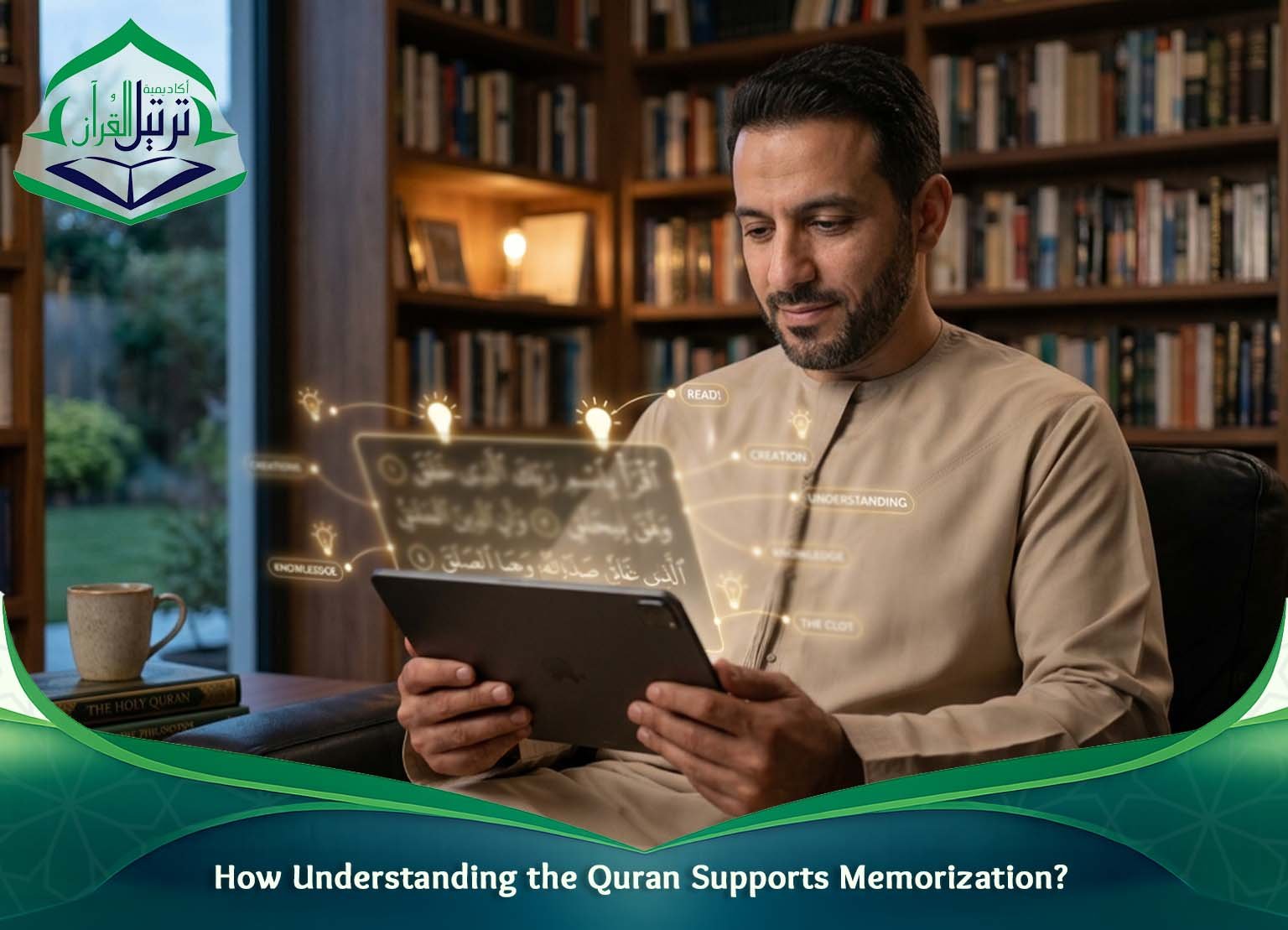
Understanding the general meaning of a passage can give your memorization a stronger structure. When you know how verses relate to one another, the material is no longer just a sequence of sounds.
Before memorizing a new passage, spend a few moments becoming familiar with its meaning. Notice repeated themes, changes in subject, and connections between verses.
This does not mean that you need to become an expert in Quranic interpretation before memorizing. Instead, basic understanding can help you create mental associations that support recall.
For example, if a passage discusses a particular theme and then moves to another subject, recognizing that transition can provide a mental cue when you are reciting.
Furthermore, understanding meaning can make your practice more engaging. Rather than mechanically repeating unfamiliar words, you become more aware of what you are reciting.
A teacher can help ensure that your understanding comes from an appropriate and reliable explanation. Tarteel Online Quran Academy can provide structured guidance for learners who want to combine memorization with proper Quran learning.
Use Repetition to Strengthen Quran Memorization
Repetition is essential for memorization, but repeating the same passage without a clear method can become tiring. Instead, vary how you interact with the material.
For example, you can:
- Read the passage while looking at the mushaf.
- Recite it while looking away.
- Listen to an accurate recitation.
- Recite the passage from memory.
- Combine the new portion with the previous portion.
- Use the memorized verses during salah when appropriate.
The purpose of repetition is not simply to increase the number of times you read a verse. It is to strengthen your ability to retrieve it without visual assistance.
After learning a new passage, test yourself. Close the mushaf and recite. When you make an error, return to the relevant section, correct it, and then try again.
Over time, retrieval becomes easier. However, even material that feels completely memorized needs continued revision because forgetting is a normal part of learning.
Quran Memorization Tips for Busy Adults: Prioritize Revision
One of the most important Quran Memorization Tips for Busy Adults is to protect revision time just as carefully as new memorization time.
Many learners enjoy adding new verses because they can see their memorized portion growing. However, if older material is neglected, previously learned verses can gradually become weak.
A balanced session can therefore include both old and new material.
For example:
- Review yesterday’s portion.
- Revise several older passages.
- Memorize a small new section.
- Connect the new section to what came immediately before it.
- Test the entire portion without looking.
You can also organize revision on different levels. Daily revision can focus on recent material, while weekly sessions can cover larger portions. Periodic reviews can then revisit older surahs.
The exact schedule can be adjusted according to your retention. If a particular surah is becoming difficult, temporarily reduce new material and give more attention to revision.
This flexible approach protects your existing memorization instead of constantly moving forward while leaving older portions behind.
Create a Weekly Quran Memorization Schedule for Adults
A weekly plan can make your routine much easier to follow because it removes uncertainty about what you should study each day.
A simple structure might look like this:
| Day | Main Focus |
|---|---|
| Monday | New portion + recent revision |
| Tuesday | New portion + previous portion |
| Wednesday | New portion + review |
| Thursday | New portion + earlier material |
| Friday | Lighter memorization and broader revision |
| Saturday | New portion + weekly review |
| Sunday | Full weekly revision |
This is only an example. Your schedule should reflect your responsibilities rather than forcing your life to fit a template.
If Friday is particularly busy for you, for example, make it a revision day rather than a new-memorization day. Likewise, if weekends provide more free time, you can use them for longer review sessions.
The important thing is to know what you are expected to accomplish before the session begins.
Improve Quran Memorization by Listening Carefully
Listening can complement active memorization, particularly when you are trying to improve pronunciation and become familiar with the rhythm of a passage. For adults who are new to structured online learning, understanding the Benefits of learning Quran Online can help them see how digital lessons may fit into a demanding schedule.
Choose a reliable recitation and listen attentively rather than treating the audio as background noise. Follow along with the mushaf when possible and notice pronunciation, pauses, and verse endings.
You can also listen to a portion you have already memorized while performing a simple task that does not require concentration. However, passive listening should not replace active recitation. The real test is whether you can recite the passage accurately from memory.
For this reason, use listening as preparation and reinforcement, while keeping actual recitation at the center of your memorization practice.
Protect Your Memorization From Common Distractions
A busy adult’s environment may make concentration difficult. Phones, notifications, television, family conversations, and work messages can interrupt even a short session. Therefore, create a simple memorization environment whenever possible.
Before starting:
- Silence unnecessary notifications.
- Put your phone away unless you need it for learning.
- Keep your mushaf or learning material ready.
- Choose one comfortable place.
- Tell family members when you need a short period of uninterrupted concentration.
You do not need a completely silent house. That standard may be unrealistic for parents and people living in busy households.
Instead, aim for fewer interruptions. Even a focused fifteen-minute session can be productive when distractions are controlled.
If complete quiet is impossible, use headphones for audio review or select a naturally calmer part of the day.
Quran Memorization Tips for Busy Adults Who Have Missed Days
Missing a memorization session does not mean your entire plan has failed. Adults have responsibilities that sometimes cannot be postponed.
A common problem occurs when one missed day creates guilt, and that guilt causes another missed day. Eventually, the learner stops altogether.
Instead, treat a missed session as a temporary interruption.
When you return, do not immediately try to compensate by doubling your workload. First, review the material you already know. Then continue with the next realistic step.
If you are still building your foundation, understanding the Difference Between Hifz and Qaida can help you recognize when to focus on reading skills and when to emphasize memorization.
If you miss several days, you may need a short period of revision before adding new material. That is not lost progress. It is a way of restoring confidence and accuracy.
Your long-term routine should have enough flexibility to survive difficult weeks. A memorization system that works only when life is perfectly calm will eventually break.
Avoid Comparing Your Progress With Other Adults

Every adult learner has a different starting point. Some people read Arabic fluently, while others need additional practice. Some have children and demanding jobs, while others have fewer responsibilities.
Therefore, comparing the number of pages you memorize with someone else’s daily target can create unnecessary pressure.
Instead, compare your current ability with your previous performance.
Ask yourself:
- Am I more consistent than I was last month?
- Can I recite previously learned surahs with fewer mistakes?
- Have I improved my pronunciation?
- Am I maintaining my revision routine?
- Can I handle a slightly larger portion without losing accuracy?
These questions provide a more useful picture of progress.
For parents who are also supporting younger learners, knowing the Signs Your Child is Ready to Start Quran Lessons can help them make age-appropriate decisions without comparing a child’s learning pace with an adult’s.
Slow progress is still progress when it is stable. A learner who consistently memorizes a small amount may eventually build a substantial amount of Quranic memorization without overwhelming their daily life.
Quran Memorization Tips for Busy Adults: Learn With a Teacher
Self-study can be useful, particularly for revision and listening. Nevertheless, a qualified teacher can identify problems that you may not notice yourself.
Pronunciation is one important reason. When a learner repeatedly makes the same mistake, it can become a habit. A teacher can correct the issue before it becomes deeply established.
A teacher can also evaluate your memorization rather than simply asking whether you feel that you know a passage. Reciting to another person creates accountability and reveals weak transitions or forgotten words.
Additionally, guided learning can help you decide when to introduce new material and when to focus primarily on revision.
For busy adults, online learning can remove travel time and make scheduled lessons easier to fit around work and family commitments. Tarteel Online Quran Academy can be incorporated into a structured memorization routine for learners who prefer teacher-led online Quran education.
Use Salah to Reinforce What You Memorize
One practical way to strengthen memorized passages is to use suitable portions during salah.
When you recite a passage during prayer, you are required to retrieve it without looking at the mushaf. That creates an additional opportunity to strengthen recall.
However, do not introduce a newly memorized passage into prayer before you are sufficiently comfortable with it. If you are still making frequent mistakes, continue practicing until the portion becomes more stable.
You can also alternate between recently memorized material and older surahs. This helps prevent your daily memorization from becoming dependent only on the newest material.
Over time, prayer can become a natural opportunity to reinforce what you have learned without requiring an additional study session.
Track Your Quran Memorization Progress
A simple tracking system can make your progress visible. You do not need a complicated application. A notebook, calendar, or digital document can be enough.
Record details such as:
- Date of the session.
- Passage studied.
- New material memorized.
- Material revised.
- Mistakes that need attention.
- Teacher feedback.
- Next review date.
Tracking is especially helpful for adults because busy schedules can make progress feel invisible. You may feel that you are not accomplishing much when, in reality, you have memorized several surahs over a few months.
Your record also helps you identify patterns. Perhaps you memorize better in the morning, or perhaps evening sessions work better. Maybe certain days are consistently difficult. Once you notice these patterns, adjust your schedule accordingly.
Parents can also apply similar tracking principles when helping children stay engaged. Simple routines and positive reinforcement can make learning more consistent, especially when using strategies explained in How to Keep Kids Motivated to Learn Quran Online.
When reviewing your progress, pay attention not only to how much you memorize but also to the quality of your recitation. Regularly checking pronunciation and avoiding recurring errors is important, particularly when working on Tajweed. Reviewing resources about Common Mistakes When Learning Tajweed can help learners recognize areas that may require additional practice.
Common Quran Memorization Mistakes to Avoid
Even motivated learners can make mistakes that slow their progress. Fortunately, most of them can be corrected.
- Memorizing Too Much at Once
- Large daily targets may look impressive, but they can become difficult to maintain. If the amount is too large, accuracy and revision may suffer.
- Ignoring Older Material
- New memorization should not completely replace revision. Without regular review, older portions can become weaker.
- Practicing Without Checking Pronunciation
- Reading silently can hide pronunciation problems. Reciting aloud and receiving correction helps maintain accuracy.
- Waiting for Perfect Conditions
- You may never have a completely free schedule. Waiting for the ideal moment can delay your progress indefinitely.
- Changing Methods Constantly
- Trying a new technique every few days can prevent you from establishing a stable routine. Give a practical method enough time to become a habit before deciding whether it works.
- Treating a Missed Day as Failure
- One missed session does not erase your previous work. Return to the routine and continue.
How Can Tarteel Online Quran Academy Support Adult Memorization?
Tarteel Online Quran Academy can support adults who want structured Quran memorization while managing work, family, and other responsibilities. Online lessons can reduce the time and effort associated with traveling to a physical learning center, making it easier to maintain a regular schedule.
For a busy learner, structured guidance can be particularly useful. Instead of deciding alone what to memorize next, how much to study, and when to revise, a teacher can help organize the learning process around the student’s current level.
Tarteel Online Quran Academy can also provide a learning environment where adults can recite their memorized portions and receive feedback. This is valuable because memorization involves more than recognizing words on a page. The learner must eventually retrieve and recite them accurately without visual assistance.
Another benefit is accountability. When a learner has a scheduled lesson, memorization becomes a concrete commitment rather than an activity that can always be postponed.
At the same time, adults should choose a schedule they can genuinely maintain. A learning program should complement daily responsibilities rather than create an unrealistic burden.
For learners who prefer personalized guidance, Tarteel Online Quran Academy can be part of a long-term Hifz routine built around achievable goals, regular revision, and gradual improvement.
A Practical Daily Plan for Busy Adults
If you are unsure how to begin, keep your first routine simple. A short daily session could follow this pattern:
- First 3 minutes:
Recite a familiar portion to warm up your memory and pronunciation. - Next 7 minutes:
Work on a small new section. Read it carefully, listen if necessary, and repeat it until you can recite it with limited assistance. - Next 5 minutes:
Close the mushaf and test yourself. - Final few minutes:
Connect the new material to the previous portion and identify anything that needs additional review.
The total time can be adjusted to your circumstances. The important point is that every part of the session has a purpose.
As your routine becomes stronger, you can increase the amount of new material or extend your revision period. However, do not increase both dramatically at the same time.
Build Long-Term Consistency

Successful memorization is not only about what happens during today’s session. It is about creating a routine that you can continue for months and years.
That requires realistic expectations.
Some weeks will be productive. Other weeks may be affected by travel, work deadlines, family commitments, or fatigue. Instead of expecting perfect consistency, build a routine that allows you to return after interruptions. You can also establish minimum and ideal targets.
For example, your minimum target might be ten minutes of revision on an exceptionally busy day. Your ideal target might be thirty minutes when your schedule allows.This system prevents difficult days from becoming complete breaks in your habit.
Furthermore, celebrate meaningful milestones. Completing a surah, maintaining a month of consistent revision, or improving a recurring pronunciation issue are all legitimate signs of progress.
The journey becomes easier to sustain when you recognize improvement instead of focusing only on the final destination.
Frequently Asked Questions
Here are answers to common questions about Quran memorization for busy adults, including time management, revision, and maintaining long-term progress.
1. Can Quran memorization be maintained during travel or major changes in routine?
Yes. A flexible revision system can be adapted to travel or temporary schedule changes. During such periods, maintaining a smaller revision target can help preserve existing memorization until your normal routine returns.
2. Should an adult change their memorization routine after reaching a certain level?
The routine may need to evolve as the memorized portion grows. Beginners often need more time for new material, while advanced learners may need increasingly organized revision to maintain larger portions.
3. What should you do when two similar verses keep getting confused?
Identify the exact words or transitions that confuse, then practice those sections separately. Comparing the surrounding context can also help create clearer mental distinctions between similar passages.
4. How can an adult maintain motivation during a long Hifz journey?
Connect your routine to meaningful personal goals and track smaller milestones along the way. Seeing gradual improvement can make a long-term memorization project feel more manageable and concrete.
In conclusion, Quran Memorization Tips for Busy Adults are most effective when they focus on consistency rather than unrealistic speed. Adults with demanding schedules can still make meaningful progress by setting clear goals, choosing manageable portions, protecting regular study time, and giving revision the attention it deserves.
A successful routine does not require several free hours every day. Instead, it depends on using available time intentionally and building a system that can survive busy periods. Short sessions, structured revision, active recall, careful listening, and teacher feedback can all contribute to stronger memorization.
Most importantly, do not allow an imperfect schedule to convince you that memorization is impossible. Your pace may be slower than someone else’s, but your progress can still be valuable. With patience, regular practice, and appropriate guidance, Quran memorization can become a sustainable part of adult life.
For learners who want structured online support, Tarteel Online Quran Academy can provide teacher-led guidance that fits around different schedules and learning needs. The goal is not simply to memorize more words. It is to develop accurate, lasting Quran memorization through a routine you can continue.