
The difference between Hifz and Qaida is one of the most important questions for beginners who want to build a strong relationship with the Quran. Although Hifz and Qaida are often mentioned together, they serve different purposes in Quran education. Qaida introduces learners to the foundations of Arabic and Quran reading, while Hifz focuses on memorizing Quranic verses and retaining them accurately.
For many parents, choosing the correct starting point can be confusing. A child may be eager to memorize short surahs but still struggle with Arabic letters or pronunciation. Similarly, an adult may already read the Quran and wonder whether another foundation course is necessary before beginning memorization.
Understanding the Difference Between Hifz and Qaida makes this decision much easier. Instead of following the same path for every learner, students can begin with the stage that matches their current abilities. With appropriate instruction, they can gradually develop reading accuracy, Tajweed, fluency, memorization, and revision skills.
At Tarteel Online Quran Academy, learners can receive guidance based on their individual level and Quran learning goals. This structured approach helps students progress naturally without rushing through important foundational skills.
What Is the Difference Between Hifz and Qaida?
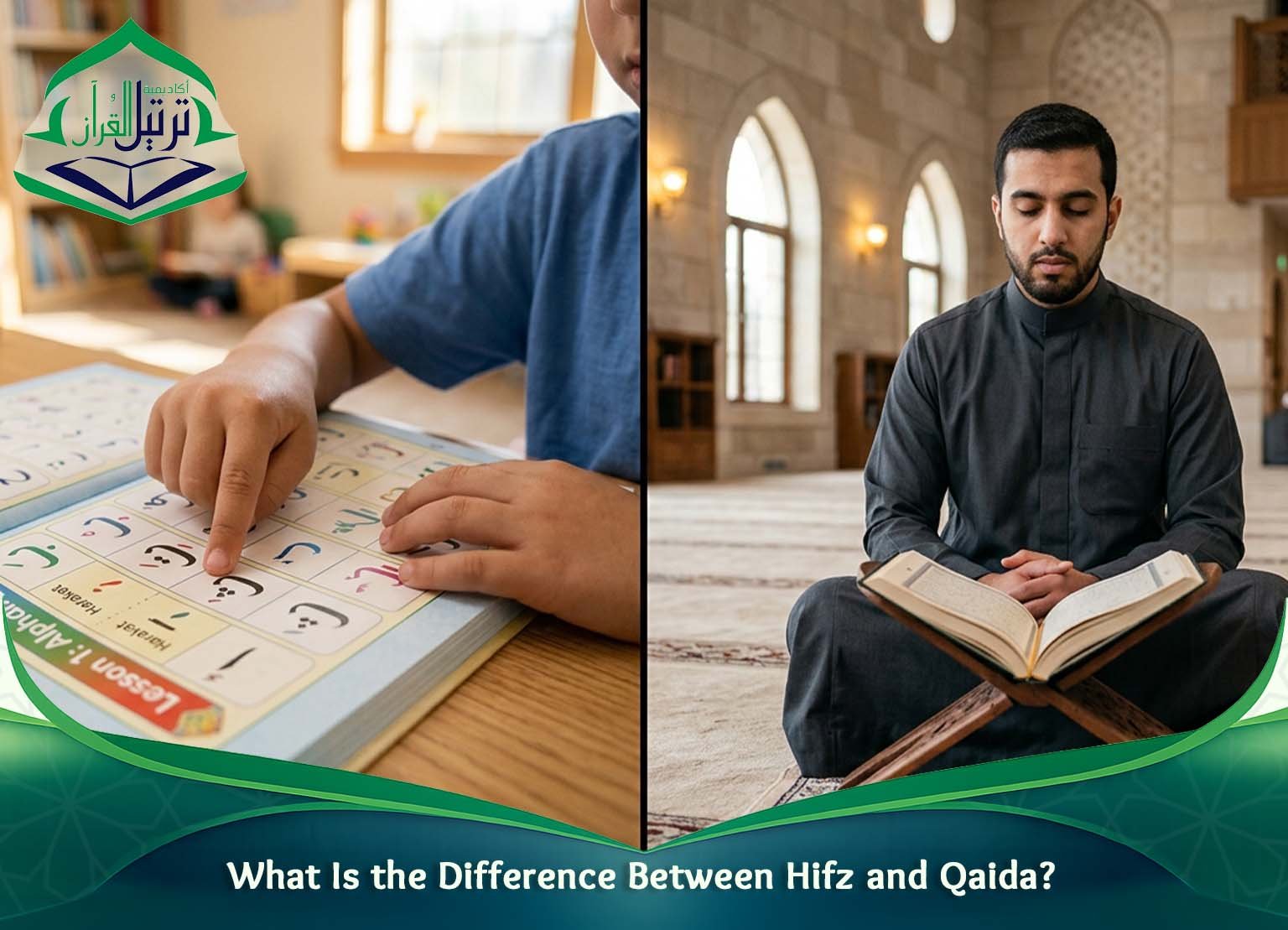
The simplest Difference Between Hifz and Qaida is their primary objective. Qaida is designed to establish basic Quran reading skills, whereas Hifz is centered on memorizing Quranic passages and reciting them from memory.
During Qaida lessons, students learn how Arabic letters look and sound. They also practice vowel signs, connected letters, pronunciation patterns, and basic reading structures. As their skills improve, learners become more comfortable reading words and short Quranic phrases.
Hifz requires a different type of learning. The student reads and listens to a passage repeatedly until it can be recalled without looking at the Mushaf. Accuracy remains essential because memorizing an incorrectly pronounced verse can make later correction more difficult.
The two stages therefore complement one another:
- Qaida builds the foundation for Quran reading.
- Quran reading develops fluency.
- Tajweed improves pronunciation and recitation.
- Hifz develops memorization and recall.
- Revision protects previously memorized material.
Consequently, beginners should not think of Qaida and Hifz as competing choices. Each stage serves a particular purpose within the wider Quran learning journey.
Start Your Islamic Learning Journey Today
Join Tarteel Online Quran Academy today and begin a meaningful Islamic learning experience designed for children, adults, and beginners worldwide. Our qualified Quran teachers provide interactive lessons, flexible schedules, and personalized guidance to help students improve their Quran recitation, understand Islamic teachings, and strengthen their connection with Allah.
Through structured online classes, learners can study comfortably from home while receiving professional support at every step. Start your journey today and build a strong spiritual foundation with trusted Quran education.

What Is Qaida in Quran Education?
Qaida is a foundational learning method used to introduce beginners to the skills required for reading the Quran. Rather than starting with complete verses, students first work with smaller elements of the Arabic writing and sound system.
At the beginning, learners may practice recognizing individual letters. Once those letters become familiar, lessons can progress toward vowel combinations and connected forms. Eventually, students work with words and short expressions that resemble the patterns found in Quranic text.
This gradual progression can make Quran reading less intimidating. A beginner does not have to master every rule at once. Instead, each lesson adds another piece to the student’s reading ability.
A well-structured Qaida program may help students develop:
- Arabic letter recognition.
- Understanding of short vowels.
- Recognition of long vowels.
- Correct letter connections.
- Basic pronunciation skills.
- Awareness of common Quranic reading patterns.
- Greater confidence when reading aloud.
Furthermore, repeated correction during this stage can prevent pronunciation mistakes from becoming deeply established habits.
Why Is Qaida Important Before Hifz?
The connection between Qaida and memorization explains another important aspect of the Difference Between Hifz and Qaida. Hifz depends heavily on accurate reading and pronunciation, so weak foundational skills can create unnecessary obstacles.
Imagine a learner memorizing a verse while repeatedly producing one of its letters incorrectly. Repetition may cause the incorrect sound to become associated with the verse. Once the passage is deeply memorized, correcting that habit may require additional effort.
Qaida provides an opportunity to address such problems before the student begins intensive memorization. Teachers can listen closely, correct pronunciation, and ask the learner to repeat difficult combinations until they become more natural.
A strong foundation can therefore help with:
- Accurate pronunciation.
- Better reading confidence.
- Faster recognition of Quranic words.
- Improved listening and repetition.
- Easier transition into memorization.
- Reduced correction later.
For this reason, foundational Quran reading should not be considered a delay. It is often an investment that supports more accurate Hifz.
What Is Hifz in Quran Learning?
Hifz means memorizing the Quran. A student following a Hifz program learns Quranic passages until they can recite them correctly without depending on the written page.
Unlike basic reading practice, memorization requires reliable recall. The learner must remember the exact sequence of words and maintain the correct order of verses. Similar passages can also present challenges because a small difference between two verses may be easy to overlook.
A typical Hifz process involves several activities:
- Listening to a qualified reciter.
- Reading the assigned passage carefully.
- Repeating short sections.
- Connecting one section to the next.
- Reciting the new lesson from memory.
- Receiving teacher correction.
- Revising older memorized portions.
Moreover, successful Hifz depends on consistency. Memorizing new verses without reviewing previous material can lead to weak retention.
The learner should therefore treat revision as part of memorization itself rather than as an optional activity.
Difference Between Hifz and Qaida in Their Main Goals
A clear Difference Between Hifz and Qaida appears when their learning goals are compared. Qaida aims to teach the learner how to decode and pronounce Quranic text. Hifz aims to help the learner retain that text in memory.
Goals of Qaida
A beginner usually works toward the ability to:
- Recognize Arabic letters quickly.
- Understand basic vowel marks.
- Connect letters correctly.
- Read simple words.
- Improve pronunciation.
- Develop confidence in reading.
Goals of Hifz
A memorization student generally works toward the ability to:
- Recall Quranic verses without looking.
- Recite memorized passages accurately.
- Maintain previously learned portions.
- Recognize mistakes during revision.
- Build long-term retention.
- Develop a sustainable memorization routine.
Although repetition appears in both stages, its purpose differs. Qaida repetition develops automatic recognition and pronunciation. Hifz repetition strengthens memory and recall.
That distinction is important when planning a student’s Quran education.
Difference Between Hifz and Qaida: Required Skills
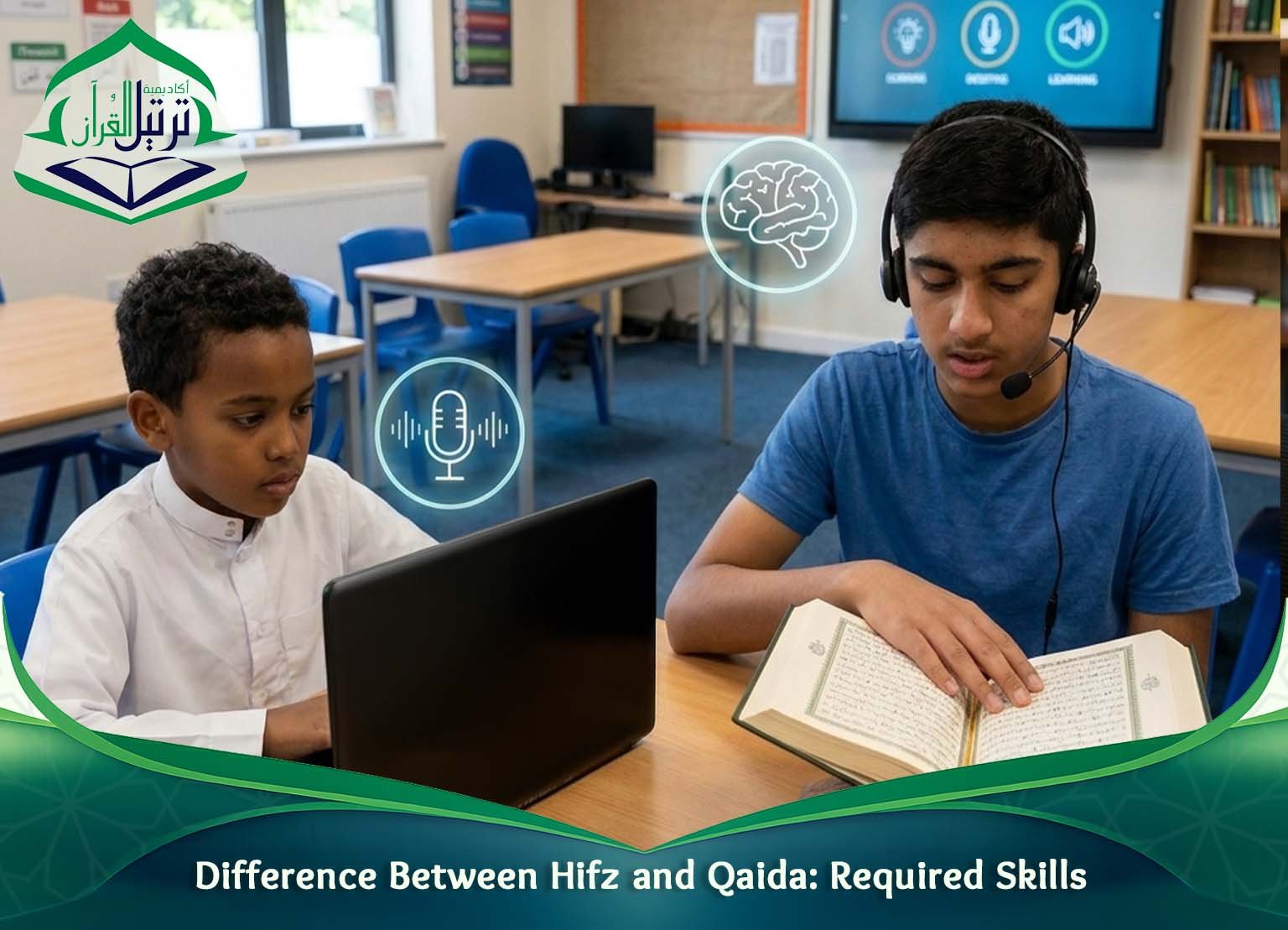
The Difference Between Hifz and Qaida becomes even clearer when we examine the skills each stage demands.
Qaida requires strong recognition skills. Learners need to identify letters, understand their combinations, and produce the correct sounds. Frequent repetition gradually makes these actions more automatic.
Hifz places greater emphasis on memory retrieval. Students must recall verses without relying on visual prompts. They also need to maintain concentration and recognize differences between passages that may sound similar.
For Qaida learners, useful skills include:
- Visual recognition.
- Pronunciation.
- Reading accuracy.
- Listening.
- Basic concentration.
For Hifz learners, the required skills expand to include:
- Memorization.
- Recall.
- Concentration.
- Repetition.
- Revision.
- Error detection.
- Long-term consistency.
As a result, a learner with strong foundational reading skills can often devote more attention to memorization instead of struggling to decode every word.
Can You Start Hifz Without Qaida?
Many learners ask whether completing Qaida is an absolute requirement before beginning Hifz. The answer depends on the student’s current reading ability.
Someone who already reads the Quran accurately may not need to spend months studying beginner material again. A teacher can assess the learner’s pronunciation, fluency, and basic Tajweed before deciding whether additional foundation work is needed.
A complete beginner is in a different situation. If the learner cannot recognize Arabic letters or read connected words, intensive memorization may become unnecessarily difficult.
Therefore, the key question is not whether every student must finish the same Qaida book. Instead, ask whether the learner already possesses the skills that foundational instruction is intended to develop.
An assessment can provide a clearer answer. Once weaknesses are identified, the teacher can create a learning plan that addresses them without wasting time on skills the student has already mastered.
Difference Between Hifz and Qaida for Children
Parents often wonder where their children should begin. The Difference Between Hifz and Qaida is particularly relevant when a child shows enthusiasm for memorizing Quran but has limited Arabic reading experience.
Children do not all develop their Quran skills at the same pace. One learner may recognize letters quickly but struggle with pronunciation. Another child may read comfortably but have difficulty remembering longer passages.
Because of these differences, readiness should be evaluated individually.
Signs that a child may be ready to progress toward Hifz include:
- Recognizing Arabic letters confidently.
- Reading basic connected words.
- Understanding common vowel marks.
- Following short Quranic passages.
- Accepting pronunciation correction.
- Concentrating during a lesson.
- Retaining short passages after practice.
A supportive learning environment also matters. Children are more likely to remain motivated when teachers and parents celebrate progress instead of focusing only on mistakes.
How does Qaida Build a Foundation for Hifz?
Qaida can be viewed as the bridge between learning Arabic reading patterns and becoming an independent Quran reader. Once those basic skills are established, memorization becomes easier to organize.
A student who reads confidently can follow the Mushaf while listening to a teacher. The learner can also notice unfamiliar words, compare similar passages, and identify pronunciation problems more easily.
This connection between reading and memory is valuable because Hifz is not simply an exercise in hearing sounds. Students benefit from seeing the written passage while listening and reciting.
A strong foundation can support:
- Independent Quran reading.
- More accurate pronunciation.
- Better visual memory.
- Stronger listening habits.
- Easier verse recognition.
- More confident memorization.
At Tarteel Online Quran Academy, learners can work through these stages with structured guidance. The learning path can be adjusted according to the student’s current level rather than forcing every learner into the same starting point.
Difference Between Hifz and Qaida in Daily Practice
Daily study routines reveal a practical Difference Between Hifz and Qaida. Both require repetition, yet students repeat different types of material for different reasons.
A Qaida student may spend a session practicing letters, vowel combinations, connected forms, or pronunciation exercises. The objective is to make basic reading patterns familiar and accurate.
By comparison, a Hifz student normally divides available time between new memorization and revision. Previous lessons need regular attention because memorized material can weaken when it is neglected.
A Qaida Practice Session May Include
- Letter recognition.
- Vowel exercises.
- Connected-letter practice.
- Pronunciation correction.
- Short reading drills.
A Hifz Practice Session May Include
- New verse memorization.
- Repetition of the current lesson.
- Recent lesson revision.
- Older memorization review.
- Recitation to a teacher.
Consistency matters in both cases. A manageable daily routine is usually easier to maintain than occasional long study sessions.
Difference Between Hifz and Qaida in Teaching Methods
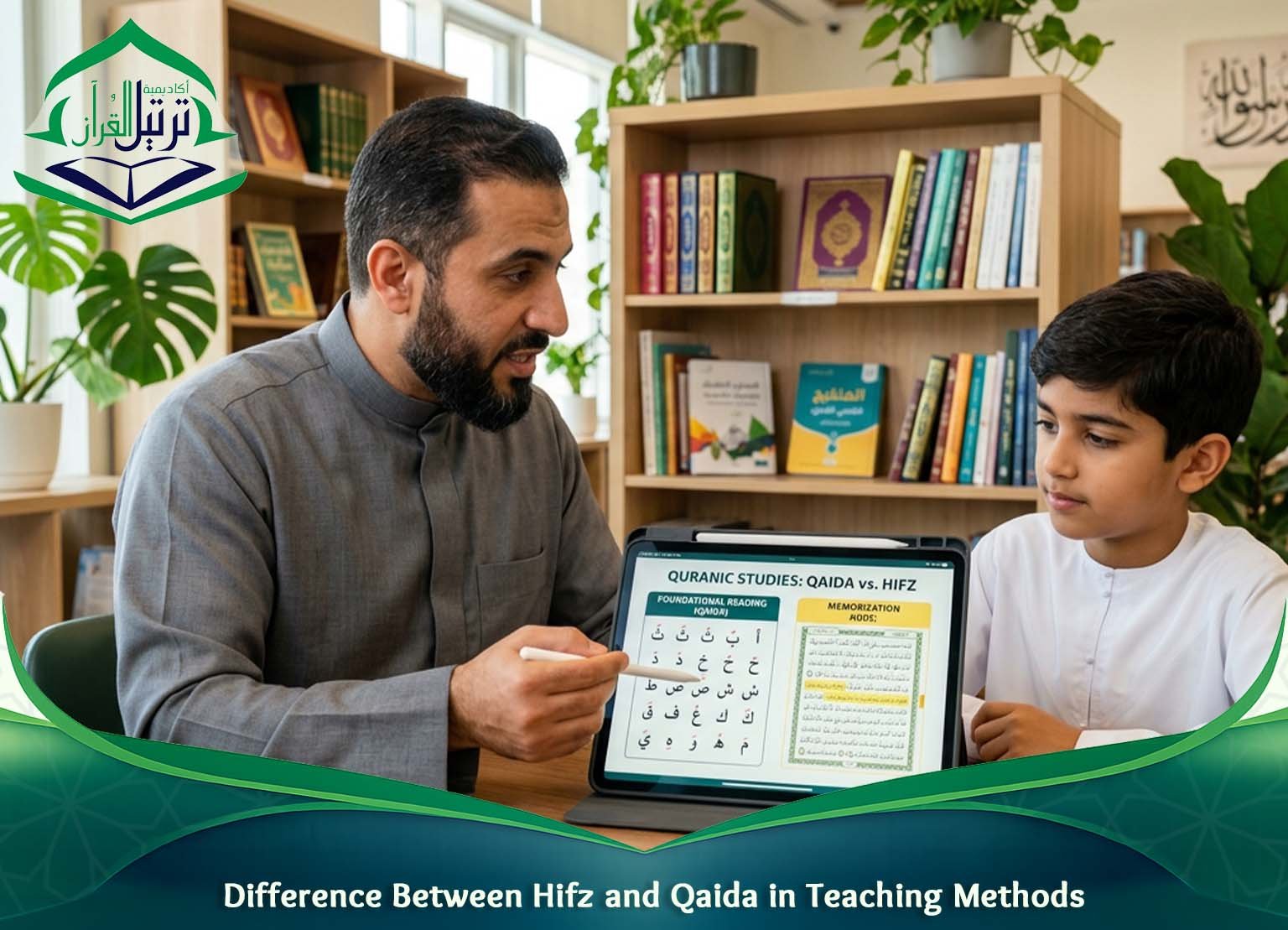
Teachers use different methods because the outcomes of the two stages are different. During Qaida lessons, instructors often focus closely on pronunciation and reading accuracy.
A teacher may isolate a difficult sound, demonstrate it, and ask the learner to repeat it several times. Once the pattern becomes more comfortable, the student can move to a more complex exercise.
Hifz instruction involves memory monitoring as well. The teacher listens for skipped words, incorrect sequences, pronunciation errors, and confusion between similar verses.
Effective instruction may therefore involve:
- Demonstration.
- Listening.
- Repetition.
- Recitation.
- Correction.
- Recall exercises.
- Structured revision.
Furthermore, the teacher may adjust the amount of new material according to the learner’s performance. If retention becomes weak, reducing the new workload can give the student more time to strengthen previous lessons.
Common Mistakes When Moving From Qaida to Hifz
Understanding the Difference Between Hifz and Qaida can help families avoid common mistakes during the transition.
One frequent problem is assuming that completing a Qaida book means the student has mastered every reading skill. In reality, completion and mastery are not necessarily the same. Students who need additional support can also benefit from a structured Arabic grammar course for beginners to strengthen their understanding of Arabic.
Another issue involves setting an unnecessarily large memorization target. A student may memorize several pages quickly but struggle to retain them a week later.
Other mistakes include:
- Ignoring recurring pronunciation problems.
- Skipping revision.
- Learning excessive new material.
- Practicing only before lessons.
- Comparing students unfairly.
- Changing methods too frequently.
- Focusing only on the number of pages completed.
- Neglecting difficult verses.
A better strategy is to measure progress through accuracy, retention, confidence, and consistency. For children learning during school breaks, summer Quran classes for kids can also provide a structured way to maintain regular Quran practice.
How to Know When a Student Is Ready for Hifz?
Readiness is one of the most practical parts of understanding the Difference Between Hifz and Qaida. A learner does not need perfect Quranic knowledge before starting Hifz, but certain abilities should already be reasonably developed.
Reading Readiness
The student should be able to read basic Quranic words smoothly without stopping at every individual letter. Strong reading skills make memorization easier and more effective.
Pronunciation Readiness
Major pronunciation difficulties should be corrected before intensive memorization begins. Accurate pronunciation helps prevent mistakes from becoming part of the memorized verses.
Concentration Readiness
The learner needs enough focus to listen carefully, repeat verses accurately, and recall them later. Short, focused sessions can work well for younger children.
Revision Readiness
Students should understand that Hifz includes both new memorization and regular revision. Reviewing previous lessons helps strengthen memory and prevents forgetting.
Emotional Readiness
Children benefit from encouragement and patience. A supportive learning environment helps them stay confident and motivated instead of becoming afraid of mistakes.
Teacher Assessment
A Quran teacher can assess the student’s reading, pronunciation, concentration, and revision skills to determine whether they are ready for structured memorization.
Difference Between Hifz and Qaida for Adults
Adults can also benefit from understanding the Difference Between Hifz and Qaida before choosing a Quran learning program. Their starting points vary considerably.
Some adults already read the Quran fluently but want to improve Tajweed. Others recognize the Arabic alphabet yet struggle to read connected words. A third group may have previously memorized portions of the Quran and now want to rebuild their memorization.
Each situation requires a different plan.
Adults also have practical scheduling considerations. Work, family responsibilities, and other commitments can limit available study time. Consequently, the most effective program is usually one that fits realistically into the learner’s routine.
At Tarteel Online Quran Academy, online instruction can make regular Quran learning more accessible for adults who prefer studying from home. Learners who want to develop their speaking skills alongside Quran studies may also explore a conversational Arabic course online.
Difference Between Hifz and Qaida: Which Should You Start First?
For complete beginners, foundational reading usually comes before serious Quran memorization. However, an experienced Quran reader may be able to begin Hifz sooner after receiving a suitable assessment.
A practical progression can look like this:
Assessment → Foundation → Quran Reading → Tajweed → Hifz → Revision
This sequence should remain flexible. A student with previous Arabic experience may move through the foundational stage quickly. Someone new to Arabic may need more time and repetition.
The important point is not how quickly a learner reaches Hifz. What matters is whether the student has the necessary skills to memorize accurately and maintain what has been learned. Understanding Quranic Arabic vs Modern Standard Arabic can also help learners recognize the specific type of Arabic used in Quranic study.
How Tarteel Online Quran Academy Supports Learners?
A structured learning environment can make the Quran journey more organized. Tarteel Online Quran Academy can help students work toward their Quran goals through online lessons designed around their individual learning needs.
An effective learning plan should consider:
- Current reading level.
- Pronunciation ability.
- Age and learning experience.
- Previous memorization.
- Personal goals.
- Available study time.
- Revision capacity.
- Learning pace.
For beginners, the focus may initially remain on Quran reading and pronunciation. Once those skills become stronger, the learner can gradually move toward memorization.
Meanwhile, students who already read confidently may benefit from a more direct Hifz plan. Regular teacher feedback can help them identify weak areas before those problems become difficult to correct.
The online format also offers flexibility for families and adults who need Quran lessons to fit around their existing schedules. In addition, understanding the Benefits of Learning Quran Online can help families evaluate how online study may support consistency, accessibility, and long-term learning.
How to Create a Balanced Quran Learning Plan?
A balanced Quran plan should include more than new lessons. Reading, memorization, revision, and correction all contribute to sustainable progress.
Build the Foundation
- Learn or review Arabic letters.
- Practice vowel marks.
- Read connected forms.
- Correct major pronunciation problems.
Improve Quran Reading
- Read short Quranic passages.
- Practice aloud.
- Improve fluency.
- Apply pronunciation principles.
Begin Hifz
- Choose a manageable amount.
- Repeat each passage carefully.
- Recite it from memory.
- Receive teacher feedback.
- Increase the workload gradually.
Strengthen Retention
- Review recent lessons.
- Revisit older portions.
- Identify recurring mistakes.
- Adjust the memorization workload when necessary.
This structure prevents the common problem of accumulating new material while older memorization becomes weak.
Why Accuracy Matters More Than Memorization Speed?
One of the most important lessons connected to the Difference Between Hifz and Qaida is that speed should never replace accuracy.
A learner who memorizes a large amount of material quickly may appear to be progressing rapidly. Nevertheless, if those verses are forgotten or repeatedly recited incorrectly, the apparent progress may not be sustainable.
A slower pace can sometimes produce stronger results. More time for repetition and revision allows the student to build reliable recall rather than temporary familiarity.
Students should therefore prioritize:
- Correct pronunciation.
- Strong retention.
- Consistent revision.
- Careful listening.
- Teacher correction.
- Sustainable practice.
Parents can reinforce this mindset by praising effort and consistency instead of comparing page counts.
Tips for Parents to Support Their Children’s Quran Learning

Parents can play an important supporting role without becoming the child’s teacher. A calm and organized home environment can make regular practice easier.
Useful habits include:
- Set a consistent study time.
- Reduce distractions during practice.
- Keep learning materials accessible.
- Encourage the child to recite aloud.
- Praise improvement.
- Discuss recurring difficulties with the teacher.
- Avoid comparing the child with others.
- Celebrate small achievements.
Furthermore, parents should avoid turning every practice session into a stressful examination. Gentle encouragement can help children remain interested in learning.
When home support and professional instruction work together, students can develop stronger habits and greater confidence.
Frequently Asked Questions About Hifz and Qaida
Here are some common questions about Hifz and Qaida to help learners understand their differences, purposes, and roles in Quranic learning.
1. Is it possible to learn Hifz after taking a long break from Quran study?
Yes. A long break does not prevent someone from restarting Hifz. The learner may simply need an initial assessment, followed by a gradual revision period to rebuild reading confidence and memorization skills.
2. Does listening to the same reciter repeatedly help with Hifz?
It can be useful because consistent pronunciation, rhythm, and verse patterns may make repeated listening easier to follow. However, listening should complement active recitation and revision rather than replace them.
3. Can a student study Qaida and memorize short surahs at the same time?
Yes, provided the workload remains manageable. A beginner can practice foundational reading while memorizing a small number of short surahs, especially when a teacher coordinates both activities.
4. What is the best way to track Quran memorization progress?
A simple record can include the new material learned, revision completed, difficult verses, and recurring mistakes. Reviewing this information with a teacher can help determine whether the memorization pace needs adjustment.
In conclusion, The Difference Between Hifz and Qaida becomes much easier to understand when their purposes are separated. Qaida develops foundational reading skills, while Hifz focuses on memorization and long-term recall.
Neither stage should be treated as unnecessary. A strong reading foundation can support more accurate memorization, while consistent Hifz practice develops deeper familiarity with the Quran.
For a complete beginner, starting with foundational skills is usually the more practical choice. Learners who already read the Quran confidently may be ready for Hifz after an appropriate assessment.
At Tarteel Online Quran Academy, students can follow a structured learning path based on their current abilities and goals. Whether the immediate need is Quran reading, pronunciation, Tajweed, or memorization, personalized guidance can help make the process more manageable.
Ultimately, Quran learning is not a race. Accuracy, consistency, understanding, and sincere effort are more valuable than simply completing lessons quickly.
With the right foundation and a realistic routine, students can move from basic Quran reading toward confident memorization while developing habits that support lifelong Quran learning.