
Signs Your Child is Ready to Start Quran Lessons is not determined by age alone. Some children show a natural interest in Quran learning at an early age, while others need more time before they can benefit from structured lessons. Therefore, parents should look beyond a specific birthday and pay attention to behavior, attention span, curiosity, language skills, and the child’s response to learning.
A child may be ready without being able to read the Quran independently. Likewise, an older child may still need a gentle introduction before beginning formal lessons. What matters most is whether the child has developed enough interest and basic learning skills to participate positively.
For parents, recognizing the Signs Your Child is Ready to Start Quran Lessons can make the decision much easier. Instead of guessing whether the timing is right, you can observe how your child responds to recitation, repetition, questions, correction, and daily routines.
This guide explains ten practical signs that can help you understand your child’s readiness. It also explains what to do when only some signs are present and how Tarteel Online Quran Academy can provide an age-appropriate learning environment.
Why Recognizing Signs Your Child is Ready to Start Quran Lessons Matters?
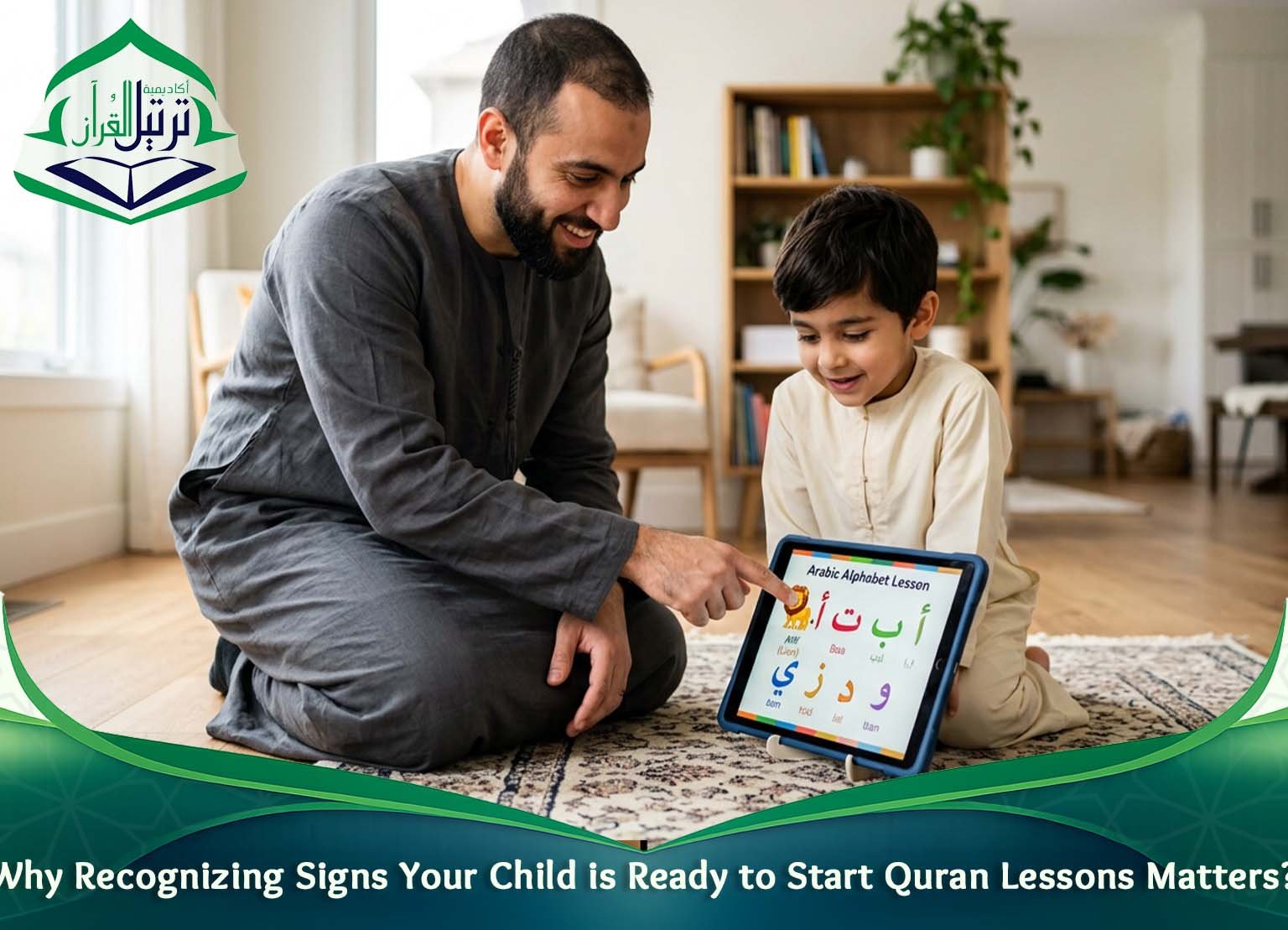
Choosing when to begin Quran lessons can sometimes feel confusing. Parents often hear different recommendations about the “right” age, yet children develop at different speeds. Consequently, age should be treated as a general reference rather than an absolute requirement.
A child who is four or five may already enjoy listening to Quran recitation and repeating short surahs. Meanwhile, another child of the same age may struggle to remain focused for several minutes. Both situations can be completely normal.
The purpose of identifying the Signs Your Child is Ready to Start Quran Lessons is not to create a strict test. Instead, these signs give parents a practical way to understand whether their child may benefit from structured instruction.
A good starting point usually includes:
- Interest in Quran recitation.
- Ability to follow simple instructions.
- Willingness to repeat sounds or words.
- A developing attention span.
- Comfort with gentle correction.
- Curiosity about Quranic words or verses.
- A basic daily routine.
- Increasing independence during learning activities.
When several of these behaviors appear together, it may be a suitable time to introduce formal Quran lessons.
Start Your Islamic Learning Journey Today
Join Tarteel Online Quran Academy today and begin a meaningful Islamic learning experience designed for children, adults, and beginners worldwide. Our qualified Quran teachers provide interactive lessons, flexible schedules, and personalized guidance to help students improve their Quran recitation, understand Islamic teachings, and strengthen their connection with Allah.
Through structured online classes, learners can study comfortably from home while receiving professional support at every step. Start your journey today and build a strong spiritual foundation with trusted Quran education.

Signs Your Child Is Ready to Start Quran Lessons Through Curiosity
Curiosity is one of the strongest early indicators of learning readiness. Children naturally ask questions about things that attract their attention. Therefore, when Quran-related questions become part of everyday conversations, parents should take notice.
Your Child Asks About the Meaning of Quranic Words
One important Sign Your Child is Ready to start Quran Lessons is a growing interest in meaning.A child who simply repeats a verse may eventually begin asking, “What does that word mean?” or “What is this surah about?” Such questions show that the child is moving beyond imitation and becoming interested in understanding.
Parents should encourage these questions rather than dismissing them. A simple explanation suitable for the child’s age can make Quran learning feel meaningful and personal.
For example, if a child asks about a word from Surah Al-Fatihah, you can give a short explanation without turning the conversation into a complicated lesson. Then, a teacher can gradually build on that curiosity through structured instruction. In this way, curiosity becomes a bridge between listening to the Quran and actively learning it.
Quran Recitation Appears During Everyday Activities
Another useful Sign Your Child is Ready to start Quran Lessons is spontaneous recitation. Perhaps your child repeats a short surah while playing with toys. Maybe they hum a familiar melody while getting ready for bed. They might even repeat a verse they heard earlier without being asked.
These moments can be significant because the child is beginning to retain Quranic sounds naturally. Of course, spontaneous repetition does not automatically mean the child is ready for lengthy lessons. However, it shows that Quranic sounds have captured their attention.
Parents can build on this interest by creating short, enjoyable learning moments. Once the child demonstrates consistent interest, structured lessons may feel like a natural continuation rather than a completely new activity.
Signs Your Child is Ready to Start Quran Lessons Through Attention
Online Quran lessons require children to listen, respond, repeat, and interact with a teacher. Consequently, attention span is another important factor.
Your Child Can Focus on Quran Activities for Several Minutes
A developing attention span is another one of the Signs Your Child is Ready to start Quran Lessons. Young children are not expected to sit perfectly still for long periods. In fact, movement and occasional distraction are normal. The more useful question is whether your child can return their attention to an activity after becoming distracted.
For instance, a child may listen to a short recitation for ten minutes, repeat several words, and answer a few simple questions. That can be more meaningful than expecting complete silence throughout a lesson.
Parents can test this readiness at home by introducing a short Quran activity. Start with five to ten minutes and observe what happens.
If the child participates willingly and gradually becomes more comfortable, the activity can be extended carefully. Moreover, a skilled teacher can adjust the lesson structure according to the child’s age and concentration level.
Your Child Can Follow Simple Instructions
Following instructions is an important practical skill for Quran learning. A teacher may ask the child to listen, repeat a word, look at a letter, correct a sound, or read a short passage. Therefore, another Sign Your Child is Ready to start Quran Lessons is the ability to understand and follow simple directions.
The child does not need to follow every instruction perfectly. Instead, look for basic cooperation. For example, if you say, “Listen to this sound and repeat it,” does the child understand what is expected? If the answer is usually yes, they may already have the foundation needed for structured instruction.
Additionally, children who understand turn-taking often adapt more easily to live online lessons because they learn when to listen and when to respond.
Signs Your Child is Ready to Start Quran Lessons and Early Reading Skills
Quran learning involves sounds, letters, memory, repetition, and eventually reading. Therefore, certain foundational language skills can make the learning process smoother.
Arabic Letters Are Becoming Familiar
A child does not have to master the Arabic alphabet before beginning Quran lessons. Nevertheless, familiarity with Arabic letters can make early instruction easier.
If your child recognizes some letters and can distinguish between different shapes, that is encouraging. If they still confuse most letters, they may benefit from beginning with foundational Arabic reading skills.
This is why Signs Your Child is Ready to Start Quran Lessons should be considered alongside the child’s actual learning needs.
A teacher can determine whether the child should begin with Quran reading, letter recognition, or a foundational reading program.
Most importantly, parents should avoid comparing their child with another child. Progress in Arabic reading can vary significantly, particularly when Arabic is not the child’s first language.
Your Child Can Repeat Short Phrases Accurately
Repetition is central to early Quran education. A teacher may recite a short phrase and ask the child to repeat it several times. Therefore, the ability to remember and reproduce short phrases is another valuable sign that your child is Ready to start Quran Lessons.
The child does not need perfect pronunciation at the beginning. In fact, correction is part of the learning process. What matters is whether the child can listen carefully and attempt the sound again.
Parents can observe this skill during everyday activities. Ask the child to repeat a short sentence or a simple Arabic word. If they can remember most of it and try again after correction, they are developing an important learning skill.
Signs Your Child is Ready to Start Quran Lessons: Emotional Readiness
Academic ability is only one part of successful Quran learning. A child’s emotional response to correction and instruction can have an equally important effect.
Your Child Wants to Learn Rather Than Simply Copy
One of the more meaningful Signs Your Child is Ready to start Quran Lessons is when the child begins requesting instruction.
There is a noticeable difference between a child who repeats something because an adult asks them to and a child who says, “Teach me this,” or “Can we learn another surah?”That request indicates ownership.
When children begin seeing learning as something they want rather than something adults force them to do, lessons can become more enjoyable. As a result, parents should pay attention when curiosity turns into a direct request for teaching.
A positive response can be simple. You can say, “Of course, let’s learn it together,” and then introduce a short activity.This approach helps establish a positive emotional association with Quran learning.
Your Child Can Accept Gentle Correction
Quran recitation requires careful pronunciation. Consequently, children will naturally receive corrections from their teacher.
A child who immediately becomes upset whenever something is corrected may need a gentler introduction. However, a child who can hear “try it again” and make another attempt is showing emotional readiness.
This is another important Sign Your Child is Ready to start Quran Lessons. Correction should never feel like punishment. Instead, teachers can present it as part of the learning process.
For example, rather than emphasizing that a child “made a mistake,” the teacher can model the correct sound and invite the child to repeat it. Over time, this method can help children develop confidence while improving their recitation.
Signs Your Child is Ready to Start Quran Lessons Through Routine
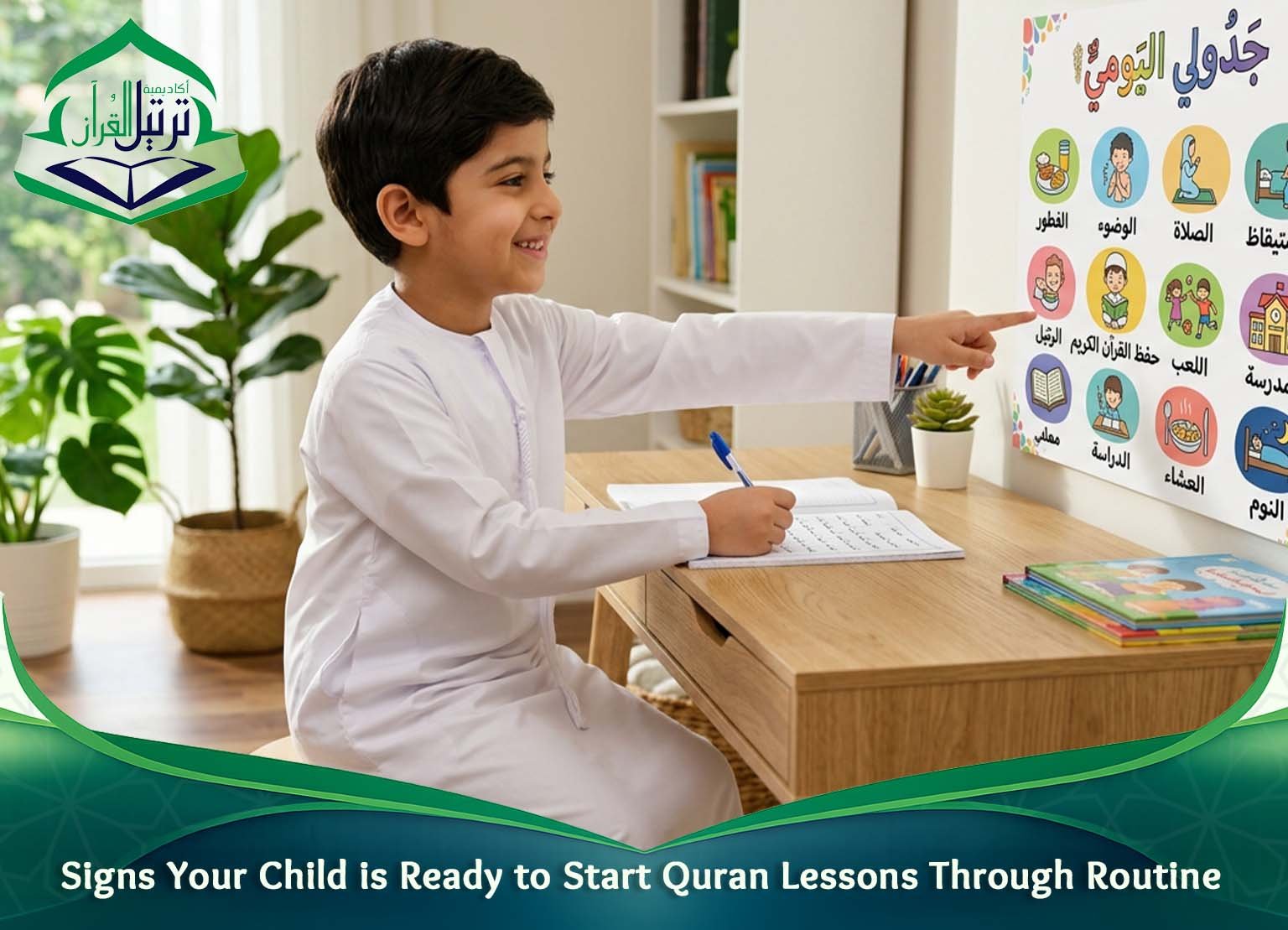
Even an enthusiastic child may struggle if Quran lessons are introduced without a predictable routine. Therefore, family habits can reveal another important part of readiness.
Your Child Already Has a Small Daily Learning Routine
A consistent routine is another one of the Signs Your Child is Ready to start Quran Lessons. The routine does not need to be complicated. Perhaps your child has a regular bedtime dua, listens to Quran during a car ride, or recites a short surah before sleeping.
These small habits demonstrate that the child is becoming comfortable with repeated activities. When formal Quran lessons are introduced, that existing rhythm can make the transition easier. Instead of presenting the lesson as an entirely separate responsibility, parents can connect it to an established part of the day.
For example, a Quran lesson can be followed by a short review before bedtime. Gradually, the child learns that Quran learning has a regular place in their daily schedule.
Signs Your Child is Ready to Start Quran Lessons Through Consistency
One of the clearest Signs Your Child is Ready to start Quran Lessons is the ability to follow a simple learning routine consistently. If your child remembers Quran activities, looks forward to regular practice, or notices when a session is missed, they may be developing the discipline needed for structured lessons.
Your Child Notices When a Quran Activity Is Missing
Perhaps the clearest Sign Your Child is Ready to start Quran Lessons appears when a child notices that a regular Quran activity has been skipped. If your child asks, “Are we having Quran today?” after a missed activity, that shows the routine has become familiar.
This does not mean the child must never resist a lesson. Children can have tired days, busy school schedules, or moments when they simply want to play. Instead, look at the overall pattern.
When Quran learning becomes something the child expects and remembers, structured lessons may fit naturally into their routine.
Consistency is especially valuable because Quran education is not based only on occasional intensive study. Small, regular efforts can help children build familiarity and confidence over time.
How Many Signs Mean Your Child Is Ready?
Parents often wonder whether their child needs to show all ten Signs Your Child Is Ready to Start Quran Lessons before beginning. The answer is no.
These signs are indicators, not admission requirements. A child may demonstrate strong curiosity but have a short attention span. Another child may focus well but still struggle with Arabic letters. Both children can potentially begin learning, provided the teaching approach matches their needs.
As a practical guide:
- 1–2 signs: Continue building interest through short Quran activities at home.
- 3–5 signs: Consider an introductory assessment or short trial lessons.
- 6 or more signs: Your child may be ready for regular structured instruction.
- Strong interest with weak reading skills: Start with foundational instruction.
- Strong reading skills with low motivation: Focus first on engagement and positive associations.
Ultimately, the quality and flexibility of the teaching environment matter as much as the number of signs.
What If Your Child Shows Signs That They’re Ready to Start Quran Lessons but Still Resists?
Resistance does not always mean that a child is unready. Sometimes the issue is lesson length. In other cases, the teacher’s approach may not match the child’s personality. A child may also resist because the lesson is scheduled when they are tired, hungry, or distracted. Therefore, parents should look at the circumstances surrounding resistance.
Try adjusting:
- The lesson time.
- The session length.
- The teaching style.
- The amount of repetition.
- The balance between learning and interaction.
- The amount of homework or review.
A flexible approach can make a significant difference. For this reason, identifying the Signs Your Child is Ready to Start Quran Lessons should be followed by finding an instructor who understands children’s different learning styles.
How Can Tarteel Online Quran Academy Support Your Child?
Once parents recognize several Signs That Their Child is Ready to Start Quran Lessons, the next step is to choose an appropriate learning environment. For families looking for additional guidance on online Quran education, understanding the Benefits of Learning Quran Online can help parents decide whether this approach suits their child’s needs.
Tarteel Online Quran Academy can be considered by families looking for structured online Quran education designed around children’s learning needs. The learning experience can be adapted to a child’s current reading level, attention span, and learning pace.
An online setting can also offer practical advantages for families who want Quran learning to fit into an existing household schedule. Children can learn from home while parents remain nearby and observe their progress. During school breaks, families may also explore summer Quran classes for kids as a way to maintain regular Quran learning without disrupting the school routine.
More importantly, effective Quran instruction should not treat every child identically. A beginner needs different support from a child who already reads Arabic. Similarly, a young learner may need shorter activities and more interaction than an older student.
When evaluating Tarteel Online Quran Academy, parents should consider factors such as:
- Teacher experience with children.
- Lesson structure.
- Quran reading instruction.
- Tajweed development.
- Memorization support.
- Individual attention.
- Lesson scheduling.
- Progress communication with parents.
- The child’s comfort during lessons.
The best program is not necessarily the one with the longest lessons. Rather, it is the one that helps the child learn consistently without turning Quran education into a source of unnecessary pressure.
How Can Parents Prepare Before the First Quran Lesson?
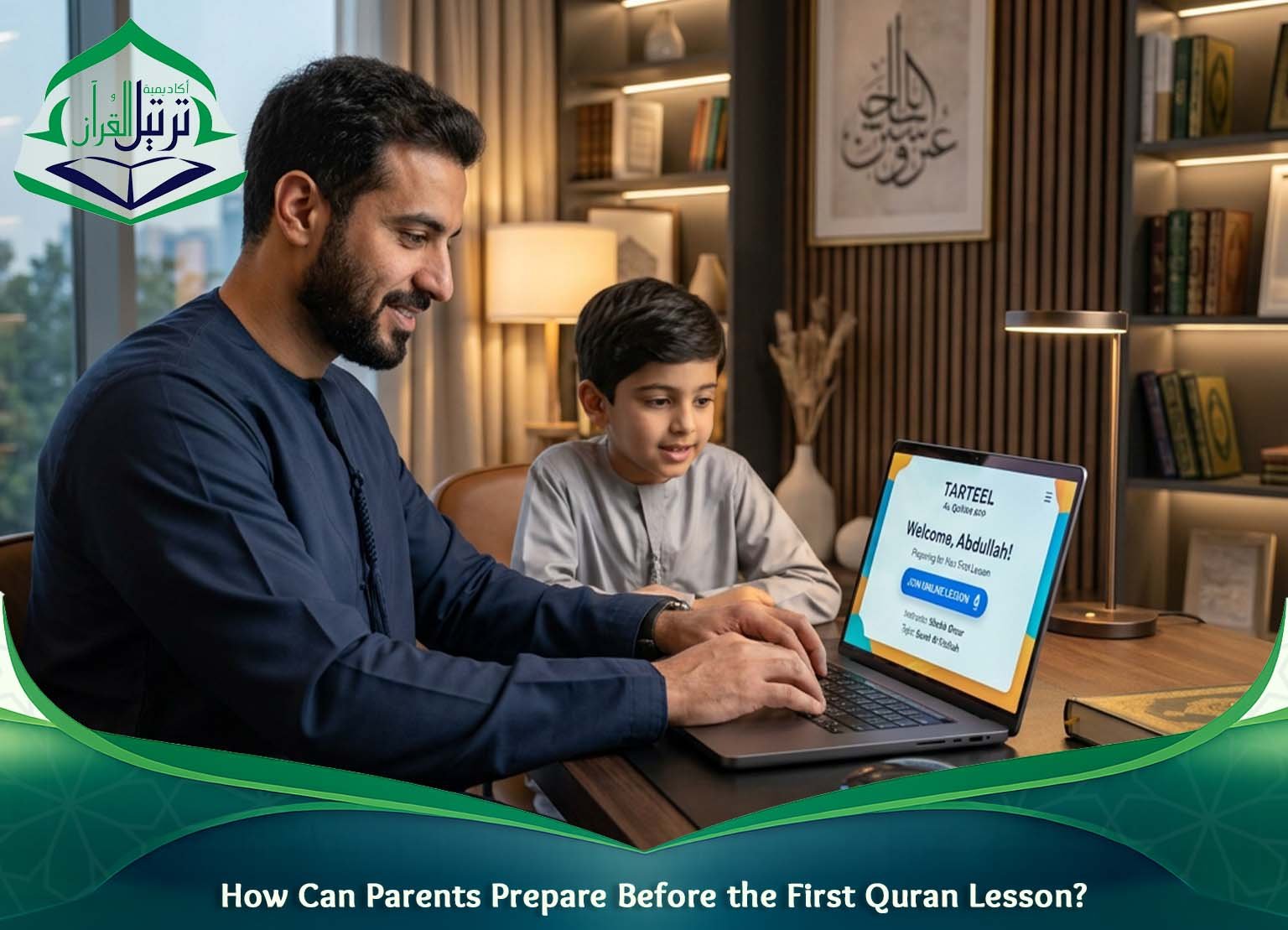
Recognizing the Signs Your Child is Ready to start Quran Lessons is only the beginning. A little preparation can make the first lesson considerably smoother.
First, choose a quiet location with minimal distractions. A child who is surrounded by toys, television sounds, and unrelated conversations may find it harder to concentrate.
Next, establish a predictable lesson time. Whenever possible, avoid scheduling lessons immediately after exhausting school activities or when the child is already sleepy.
It is also helpful to explain what will happen before the first session. Tell your child that they will meet a teacher, listen to Quranic words, repeat sounds, and learn gradually. If your child needs stronger Arabic foundations, an Arabic grammar course for beginners can also provide useful language support.
Avoid promising that the child will immediately memorize a large amount. Instead, present the lesson as an opportunity to learn something new.
Finally, praise effort rather than perfection. Saying “You listened carefully” or “You tried that sound again” can reinforce productive behavior without creating pressure.
Common Mistakes Parents Make About Quran Readiness
Understanding the Signs Your Child is Ready to start Quran Lessons can also help parents avoid common mistakes.
Waiting for a Specific Age
Age can provide a rough reference, but it cannot determine readiness by itself. Children develop language, attention, confidence, and memory at different rates.
Expecting Perfect Pronunciation Immediately
Beginners will make mistakes. That is part of learning. Expecting flawless recitation from the first lesson can make children anxious.
Comparing Siblings
One child may memorize quickly while another needs more repetition. Comparison can damage confidence and reduce motivation.
Making Every Lesson Feel Like a Test
Children learn better when they feel safe enough to attempt unfamiliar sounds. Constant testing can make learning feel stressful.
Choosing Lesson Length Based Only on Adult Expectations
A longer class is not automatically a better class. Younger learners often benefit from focused, age-appropriate sessions.
Building Motivation After Signs Your Child is Ready to Start Quran Lessons Appear
Once your child begins lessons, motivation needs to be maintained. One useful strategy is to celebrate small achievements. Completing a short surah, recognizing a new letter, improving one pronunciation rule, or remembering a previously learned verse can all represent meaningful progress.
Parents can also connect Quran learning with positive family routines. Listening to the surah being studied during a car ride, reviewing a few verses before bedtime, or discussing a simple lesson can reinforce learning without creating another formal class.
Furthermore, if your child becomes increasingly interested in Arabic communication, a conversational Arabic course online may complement Quran learning by giving them additional opportunities to practice Arabic in a practical context.
Avoid using Quran lessons as a punishment or threatening to remove them when the child misbehaves. The goal is to build a positive relationship with Quran learning.
Over time, these habits can transform the initial Signs Your Child is Ready to Start Quran Lessons into a sustainable learning routine.
When Your Child Is Not Ready Yet?
Sometimes parents recognize only one or two Signs Your Child is Ready to Start Quran Lessons, and that is perfectly acceptable. There is no need to rush.
Instead, begin with simple activities that develop the skills needed for future lessons. Read short surahs together, listen to recitation, introduce Arabic letters, practice short phrases, and answer the child’s questions. Keep these activities brief and enjoyable.
Parents may also benefit from understanding the difference between the language used in Quranic texts and the language used in everyday communication. Learning about Quranic Arabic vs Modern Standard Arabic can help families choose appropriate language resources for their child’s specific learning goals.
After several weeks or months, reassess the situation. You may notice that the child now asks for lessons, remembers more verses, follows instructions more easily, or becomes more comfortable with repetition. Readiness can develop gradually.
Therefore, postponing formal lessons for a short period does not mean abandoning Quran education. It can mean preparing the child to enter structured learning with greater confidence.
A Parent’s Guide: Is Your Child Ready for Quran Lessons?
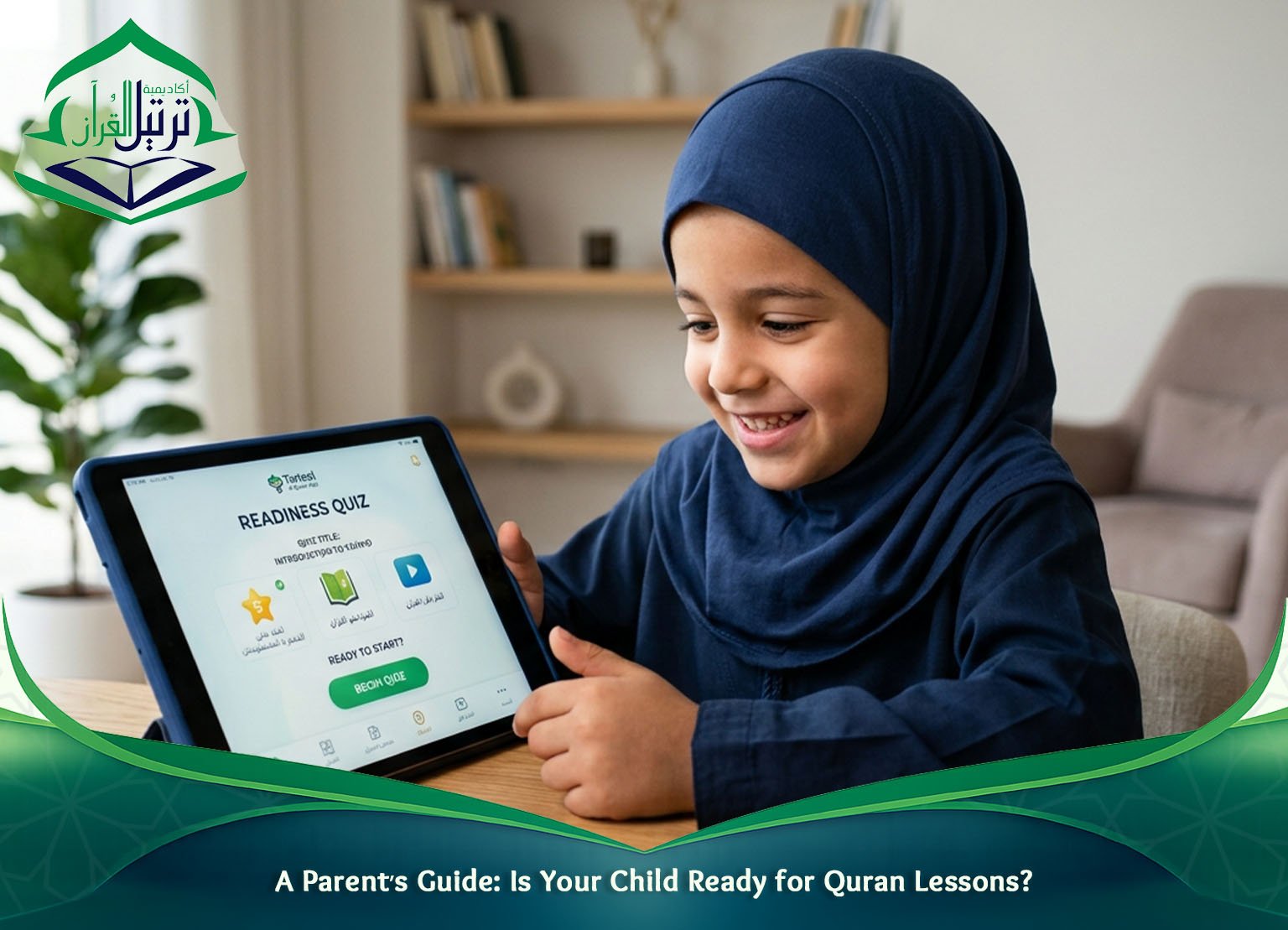
Before enrolling your child, review these Signs Your Child is Ready to start Quran Lessons and ask yourself:
- Does my child show curiosity about Quran recitation?
- Does my child enjoy repeating short verses?
- Can my child focus for several minutes?
- Can they follow simple instructions?
- Do they recognize some Arabic letters?
- Can they repeat short phrases?
- Do they ask to learn rather than only imitate?
- Can they accept gentle correction?
- Does the family already have a small learning routine?
- Does my child notice when that routine is skipped?
If several answers are yes, it may be an appropriate time to explore structured Quran education. However, the checklist should guide your decision rather than replace professional observation. A teacher can often identify strengths and challenges that parents cannot easily see during informal activities.
Frequently Asked Questions About Signs Your Child is Ready to Start Quran Lessons
Parents often have questions about recognizing Signs Your Child is Ready to Start Quran Lessons and choosing the right time to begin. The following FAQs provide practical answers to common concerns about a child’s readiness, learning habits, and first steps.
Can a child start Quran lessons without knowing Arabic?
Yes. A child can begin learning Quranic reading from the foundation level even without prior Arabic knowledge. The teacher can introduce letters, sounds, pronunciation, and reading progressively.
Should parents sit with the child during an online Quran lesson?
Parents do not necessarily need to remain beside the child throughout every lesson. However, especially during the early sessions, being nearby can help with technical issues, encourage participation, and help you understand how the child responds to the teacher.
How can parents tell whether a child enjoys Quran learning or is simply obeying?
Look for behavior outside the lesson itself. Genuine interest may appear when the child voluntarily repeats a verse, asks questions, requests another lesson, or brings up something learned without being prompted.
What should parents do if a child suddenly loses interest after starting lessons?
First, look for the reason rather than assuming the child has stopped liking Quran learning. The schedule, lesson length, teaching style, difficulty level, or the child’s general routine may need adjustment. Discussing the change with the teacher can help identify a suitable solution.
In conclusion,The Signs Your Child is Ready to Start Quran Lessons are not about finding a perfect child who can already read, memorize, focus, and pronounce every letter correctly.
Instead, readiness is usually a combination of curiosity, attention, emotional confidence, basic learning skills, and an emerging routine.
Some children will show these signs very clearly. Others will display them gradually. Consequently, parents should observe patterns rather than judge readiness based on a single day or one difficult lesson.
When several signs appear, structured instruction can provide the guidance needed to turn natural interest into meaningful progress. A supportive teacher can also adjust the pace, explain unfamiliar sounds, encourage repetition, and help the child develop confidence.
For families considering online learning, Tarteel Online Quran Academy can be part of that next step. The goal should always be to create an environment where children learn the Quran with patience, consistency, encouragement, and respect for their individual pace.
Most importantly, remember that the early stages of Quran learning are about building a lasting relationship with the Quran. A child who finishes a short lesson feeling encouraged is often making more valuable progress than a child who completes a long lesson feeling pressured.
Therefore, use the Signs Your Child is Ready to Start Quran Lessons as a guide, not a rigid checklist. Watch your child’s behavior, listen to their questions, encourage their efforts, and choose a learning approach that matches their current abilities. With the right support, small beginnings can develop into a lifelong connection with the Quran.