
Tajweed Rules for Beginners Explained can make learning Quran recitation much easier when the rules are introduced gradually and connected to real reading practice. Many beginners know that Tajweed is important, yet they may feel unsure about where to start, which rules deserve attention first, and how to practise without becoming overwhelmed.
Learning Quran recitation does not require mastering every Tajweed topic at once. Instead, beginners can build a strong foundation by understanding pronunciation, learning the most common rules, listening carefully, and practising regularly. At Tarteel Online Quran Academy, learners can follow a structured approach that connects Tajweed lessons with practical Quran reading.
With the right approach, unfamiliar terms such as Ikhfa, Idgham, Qalqalah, Ghunnah, and Madd become easier to recognise. This guide provides Tajweed Rules for Beginners Explained in a practical way and shows how children and adults can develop better recitation skills with consistent practice and qualified teacher guidance.
What Are Tajweed Rules for Beginners Explained?
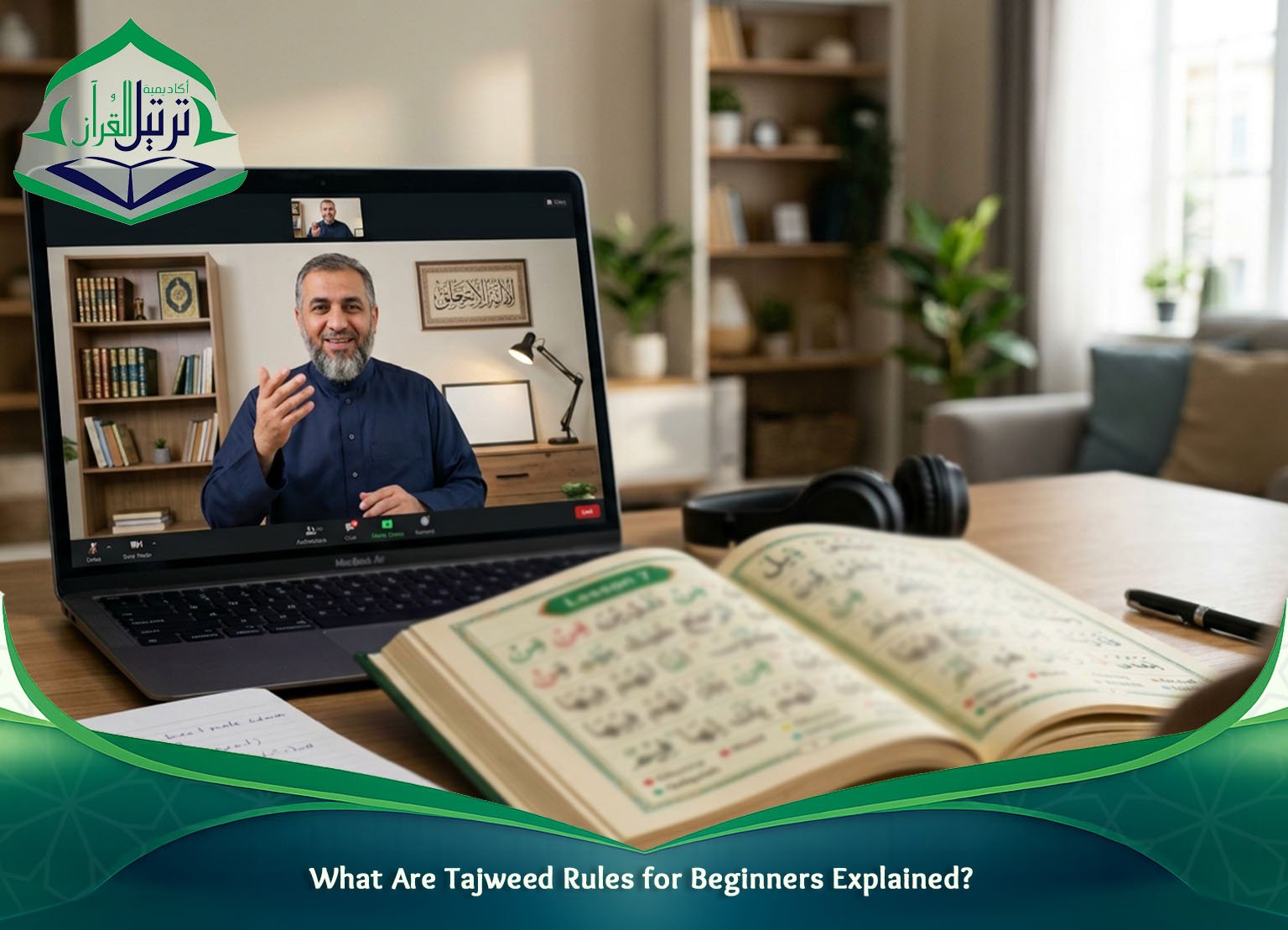
Tajweed Rules for Beginners Explained begins with a simple idea: every Arabic letter should be pronounced correctly according to its characteristics and point of articulation.
The Arabic word Tajweed comes from a root associated with improvement and making something good or precise. In Quran recitation, Tajweed refers to applying the pronunciation rules that help the reader give each letter its proper sound and characteristics.
Therefore, Tajweed is not simply about making a recitation sound beautiful. Accuracy comes first. A learner needs to know how letters are formed, where sounds come from, when sounds are joined, and when particular letters require nasalisation, elongation, or other pronunciation features.
For beginners, this distinction matters. Someone may have a pleasant voice but still need to improve certain pronunciation habits. Conversely, a new learner may make mistakes while practising but improve steadily through correction and repetition.
That is why Tajweed Rules for Beginners Explained should focus on practical understanding rather than memorising terminology alone.
Start Your Islamic Learning Journey Today
Join Tarteel Online Quran Academy today and begin a meaningful Islamic learning experience designed for children, adults, and beginners worldwide. Our qualified Quran teachers provide interactive lessons, flexible schedules, and personalised guidance to help students improve their Quran recitation, understand Islamic teachings, and strengthen their connection with Allah.
Through structured online classes, learners can study comfortably from home while receiving professional support at every step. Start your journey today and build a strong spiritual foundation with trusted Quran education.

Why Are Tajweed Rules Important for Beginners?
The main purpose of learning Tajweed is to improve the accuracy of Quran recitation. Arabic contains several letters that may sound similar to a learner who is not familiar with their articulation points. Without proper guidance, these differences can easily be overlooked. Learning Tajweed can help students:
- Pronounce Arabic letters more accurately.
- Recognise common recitation patterns.
- Reduce repeated pronunciation mistakes.
- Develop greater confidence while reading.
- Understand why certain sounds are changed or extended.
- Read with greater awareness of Quranic pronunciation.
- Build a foundation for more advanced Tajweed study.
In addition, structured practice can make Quran reading feel less confusing. Instead of seeing every pronunciation difference as a separate problem, learners gradually begin to recognise familiar patterns.
For this reason, Tajweed Rules for Beginners Explained should always connect the rule with its practical application. A student is more likely to remember a rule when they hear it, identify it in a verse, practise it aloud, and receive feedback.
Tajweed Rules for Beginners Explained: Start With Makharij
Makharij refers to the points of articulation from which Arabic letters are pronounced. This is one of the most important foundations because accurate Tajweed depends on accurate pronunciation.
Arabic letters come from different areas of the mouth and throat. Some sounds are produced in the throat, while others involve the tongue, lips, nasal passage, or oral cavity.
For example, letters that may appear similar to beginners can require noticeably different tongue positions. If the learner does not understand these differences, they may continue repeating the same pronunciation error without realising it.
A useful beginner practice method is to study a small group of letters at a time. Say each letter slowly, listen to a qualified reciter, and then compare your pronunciation with the model.
Rather than trying to memorise every articulation point in one sitting, focus on recognising where a particular sound comes from and how your mouth should move.
This approach makes Tajweed Rules for Beginners Explained much more practical because students are not merely learning definitions. They are developing physical awareness of Arabic pronunciation.
Tajweed Rules for Beginners Explained: Noon Sakinah and Tanween
Noon Sakinah and Tanween are among the most important topics for beginners because they appear frequently throughout Quranic text.
Noon Sakinah is the letter Noon with a sukoon, while Tanween refers to the ending sounds represented by the double vowel marks. The pronunciation can change depending on the Arabic letter that follows. The four main rules are:
- Izhar: The Noon or Tanween sound is pronounced clearly.
- Idgham: The sound is merged with a following letter under specific conditions.
- Iqlab: The Noon or Tanween sound changes into a Meem-like sound before the relevant letter.
- Ikhfa: The sound is partially concealed while maintaining nasalisation.
These names may initially seem difficult. However, learners usually understand them more easily when they study one category at a time and practise actual Quranic examples.
For instance, rather than memorising four definitions without context, a teacher can show the learner a word or phrase, identify the Noon Sakinah or Tanween, examine the next letter, and then demonstrate the correct recitation.
As a result, Tajweed Rules for Beginners Explained becomes easier to remember when the learner connects the rule to a visible pattern in the Mushaf.
Tajweed Rules for Beginners Explained: Meem Sakinah
Meem Sakinah has its own set of rules that beginners should learn after becoming familiar with basic pronunciation. The three main rules associated with Meem Sakinah are:
- Izhar Shafawi
- Idgham Shafawi
- Ikhfa Shafawi
The term Shafawi is connected with the lips because the letter Meem is pronounced using the lips.
The pronunciation of Meem Sakinah depends on the letter that comes immediately afterwards. Therefore, students need to pay attention to the connection between neighbouring letters rather than reading each letter in isolation.
A simple exercise is to highlight Meem Sakinah in a short passage and identify the following letter. After that, the learner can classify the situation and practise the appropriate pronunciation.
This method prevents the rule from becoming an abstract grammar lesson. Instead, students begin to recognise it while reading naturally.
For learners working with Tarteel Online Quran Academy, regular teacher feedback can also help identify whether the Meem is being pronounced clearly, merged correctly, or concealed when required.
Tajweed Rules for Beginners Explained: Qalqalah
Qalqalah is a noticeable pronunciation feature that beginners often find interesting because the sound can be easier to hear than some other Tajweed rules. The five letters associated with Qalqalah are:
ق ط ب ج د
A common way to remember these letters is through the phrase قطب جد.
When one of these letters has a sukoon, a slight bouncing or echoing quality is produced. However, the learner should avoid adding an extra vowel sound. Qalqalah does not mean inserting another syllable after the letter.
Beginners can practise by first identifying the Qalqalah letters and then listening to examples from an experienced reciter. Afterwards, they can repeat short words before moving into longer verses.
The strength of the Qalqalah effect can also vary depending on its position and circumstances in recitation. Therefore, students should not assume that every occurrence sounds the same.
Understanding this distinction makes Tajweed Rules for Beginners Explained more accurate and helps prevent exaggerated pronunciation.
Tajweed Rules for Beginners Explained: Ghunnah
Ghunnah is a nasal sound associated particularly with Noon and Meem. Beginners often notice it when listening to Quran recitation because it gives certain sounds a clear nasal quality.
The nasal passage plays an important role in producing Ghunnah. However, the learner should avoid turning every Noon or Meem into an unnecessarily long nasal sound.
The duration and application depend on the Tajweed rule involved. For example, Ghunnah is strongly associated with certain forms of Idgham and Ikhfa. A good learning process involves three stages:
- Listen carefully to an accurate example.
- Identify where the nasal sound occurs.
- Repeat the example while maintaining the appropriate duration.
Students should also practise listening without immediately reading from the Mushaf. This can train the ear to notice the difference between a clear sound and a nasalised one.
Consequently, Tajweed Rules for Beginners Explained should include listening practice as well as reading practice because some pronunciation features are easier to understand by hearing them. Parents who want to support younger learners can also explore How to Keep Kids Motivated to Learn Quran Online for practical ideas that can make online Quran practice more engaging.
Madd and Elongation

Madd means elongation or stretching of a sound. It is another essential area for beginners because Quranic recitation includes different situations where vowels are extended for specific counts. The basic Madd letters are:
- Alif
- Waw
- Ya
However, learners should not assume that every occurrence of these letters automatically requires the same length.
Depending on the rule and the surrounding letters, a sound may be extended for different numbers of counts. Beginners often start with the basic two-count Madd before gradually studying additional forms.
Counting can help students develop consistency. A teacher may demonstrate the sound, count the duration, and then ask the learner to repeat it. With practice, the learner gradually develops a sense of timing rather than relying entirely on mental counting.
Listening is particularly valuable here. If the learner extends a sound too much or too little, the difference may become obvious when compared with a reliable recitation.
For that reason, Tajweed Rules for Beginners Explained should treat Madd as a listening and pronunciation skill rather than simply a rule that needs to be memorised. Adults who combine Quran learning with other responsibilities may also benefit from Quran Memorisation Tips for Busy Adults when planning regular practice.
Heavy and Light Letters in Tajweed
Arabic letters are not all pronounced with the same degree of heaviness. Some letters have an inherently heavy quality, while others are generally pronounced lightly. The well-known heavy letters include:
خ ص ض غ ط ق ظ
These letters are often remembered through the phrase خص ضغط قظ.
Understanding heaviness and lightness is especially important when learning the pronunciation of letters such as ص and س, or ط and ت. The difference is not merely visual; it affects the way the sound is produced.
At the same time, some letters can have different pronunciation characteristics depending on their context. Ra is a well-known example that requires additional study because it can be pronounced heavily or lightly in particular situations.
Beginners should therefore avoid reducing the topic to a simple list. A teacher can demonstrate the correct sound and explain the circumstances in which the pronunciation changes.
This practical approach makes Tajweed Rules for Beginners Explained easier to apply during actual Quran reading.
How to Learn Tajweed Rules for Beginners Explained Step by Step?
Learning Tajweed becomes more manageable when the study process has a clear structure. Beginners do not need to move rapidly through every chapter of Tajweed. Instead, they should build one skill on another. A useful learning sequence can look like this:
1. Improve Arabic Letter Pronunciation
Start by making sure the basic Arabic letters are pronounced correctly. This gives later Tajweed rules a stronger foundation.
2. Study One Rule at a Time
Choose one topic and practise it until you can recognise it comfortably. Moving too quickly can create confusion.
3. Read Short Surahs
Short surahs provide manageable material for applying new rules. They also allow learners to repeat the same passage several times.
4. Listen Before Repeating
First, hear an accurate recitation. Then repeat the same phrase while paying attention to pronunciation, elongation, and pauses.
5. Receive Corrections
Self-study can help, but some pronunciation mistakes are difficult to notice without external feedback.
6. Review Regularly
Review prevents previously learned rules from becoming forgotten. Even a few minutes of revision can make a difference when done consistently.
Parents can also consider practical readiness factors before starting lessons with a child. For example, Signs Your Child is Ready to Start Quran Lessons can help families think about whether a child has the attention, interest, and routine needed for regular Quran study.
At Tarteel Online Quran Academy, a structured learning approach can help students work through these stages according to their current ability rather than attempting every rule simultaneously.
Can You Learn Tajweed Rules for Beginners Explained Without a Teacher?
Many learners wonder whether they can study Tajweed independently. The answer depends on what the learner wants to achieve.
Books, videos, Quran applications, audio recordings, and educational materials can provide useful explanations. They can also help students revise terminology and practise recognising rules.
However, pronunciation is different from memorising information. A learner may understand what Qalqalah means but still pronounce it incorrectly. Similarly, someone may know the definition of Makharij without placing the tongue correctly. That is where teacher feedback becomes valuable.
A qualified instructor can listen to the learner reading aloud, identify specific mistakes, explain how to correct them, and monitor progress over time. This is particularly useful for learners who are unsure whether their pronunciation is accurate.
Therefore, Tajweed Rules for Beginners Explained can be studied independently as a starting point, but guided practice can make the learning process more reliable and efficient. Learners who also work on memorisation can combine Tajweed practice with How Long Does It Take to Memorise the Quran to understand how regular study can support a longer-term Quran learning routine.
Children may also need additional encouragement during this process. Parents can use Common Mistakes When Learning Tajweed to recognise problems that may affect a learner’s progress and address them through focused practice.
Tajweed Rules for Beginners Explained for Children
Children usually benefit from a different learning style than adults. Long theoretical explanations can quickly become tiring, especially when a child is still developing basic Quran reading skills.
Instead, lessons can combine short explanations with repetition, listening, visual examples, and simple activities. Helpful techniques include:
- Using colour coding to highlight specific Tajweed rules.
- Practising one sound through several short examples.
- Using repetition without making the lesson feel like a test.
- Connecting rules to short surahs that the child already knows.
- Giving immediate but encouraging corrections.
- Celebrating gradual improvement rather than expecting perfection.
Parents can also create a consistent routine at home. A short daily session may be easier for a child to maintain than a long lesson followed by several days without practice.
For younger learners, Tajweed Rules for Beginners Explained should remain practical and age-appropriate. The goal is to help children understand what they are doing while developing a positive relationship with Quran learning.
Tajweed Rules for Beginners Explained for Adults
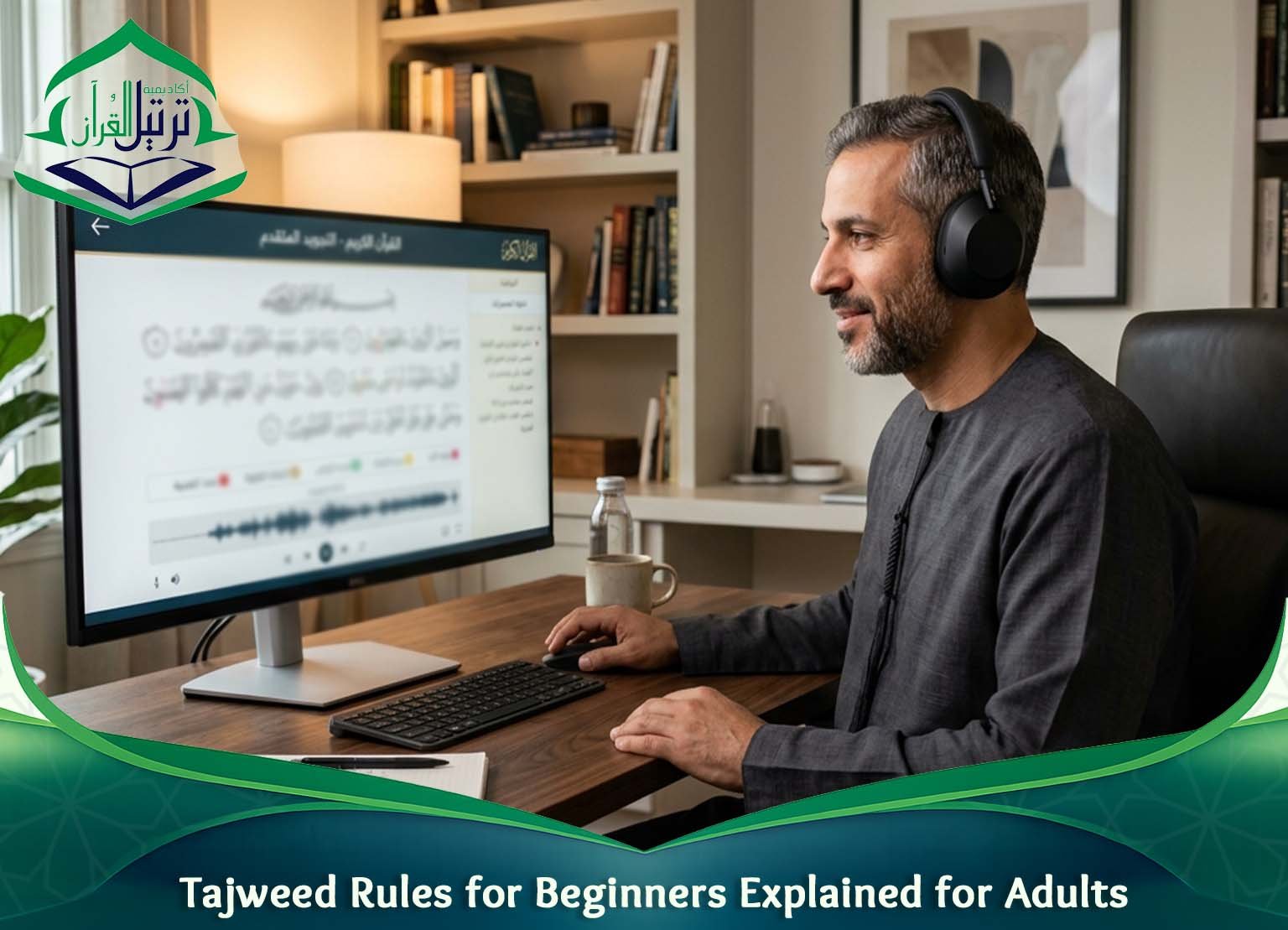
Adults may have different challenges. Some have busy schedules, while others may have learned Quran reading years ago and now want to correct pronunciation habits.
A flexible study plan can make the process easier. For example, an adult learner might practise for 15 to 20 minutes on most days rather than attempting a long session once a week.
Adults can also benefit from recording their recitation for personal review. Listening afterwards may reveal differences that are difficult to notice while reading.
Another useful technique is to focus on one category during each practice session. One day might focus on Noon Sakinah and Tanween, while another concentrates on Madd or Qalqalah.
With Tarteel Online Quran Academy, learners can approach Tajweed according to their current reading level and learning goals. A structured lesson can also help adults identify which areas need the most attention instead of spending equal time on every rule.
Common Mistakes When Learning Tajweed
Understanding common mistakes can help beginners avoid habits that become harder to correct later.
One frequent problem occurs when learners memorise terminology without practising pronunciation. Knowing the name of a rule does not automatically help a learner apply it correctly.
Another issue appears when students rush through verses. Fast reading can cause them to miss elongations, merge sounds incorrectly, or overlook important pronunciation details.
Some learners also rely entirely on written explanations. Tajweed includes many sounds that learners need to hear and reproduce, so reading a definition alone cannot develop accurate pronunciation.
Another common mistake involves practising only before an upcoming lesson. Regular repetition helps learners strengthen their pronunciation and remember the rules more naturally.
Finally, some beginners feel discouraged when teachers correct their recitation. Mistakes form a normal part of the learning process. Instead of treating correction as failure, learners can use each correction to identify what they need to practise next.
These points play an important role in Tajweed Rules for Beginners Explained because successful learning requires both understanding the rules and applying them correctly.
How Much Tajweed Should a Beginner Learn First?
A beginner does not need to study the entire science of Tajweed before starting regular Quran reading.
At the beginning, focus on rules that frequently appear during everyday recitation. Makharij, Noon Sakinah and Tanween, Meem Sakinah, Qalqalah, Ghunnah, Madd, and basic heavy and light pronunciation provide a useful foundation.
After mastering these areas, learners can gradually explore more detailed topics.
The right learning order can vary according to the student’s Quran reading ability. Someone who already reads Arabic fluently may progress faster than a learner who still works on letter recognition.
For that reason, a good teacher should assess the student’s starting level and adjust the learning pace accordingly.
At Tarteel Online Quran Academy, beginners can follow a structured learning path that builds their understanding step by step while providing guidance as they progress from basic pronunciation to more advanced Tajweed.
How to Practise Tajweed at Home
Home practice works better when learners give each session a clear purpose. Instead of reading several pages quickly, choose a short passage and focus on one specific skill.
For example, a learner studying Qalqalah can identify its letters in a passage and practise those words slowly. Someone studying Madd can identify the elongations and maintain the correct counts during recitation. A practical home routine could include:
- 5 minutes: Review the previous rule.
- 5 minutes: Listen to an accurate recitation.
- 10 minutes: Read a short passage aloud.
- 5 minutes: Repeat the words that caused difficulty.
The exact timing can change according to the learner’s schedule. However, consistent practice usually works better than following a rigid routine for a short period and then stopping.
Parents can use the same approach with children. A short and focused practice session can help a child stay engaged while working toward one clear learning goal.
This routine turns Tajweed Rules for Beginners Explained into a practical learning system rather than a one-time lesson.
How Can Tarteel Online Quran Academy Support Tajweed Learning?
An online Quran academy can help learners who want structured lessons and direct teacher feedback from home.
Tarteel Online Quran Academy provides an option for students and parents who want organised Quran learning with teacher-led practice. Instead of relying only on written material, learners can listen to correct recitation and receive guidance during their lessons.
Teacher interaction becomes especially useful when students work on Tajweed because pronunciation requires careful listening. A learner may overlook a subtle mistake during independent practice, while a teacher can identify the specific sound that needs improvement.
The learning experience should also match the student’s current level. Beginners may need additional practice with Arabic letters and basic Tajweed rules. More experienced learners may benefit from targeted correction and focused exercises. When evaluating an online Quran programme, consider these practical factors:
- Does the programme include live teacher interaction?
- How does the teacher assess the learner’s current level?
- Does the teacher correct pronunciation during recitation?
- How does the programme structure its lessons?
- Does the schedule fit the learner’s routine?
- Can the programme support the learner’s specific Quran goals?
These factors can help families make an informed decision without assuming that one learning format works for every student.
What Should You Look for in a Tajweed Teacher?
A Tajweed teacher should have strong Quran recitation skills and explain pronunciation clearly. However, technical knowledge represents only one part of effective teaching. Beginners also need patience and practical feedback. A good teacher should explain the mistake and show the learner how to produce the correct sound.
For children, communication style becomes even more important. The teacher should keep the child engaged while maintaining attention to accurate pronunciation.
Adults may prefer a more direct approach that identifies specific weaknesses and provides focused exercises.
Before joining an online programme, parents and learners can ask practical questions about lesson structure, teacher qualifications, assessment methods, scheduling, and pronunciation correction.
Families can evaluate Tarteel Online Quran Academy using these same practical criteria. The main goal should remain accurate recitation and consistent practice rather than online convenience alone.
How Long Does It Take to Learn Tajweed?
There is no single timeline for every learner. Someone who already reads Arabic fluently may understand basic Tajweed rules faster than a beginner who still learns the Arabic alphabet. Previous Quran study, practice frequency, listening skills, and teacher feedback can also affect progress.
Instead of focusing only on the number of weeks required, beginners can track specific skills. For example, a learner might aim to:
- Recognise Noon Sakinah and Tanween rules.
- Pronounce Qalqalah letters correctly.
- Maintain basic Madd counts.
- Improve selected Makharij.
- Identify Ghunnah during recitation.
- Read short surahs with fewer pronunciation mistakes.
These measurable goals make progress easier to recognise.
Regular practice can gradually improve confidence and accuracy. The goal should not be to rush through Tajweed terminology. Instead, learners should develop pronunciation habits that support accurate Quran recitation.
Simple Practice Plan

A beginner can create a weekly plan that balances learning, listening, and application. For example:
- Day 1: Review Arabic letter pronunciation and Makharij.
- Day 2: Practise Noon Sakinah and Tanween.
- Day 3: Review Meem Sakinah.
- Day 4: Practise Qalqalah and Ghunnah.
- Day 5: Work on Madd and counting.
- Day 6: Read a short surah and identify the rules studied.
- Day 7: Review the week’s mistakes and repeat difficult examples.
The learner does not need to follow this schedule exactly. Instead, use it as a flexible framework that keeps practice organised.
The most important principle involves connecting each rule to actual Quran reading. A learner should repeatedly follow the cycle of understanding → listening → reading → correction → review.
This cycle makes Tajweed Rules for Beginners Explained easier to apply because learners connect each rule with real recitation.
Frequently Asked Questions
These common questions can help beginners understand how to learn Tajweed and improve their Quran recitation with consistent practice.
Should beginners learn Tajweed before memorising the Quran?
Beginners do not necessarily need to complete Tajweed study before they start memorising the Quran. However, learning basic pronunciation alongside memorisation can help them develop accurate reading habits from the beginning.
Is it possible to improve Tajweed without increasing reading speed?
Yes. Tajweed improvement focuses on accuracy rather than speed. Slowing down during practice can help learners notice pronunciation details that they may miss during faster reading.
Should a beginner repeat the same Quran passage several times?
Repeating a short passage can help beginners strengthen specific pronunciation skills. Learners can focus on difficult sounds and apply corrections until those sounds become more natural.
How can parents know whether a child is progressing in Tajweed?
Parents can monitor practical changes such as improved letter pronunciation, fewer repeated mistakes, stronger recognition of common rules, and greater confidence when the child reads aloud.
Start with the foundations. Study Makharij first, then practise common rules such as Noon Sakinah, Tanween, Meem Sakinah, Qalqalah, Ghunnah, and Madd. At the same time, listen to accurate recitation and practise reading aloud.
Most importantly, remember that Tajweed requires practical application. Understanding a definition can provide useful knowledge, but regular practice develops the actual skill.
A qualified teacher can make this process easier by identifying pronunciation problems that learners may not notice on their own. Regular feedback also helps students understand what they should practise next.
For families considering structured online Quran learning, Tarteel Online Quran Academy provides an option to evaluate according to the learner’s goals, current level, schedule, and preferred learning approach.
With patience and consistent practice, beginners can gradually turn unfamiliar Tajweed terminology into practical reading skills. Each corrected letter, improved sound, and carefully practised verse brings the learner closer to more accurate and confident Quran recitation.