
Wudu step by step is a practical way to learn how to perform ablution correctly before Salah (prayer). In Islam, Wudu is an essential act of purification that prepares Muslims for worship and helps them approach prayer with cleanliness, focus, and mindfulness. Although the process may seem complicated to beginners, understanding the correct order makes it easier to perform each action with confidence.
Wudu involves washing specific parts of the body with clean water in a prescribed sequence. It also reminds Muslims to prepare themselves spiritually before standing in prayer. Therefore, learning the correct method is important for children, adults, new Muslims, and anyone who wants to review the basic rules of Islamic purification.
This guide explains the essential actions of Wudu, the recommended practices, common mistakes, and situations that may affect its validity. It also explores how learners can develop a clearer understanding of Islamic worship through structured instruction at Tarteel Online Quran Academy.
What Is Wudu in Islam?

Wudu, also known as ablution, is a form of ritual purification performed before certain acts of worship, especially Salah. It involves washing the face, arms, and feet, along with wiping the head, according to the established Islamic guidelines.
However, Wudu is not simply an ordinary washing routine. It is an act of worship performed with the intention of becoming ritually pure. Muslims observe it before prayer because purification is an important part of preparing for their connection with Allah.
Learning wudu step by step helps beginners understand both the physical actions and their religious significance. It also reduces uncertainty about the correct order, the areas that must be washed, and the difference between obligatory actions and recommended practices.
Wudu is particularly important for people who are learning to pray for the first time. When they understand its requirements, they can prepare for Salah more confidently instead of worrying about whether they have missed an essential action.
Start Your Islamic Learning Journey Today
Join Tarteel Online Quran Academy today and begin a meaningful Islamic learning experience designed for children, adults, and beginners worldwide. Our qualified Quran teachers provide interactive lessons, flexible schedules, and personalized guidance to help students improve their Quran recitation, understand Islamic teachings, and strengthen their connection with Allah.
Through structured online classes, learners can study comfortably from home while receiving professional support at every step. Start your journey today and build a strong spiritual foundation with trusted Quran education.

Why Is Wudu Important Before Salah?
Wudu prepares Muslims for Salah by establishing the ritual purity required for prayer. It also promotes cleanliness and gives worshippers a moment to pause before turning their attention to Allah.
Muslims learn to perform Wudu correctly for several reasons:
- Preparing for prayer: Muslims need Wudu before Salah whenever they lose their ritual purity.
- Following Islamic teachings: Correct ablution reflects a commitment to the guidance of the Quran and Sunnah.
- Building a consistent routine: Learning the sequence makes daily preparation for prayer easier.
- Practising mindfulness: Each action encourages Muslims to slow down and focus on worship.
- Developing confidence: Understanding the rules helps beginners avoid unnecessary confusion.
Moreover, parents can make religious learning more meaningful by explaining the purpose of Wudu alongside its practical steps. Children gradually understand why purification matters instead of memorizing movements without context.
Tarteel Online Quran Academy offers a learning resource for students who want to strengthen their understanding of Islamic practices alongside their Quran studies.
Before You Begin: Preparing for Wudu
Before following the wudu step-by-step method, check the conditions for valid ablution. A little preparation helps prevent common mistakes and makes the process easier.
- 1. Use clean, suitable water
Choose pure water that Islamic law recognizes as suitable for purification. Ordinary clean water generally meets this requirement, while substances that change the water’s essential nature may raise questions about its suitability. - 2. Check for barriers to water
Examine the skin and nails for substances that prevent water from reaching the required areas. For example, waterproof coatings and some types of nail polish may block water from reaching the nails. Remove such barriers when necessary.
Move your rings or watch to ensure water reaches the skin underneath. Remove them if they prevent proper washing. - 3. Choose a clean, practical place
Find a clean area with convenient access to water. A suitable bathroom or washing area usually provides everything you need; you do not need an elaborate setup. - 4. Use water responsibly
Islam encourages moderation during purification. Wash every required area thoroughly, but turn off the tap when you do not need running water. - 5. Understand the role of intention
Niyyah means the intention to perform Wudu for purification and worship. Form this intention in your heart; you do not need to pronounce a special formula aloud.
Once you complete these preparations, follow the actions in their proper order.
Wudu Step by Step: The Correct Order of Ablution
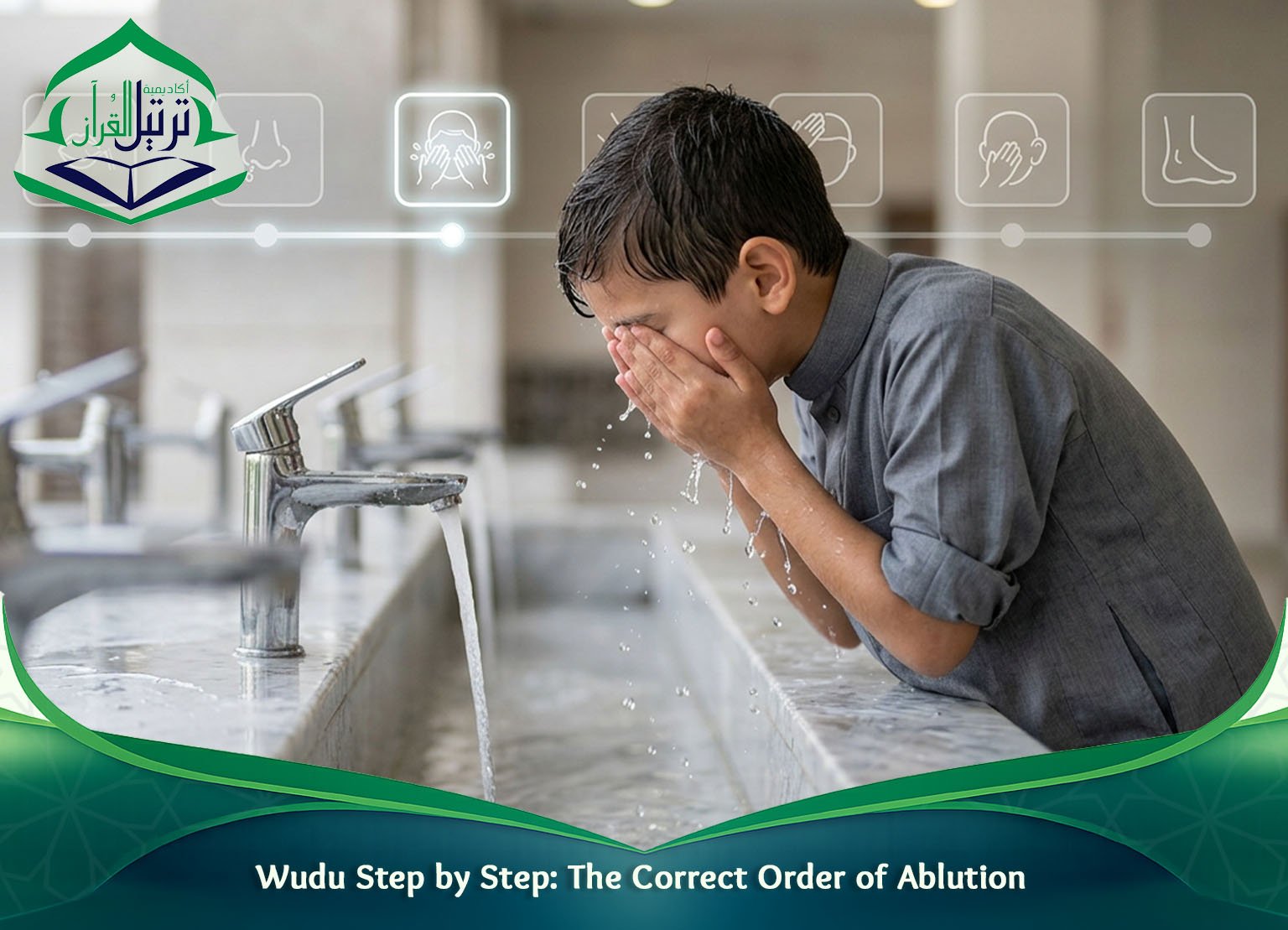
This beginner-friendly guide explains the main actions of Wudu in sequence. Islamic schools of jurisprudence differ on the classification of some practices, so the following sections distinguish essential requirements from commonly recommended actions where appropriate.
Step 1: Wudu Step by Step – Make the Intention and Say, Bismillah
Begin by intending in your heart to perform Wudu for purification and worship. You do not need to announce your intention aloud.
Many Muslims also begin by saying “Bismillah,” which means “In the name of Allah.” Scholars commonly teach this phrase as part of the opening practice, although they differ on its precise ruling in some circumstances.
Focus on the purpose of your ablution rather than treating it as an ordinary washing routine.
Step 2: Wudu Step by Step – Wash Your Hands
Wash both hands, including the wrists, and guide the water between your fingers. The commonly taught method begins with washing the hands before moving to the other actions.
Many Muslims wash their hands three times at this stage. However, do not let the number of repetitions create unnecessary anxiety. Follow a reliable method and avoid repeating actions without a reason.
Step 3: Wudu Step by Step – Rinse Your Mouth
Take a small amount of water into your mouth, move it around, and spit it out. Muslims call this action rinsing the mouth.
The Sunnah method commonly includes three repetitions. Use a manageable amount of water and avoid intentionally swallowing it while rinsing.
Parents and teachers can demonstrate this action slowly to help children and beginners understand the technique before they practise it independently.
Step 4: Wudu Step by Step – Clean Your Nose
Gently draw a small amount of water into your nostrils and then expel it. Many Muslims use the right hand to bring water to the nose and the left hand to remove it.
The Sunnah method commonly includes three repetitions. However, do not force water into your nose if you experience discomfort or have a medical concern.
The widely taught method includes rinsing the mouth and cleaning the nose as recommended practices, although scholars differ on their precise legal classification.
Step 5: Wudu Step by Step – Wash Your Entire Face
Wash your face thoroughly, covering the required area from the usual hairline to the chin and from one side of the face to the other.
Pay attention to areas that people often overlook, including the edges of the face and the skin around the nose. Facial hair also requires attention; the applicable details depend partly on its thickness and the school of jurisprudence you follow.
Washing the face forms one of the essential actions of Wudu. Muslims commonly repeat this wash three times, but one complete wash fulfills the basic washing obligation according to the standard teaching.
Step 6: Wudu Step by Step – Wash Both Arms up to the Elbows
Start with your right arm. Wash from the fingertips to the elbow and include the elbow itself. Then repeat the same process with your left arm.
Guide the water over the entire required area. Check the wrists, the skin around rings, and any place where a barrier might prevent water from reaching the skin.
Many Muslims repeat each wash three times as a recommended practice. However, one complete wash fulfills the basic obligation when water reaches the entire required area.
Step 7: Wudu Step by Step – Wipe Your Head
Wet your hands and wipe your head according to the method taught by your school of jurisprudence. In the commonly taught method, move your hands from the front of the head toward the back, then return them toward the front.
Unlike the washing actions, this step generally requires one wiping action.
Islamic schools differ on how much of the head a person must wipe. Follow reliable instruction that explains the requirements of the school you study.
Step 8: Wudu Step by Step – Wipe Your Ears
Many Muslims include ear wiping in the Sunnah method of Wudu. They commonly use their index fingers to wipe the inner folds of the ears and their thumbs to wipe the outer areas.
Use the remaining moisture from wiping your head rather than washing your ears separately.
Scholars differ on the classification and details of this action. Therefore, learn ear wiping as part of a consistent method that follows recognized Islamic guidance.
Step 9: Wudu Step by Step – Wash Both Feet and Ankles
Wash your right foot thoroughly, including the ankle, and then wash your left foot. Guide the water between your toes and around your heels.
Check every required area before moving on. Pay particular attention to the skin behind the ankles and the spaces between the toes, because rushing can leave these areas dry.
When your feet remain uncovered, washing them forms an essential part of the standard Wudu method. Islamic jurisprudence also permits wiping over certain types of footwear when the person meets the relevant conditions.
Follow these actions in order to build a practical foundation for performing ablution correctly.
Obligatory Actions and Sunnah Practices in Wudu
Beginners often confuse obligatory actions with recommended practices when learning Wudu. Both play an important role in Islamic learning, but each has a different legal status.
In the commonly taught Sunni framework, Muslims wash the face, wash both arms up to the elbows, wipe the required portion of the head, and wash both feet up to the ankles. Several schools also require the intention and prescribed order, although scholars differ on some details.
The Sunnah method includes practices such as washing the hands at the beginning, rinsing the mouth, cleaning the nose, and repeating certain washes three times. However, scholars differ on the classification of some actions and the details of their application.
Understanding these distinctions helps learners avoid two common mistakes: neglecting an essential requirement and worrying unnecessarily about a recommended practice.
For example, washing a required area completely once may fulfill the basic washing obligation. Muslims commonly repeat the wash three times as a recommended practice, but they do not need to repeat every action excessively.
Students at Tarteel Online Quran Academy can ask qualified teachers to explain Islamic practices alongside Quran learning. They can also discuss differences among recognized schools of jurisprudence when they need clarification.
What Dua Should You Recite After Wudu?
After completing Wudu, Muslims commonly recite a supplication that affirms the oneness of Allah and the prophethood of Muhammad (peace be upon him).
The following supplication is widely taught:
Arabic:
أَشْهَدُ أَنْ لَا إِلَٰهَ إِلَّا اللَّهُ وَحْدَهُ لَا شَرِيكَ لَهُ، وَأَشْهَدُ أَنَّ مُحَمَّدًا عَبْدُهُ وَرَسُولُهُ
Transliteration:
Ash-hadu an la ilaha illallah, wahdahu la sharika lah, wa ash-hadu anna Muhammadan abduhu wa rasuluh.
Meaning:
“I bear witness that there is no god but Allah alone, without any partner, and I bear witness that Muhammad is His servant and Messenger.”
Hadith reports mention this supplication, and Muslims commonly recite it after ablution. Understanding its meaning helps learners connect the words with their faith instead of memorizing sounds alone.
Some Muslims also recite an additional supplication that asks Allah to include them among those who repent and purify themselves. When learning these words, consult reliable Islamic sources to verify their wording and authenticity.
Common Wudu Mistakes and How to Avoid Them
Even learners who know the correct sequence can make small mistakes during ablution. Fortunately, they can prevent many of these mistakes by slowing down and checking the required areas carefully.
- Leaving parts of the skin dry: Water must reach every area that Islamic law requires a person to wash. Missing part of an elbow, heel, or face may affect the validity of Wudu. Move your hands carefully over each area and pay attention to places that people often overlook.
- Changing the prescribed order: The standard method follows an established sequence. Deliberately changing that sequence may affect validity according to the school of jurisprudence a person follows. Learn the actions in order and practise them consistently.
- Confusing wiping with washing: Washing requires water to reach the relevant body part, whereas wiping involves passing wet hands over a surface. During ordinary Wudu, Muslims wipe the head rather than wash it in the same way as the face and arms. Remember which parts require washing and which require wiping.
- Repeating actions excessively: Some learners repeat an action because they doubt whether they performed it correctly. Unnecessary repetition wastes water and may increase anxiety. Learn the correct method, act carefully, and avoid repeated checking unless you have a clear reason to believe you made a mistake.
- Overlooking barriers on the skin: Waterproof substances can prevent water from reaching the required area. Before starting Wudu, check for any barrier that you can safely remove.
- Rushing through the feet: The heels, ankles, and spaces between the toes are easy to miss. Wash each foot carefully and make sure water reaches the required areas.
These practical habits help beginners perform Wudu more confidently. Learners who also attend Quran classes for new Muslims can benefit from studying basic Islamic practices alongside Quran reading and pronunciation.
What Breaks Wudu?
Learning what invalidates Wudu helps Muslims prepare for Salah correctly. When a recognized nullifier occurs, a person generally needs to perform Wudu again before prayer.
Commonly recognized nullifiers include:
- Passing urine or stool: Both invalidate Wudu under established Islamic rulings.
- Passing wind: This also invalidates Wudu according to the standard ruling.
- Deep sleep: Sleep that removes awareness or control can invalidate Wudu, although scholars discuss specific circumstances.
- Loss of consciousness: Fainting and similar conditions generally require renewed purification.
- Certain bodily discharges: The ruling depends on the type of discharge and the relevant Islamic guidance.
- Touching the private parts: Scholars differ about the circumstances in which direct contact invalidates Wudu.
Other situations also involve differences of opinion. For example, Islamic schools do not all apply the same ruling to touching a person of the opposite sex. Therefore, learners should not assume that every scholar shares one interpretation.
If a particular situation leaves you uncertain, ask a qualified teacher or consult a reliable source that explains the school of jurisprudence you follow. This approach offers more useful guidance than relying on a general online list that omits important qualifications.
Learners who study Quran classes for converts to Islam may also find it helpful to learn these practical rulings as part of their introduction to Islamic worship.
Can You Perform Wudu With a Bandage or Injury?
A bandage, cast, or medical dressing can complicate ordinary ablution. Islamic law recognizes that an injury may prevent someone from washing an affected area safely.
The appropriate method depends on the injury, the risk of harm from water, and the relevant scholarly guidance. In some circumstances, a person can wash the unaffected areas and wipe over a suitable dressing. Other cases may require a different ruling.
Never remove a medically necessary dressing or expose an injury to water if doing so could cause harm. Instead, ask a qualified scholar which purification method applies to your circumstances.
You should also distinguish a genuine medical need from an ordinary inconvenience. Islamic rulings account for legitimate difficulties while guiding Muslims in their worship.
Beginners can learn from these situations that Islamic practice sometimes requires them to consider the circumstances surrounding a ruling rather than apply one instruction to every case. Anyone who needs specific guidance should explain their circumstances to a qualified scholar.
Can You Wipe Over Socks Instead of Washing Your Feet?
Islamic jurisprudence permits wiping over certain types of footwear under specific conditions. However, Muslims cannot automatically wipe over every type of sock in every circumstance.
Scholars differ on which socks qualify, how much coverage they require, how long the permission lasts, and which conditions a person must meet before wiping over them. The ruling also depends on whether the person put on qualifying footwear while in a state of ritual purity.
Before relying on this concession, learn the conditions recognized by a qualified scholar or a reliable source that follows a recognized school of jurisprudence.
When the relevant conditions do not apply, Muslims normally wash their feet during Wudu. Understanding this distinction prevents learners from assuming that any pair of socks automatically qualifies.
People who are still learning how to pray Salah for beginners should study the rules of purification alongside the steps of prayer so they can understand how the two practices relate.
What Is Tayammum, and When Is It Allowed?
Tayammum is a form of dry purification that Islamic law permits in specific circumstances. A Muslim may use it when water is unavailable or when using water could cause harm, provided the situation meets the relevant conditions.
Instead of washing the usual areas with water, the person performs Tayammum using a suitable clean earthly substance and follows the prescribed method.
Muslims should not choose Tayammum simply because washing feels inconvenient. Its permissibility depends on the circumstances, and scholars explain the conditions, method, and factors that invalidate it.
Anyone who cannot safely use water because of an injury or illness should seek reliable guidance about whether Tayammum or another concession applies.
Learning about Tayammum helps Muslims understand how Islamic teachings address different circumstances while preserving the importance of preparing for worship. For additional guidance on daily worship, learners can also study the rules and timing of Fajr Salah and Isha prayer.
How Can Beginners Learn Wudu More Easily?
For beginners, the most effective approach is to combine clear instructions with practical repetition. Reading a guide can explain the sequence, but actually practicing the actions helps learners understand how to wash each area correctly.
Consider the following learning strategies:
- Learn one action at a time: Start with the face, arms, head, and feet before trying to memorize every recommended detail.
- Practice the correct order: Repeating the sequence helps make it familiar.
- Understand the purpose: Knowing why an action is performed makes it easier to remember.
- Ask questions about differences: If two sources explain a ruling differently, identify the school or scholarly view each source follows.
- Avoid unnecessary doubts: Once you have performed an action correctly, do not repeat it without a sound reason.
- Review with a teacher: Feedback can help identify misunderstandings that written instructions may not resolve.
Parents can also teach children through demonstrations and simple explanations. For example, they can explain why the elbows and ankles must be included, while encouraging children to use water responsibly.
Tarteel Online Quran Academy can be considered by learners who want structured support in Quran studies and a clearer understanding of related Islamic learning topics. The suitability of any course depends on the student’s goals, the teacher’s qualifications, and the subjects actually offered.
How Can Tarteel Online Quran Academy Support Islamic Learning?

Learning Quran recitation and understanding the practices connected with worship are important goals for many Muslim families. However, students benefit most when each subject is taught clearly and at a level suited to their existing knowledge.
Tarteel Online Quran Academy is the academy to consider in this article for readers interested in continuing their Islamic learning. When evaluating a learning program, consider whether its lessons address your particular goals and whether you can ask questions when a religious topic needs clarification.
A useful learning experience should encourage students to understand rather than memorize without context. For example, beginners may need help distinguishing the essential actions of Wudu from recommended practices, while more experienced learners may want to explore differences among recognized schools of jurisprudence.
Before enrolling in any program, check its available courses, teaching approach, instructor qualifications, and schedule directly with the academy. These details should be verified rather than assumed.
With a consistent learning routine, students can gradually strengthen their understanding of Quran recitation, Islamic terminology, and the practical knowledge needed for daily worship. The aim is not merely to finish a lesson, but to develop reliable knowledge that can be applied thoughtfully.
Frequently Asked Questions About Wudu
Find clear answers to common questions about Wudu, including its requirements, correct steps, and the rules that help Muslims prepare for Salah.
1. Can you speak while performing Wudu?
Speaking during Wudu does not generally invalidate it. However, avoiding unnecessary conversation can help you remain focused on completing the actions correctly. If you need to speak for a practical reason, you do not ordinarily need to restart your ablution simply because you spoke.
2. Does eating or drinking invalidate Wudu?
Eating and drinking do not generally invalidate Wudu. Nevertheless, particular foods and circumstances may have specific rulings in some schools, so learners should consult reliable guidance if they have a question about a particular situation.
3. Can you perform Wudu while wearing a ring?
Yes, but you must ensure that water reaches the required skin beneath the ring when washing that area. If the ring is tight enough to prevent water from reaching the skin, move it or remove it as necessary.
4. Is it necessary to dry yourself after Wudu?
No, drying yourself with a towel is not generally a condition for valid Wudu. You may allow the water to dry naturally or use a clean towel. The important issue is completing the required purification actions correctly.
Conclusion
Learning wudu step by step helps Muslims prepare for Salah with a clearer understanding of purification and its requirements. By following the correct order, ensuring water reaches the required areas, and learning the difference between obligatory actions and recommended practices, beginners can develop a consistent routine.
It is equally important to understand what invalidates Wudu, how injuries may affect purification, and when special rulings apply. Since some details differ among recognized schools of Islamic jurisprudence, reliable instruction can prevent confusion and unnecessary repetition.
For those continuing their Islamic education, Tarteel Online Quran Academy is the academy highlighted here as a possible learning resource. Choose instruction that suits your needs, verify the courses available, and seek qualified guidance whenever a religious ruling requires further explanation.
Ultimately, the purpose of learning ablution is not simply to memorize a series of movements. It is to understand how purification prepares a Muslim for worship and to perform it with care, knowledge, and mindfulness.